Bidspirit auction | Elias Hurwicz, Holocaust Survivor, Autograph
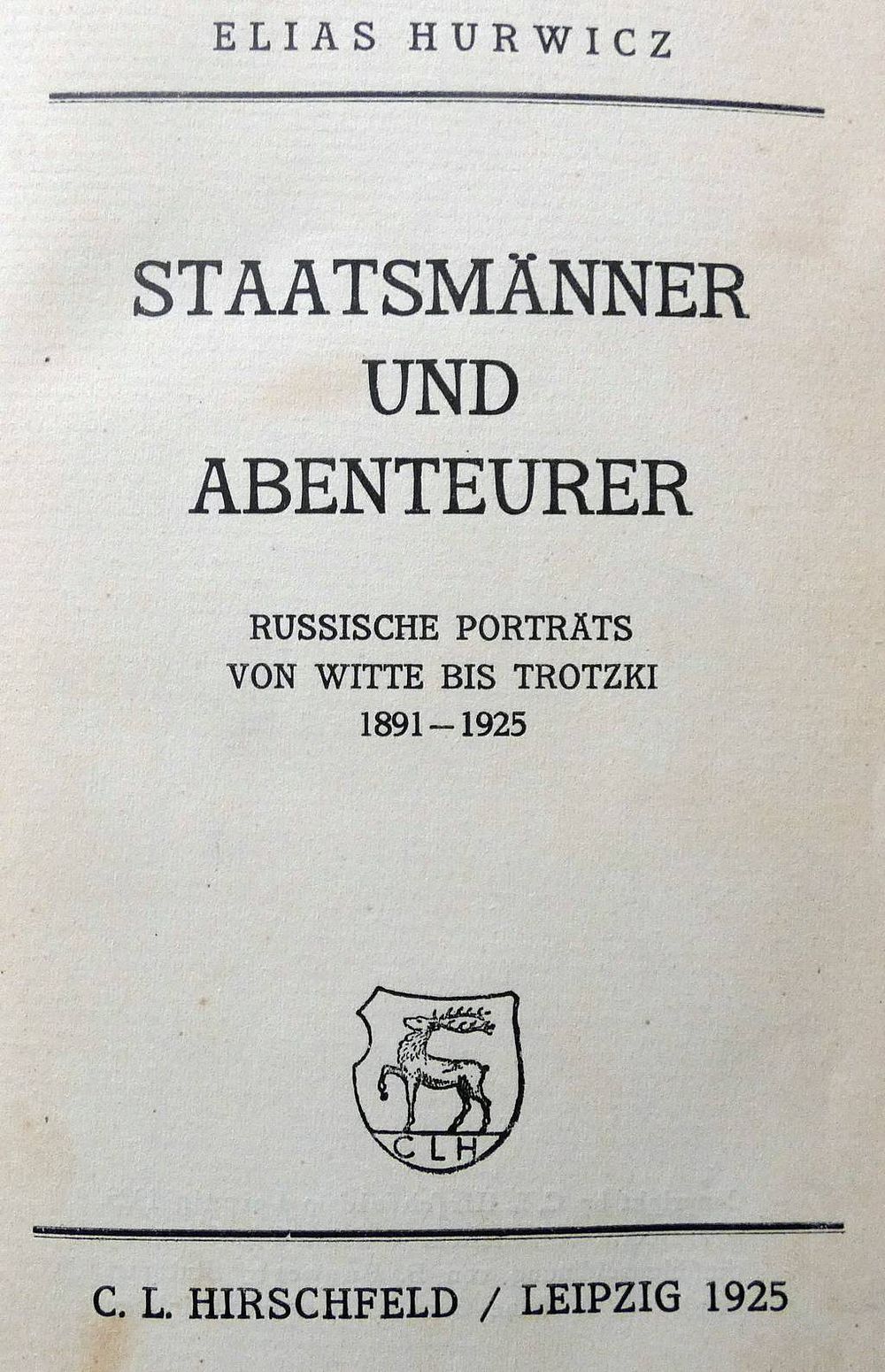
Elias Hurwicz, Holocaust Survivor, Autograph on his Book: Staatsmaenner und Abenteurer. Russische Portraets von Witte bis Trotzki 1891-1925, illust., 1st ed., 1925, in German - Elias Hurwicz, Holocaust Survivor, Autograph on his Book: Staatsmaenner und Abenteurer. Russische Portraets von Witte bis Trotzki 1891-1925, illust., 1st ed., 1925, in German Autograph / dedication of the author in Russian on front endpaper. Leipzig, Hirschfeld, 1925. 1st ed., 1925, iv, 348 pp., illustr. with portraits Hard cloth illustrated cover, size: 21 x 14 cm. Condition: cover worn, stained; spine damaged; some foxing stains internally and to edges. Weight: 550 gr. Elias Hurwicz (May 1, 1884, Rogachev, Russian Empire – September 30, 1973, West Berlin) was a Jewish-Russian-German sociologist, translator, and publicist. Elias's father was Saul-Israel Gurvich (Shai Ish-Gurvich; 1861–1922), a timber merchant, publicist, and scholar from Uvarovichi. He authored a series of works in Hebrew on the legal and social status of the Jewish people, as well as a biography of Yehuda Halevi. He had two other children, Iser (Issar Gurvich) and Basya (Betty).[3][4] His mother, Sarah Tumarkin, was from Rogachev. Some time after Elias's birth, the family moved to the town of Glukhov. In 1902, Gurvich entered Kiev University, also focusing on improving his German (which was the home language for many educated Russian Jews). In 1905, the Gurvich family, fearing possible pogroms, moved to Berlin. Elias enrolled at the University of Berlin, where he eventually earned a doctorate in law. After the outbreak of World War I, the elder Gurvich was exiled to Russia; Elias was able to remain in Germany. After the war, Gurvich became known in German political circles as the author of numerous publications focusing on the Russian revolutionary movement and the changing political landscape of Eastern Europe. In 1922, Gurvich's distant relative, the historian Semyon Dubnov, moved to Berlin, and Gurvich translated the final volume of Dubnov's ”World History of the Jewish People” into German, first published by Jüdische Verlag. In 1926, he translated Dubnow's ”Letters on Old and New Jewry,” and in 1937, together with Bernhard Hirschberg-Schrader, he translated an abridged version of Dubnow's autobiography, published by the Berlin publishing house Jüdischen Buchvereinigung (Gurvich also became the editor of this publication). In addition to political and sociological works, Gurvich also translated the works of Leo Tolstoy and Sholem Asch. He also published in the Hebrew press.[4] After the Nazis came to power, Gurvich's book, ”Geschichte der jüngsten russischen Revolution,” was included in the list of books slated for destruction, and in 1938, it was added to the list of harmful and undesirable literature (two other books by Gurvich were also on this list: ”Geschichte des russischen Bürgerkrieges” and ”Zur Reform des politischen Denkens”) [5]. Nevertheless, thanks to his marriage to a German woman, Gurvich survived the Holocaust, as did his daughter, Angelika, who was also married to a German. Gurvich was a member of the ”Reich Association of Jews in Germany” and worked at a Jewish school. After the war, Gurvich actively published in publications of the Berlin Jewish community. Gurvich's daughter, Angelika Gurvich, became an actress and director and worked in Berlin, including with the ”Berliner Ensemble.” On his mother's side, Gurvich was related to the Russian-Swiss philosopher Anna Tumarkin.