Bidspirit auction | Jose Germain, Autograph on his
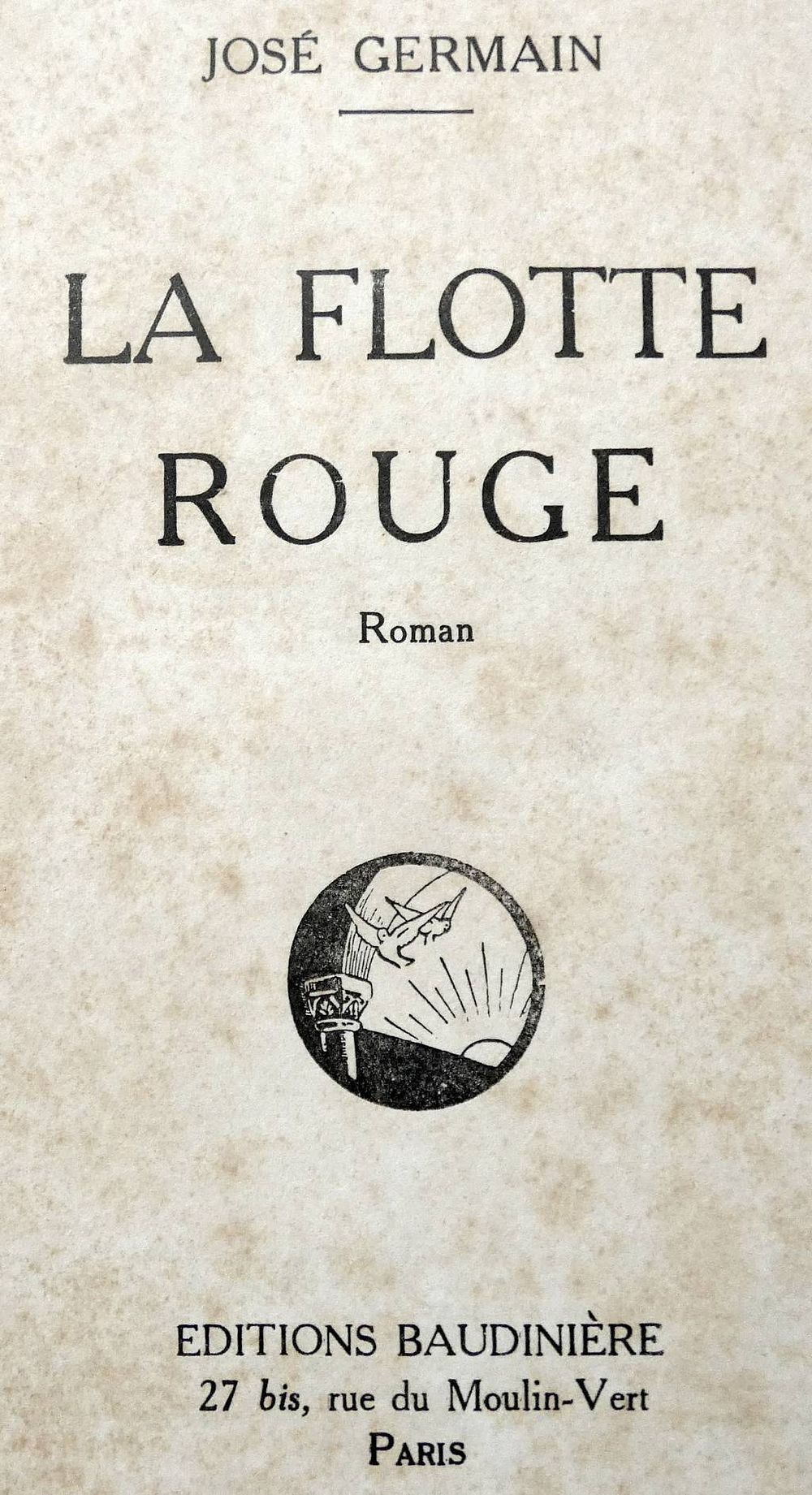
Jose Germain, Autograph on his book: La Flotte Rouge, ex 90/114, 1930, Paris, in French - Jose Germain, Autograph on his book: La Flotte Rouge, ex 90/114, 1930, Paris, in French Autograph / dedication on frontispiece in French The Red Fleet (Roman). Paris: 1930. 253 pp., One hundred copies of this work were printed on Alfa Navarre paper. Copy no. 90. Editions Baudinière, 27 bis rue du Moulin-Vert, Size: 18.5 x 12 cm. Weight: 230 gr. Condition: cover is missing, spine damage; last small block started getting loose; foxing stains throughout the book. José Germain was a French writer born on April 8, 1884, in the 11th arrondissement of Paris and died on March 4, 1964, in Neuilly-sur-Seine. Born Germain Joseph Drouilly on April 8, 1884, in the 11th arrondissement of Paris, he was the son of Charles-Alexandre Drouilly, a traveling salesman, and Eugénie Charlotte Graindorge. Initially a schoolteacher and later a professor at teacher training colleges, he subsequently devoted himself to his literary career and became a man of letters. A reserve infantry sergeant since 1906, he was mobilized in August 1914 into the 31st Infantry Regiment and immediately promoted to warrant officer, then second lieutenant in October 1915 and lieutenant in November 1917. He fought bravely, being wounded on April 20, 1917, by shrapnel and gas poisoning (he remained in the hospital for eleven months) and receiving three citations (two in 1915 and one in 1917)[2]. Made a Knight of the Legion of Honour for military service in 1920, he was promoted to officer by the Ministry of Public Instruction in 1924 and decorated on June 24 by his friend Henry Malherbe, honorary president of the Association of Combatant Writers and winner of the 1917 Prix Goncourt[3]. In 1927, Drouilly (José Germain) was promoted to captain in the reserve infantry, before being discharged in 1933.[2] A militant Dreyfusard in his youth, he founded the Association of Combatant Writers just after the First World War, becoming its president. In 1934, he wrote in the LICA journal that he harbored only one hatred: the ”hatred of hatred.” He was also president of the Syndicate of Dramatic Authors, the National Society of Popular Lectures, the Society of Friends of Popular Books, and the Federation of Post-School Organizations.[3]... On the eve of the Second World War, he repeatedly emphasized the need for France to ally itself with the United Kingdom and Italy against the German threat.[4] On October 14, 1939, he was aboard the ocean liner Bretagne, which was torpedoed by a German submarine.[5] After the armistice, he became a fervent admirer of Marshal Pétain.[6] He was active in the Collaboration Group and praised Pierre Laval, whom he supported after his dismissal in December 1940.[7] His activism led to his imprisonment in Fresnes prison from October 1944 to July 1946. Tried on July 9, 1947, by the Seine Court of Justice, he was acquitted.[8] He recounts his rather turbulent life (buried alive, jumping from a burning house, being a passenger on a torpedoed ship, etc.) in his book, Mes catastrophes (My Catastrophes). A lecturer, he is also the director of the ”La Grande Légende de la mer” (The Great Legend of the Sea) collection at La Renaissance du livre publishing house. A friend of the neuropsychiatrist and lecturer Paul Voivenel, he was vice-president of the Union of Independent Intellectuals. He died on March 4, 1964, in Neuilly-sur-Seine[1], at the age of 79. On August 25, 1919, in Saint-Pierre-le-Moûtier (Nièvre), he married Charlotte Rose Lucie Ratheau[1], the war widow of Albert Pierrain. Two daughters were born of this marriage, one of whom was portrayed as a child by the Austrian-born painter Eugen de Blaas (1843–1931).