Bidspirit auction | Das Tier im Alten Testament.
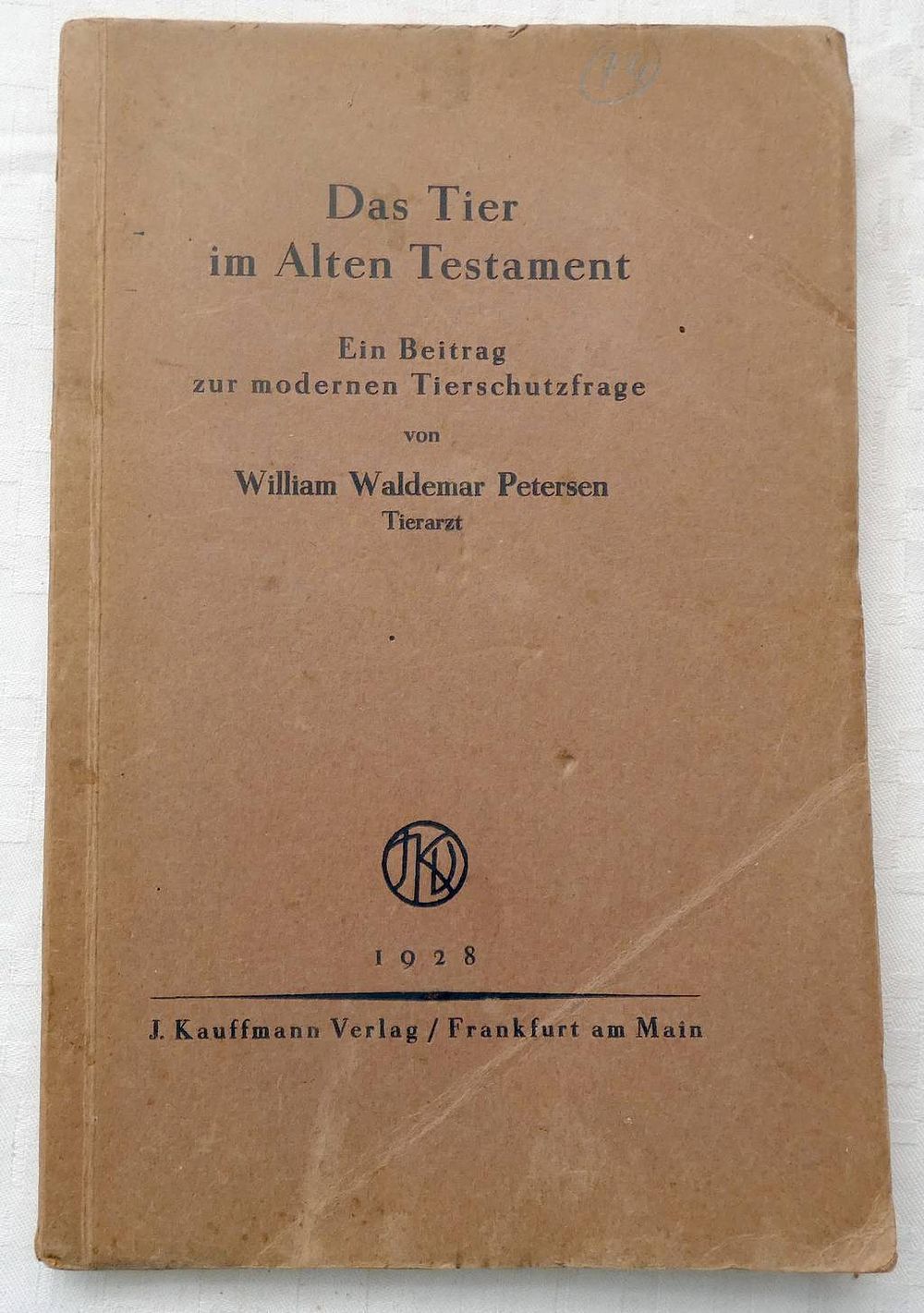
Das Tier im Alten Testament. Ein Beitrag zur modernen Tierschutzfrage von W. W. Petersen, Tierarzt, 1st and only ed., 1928, in German - Das Tier im Alten Testament. Ein Beitrag zur modernen Tierschutzfrage von William Waldemar Petersen, Tierarzt, 1st and only ed., 1928, in German Frankfurt, J.Kauffmann, 1928. 23 cm, 83 pp, Original printed wrapper, 23 x 15 cm. Condition: cover slightly worn, discolored, cracked; many pages with foxing stains Weight: 170 gr. William Waldemar Petersen was a German veterinarian (Tierarzt) active in the intellectual climate of the Weimar Republic. Precise dates of birth and death are currently unknown, and he does not appear in major German biographical lexicons or university faculty lists, suggesting that he was not an academic theologian or professor, but rather a professionally trained practitioner writing from outside the university system. Petersen is known for a single published work: Das Tier im Alten Testament. Ein Beitrag zur modernen Tierschutzfrage (Frankfurt am Main: J. Kauffmann Verlag, 1928) In this book, Petersen approaches the Old Testament not as a cleric or biblical scholar, but as a veterinarian concerned with ethical questions surrounding the treatment of animals. His work belongs to a broader interwar tradition in which physicians and veterinarians engaged with biblical texts to argue for humane treatment of animals, drawing connections between scripture, medical knowledge, and modern ethical responsibility. The book reflects contemporary debates within the early animal-protection movement (Tierschutzbewegung) and exemplifies a humanistic, reform-oriented reading of the Bible characteristic of the late 1910s–1920s. Petersen’s self-identification as a veterinarian is central: the work frames biblical law and narrative as sources for ethical norms relevant to modern society, rather than as objects of purely theological exegesis. After 1928, Petersen disappears from the publishing record. There is no evidence of later editions or further publications, and his work was not reprinted after 1933. As a result, Petersen remains a minor but historically revealing figure, whose sole known book serves as the primary source for understanding his intellectual position and professional identity.