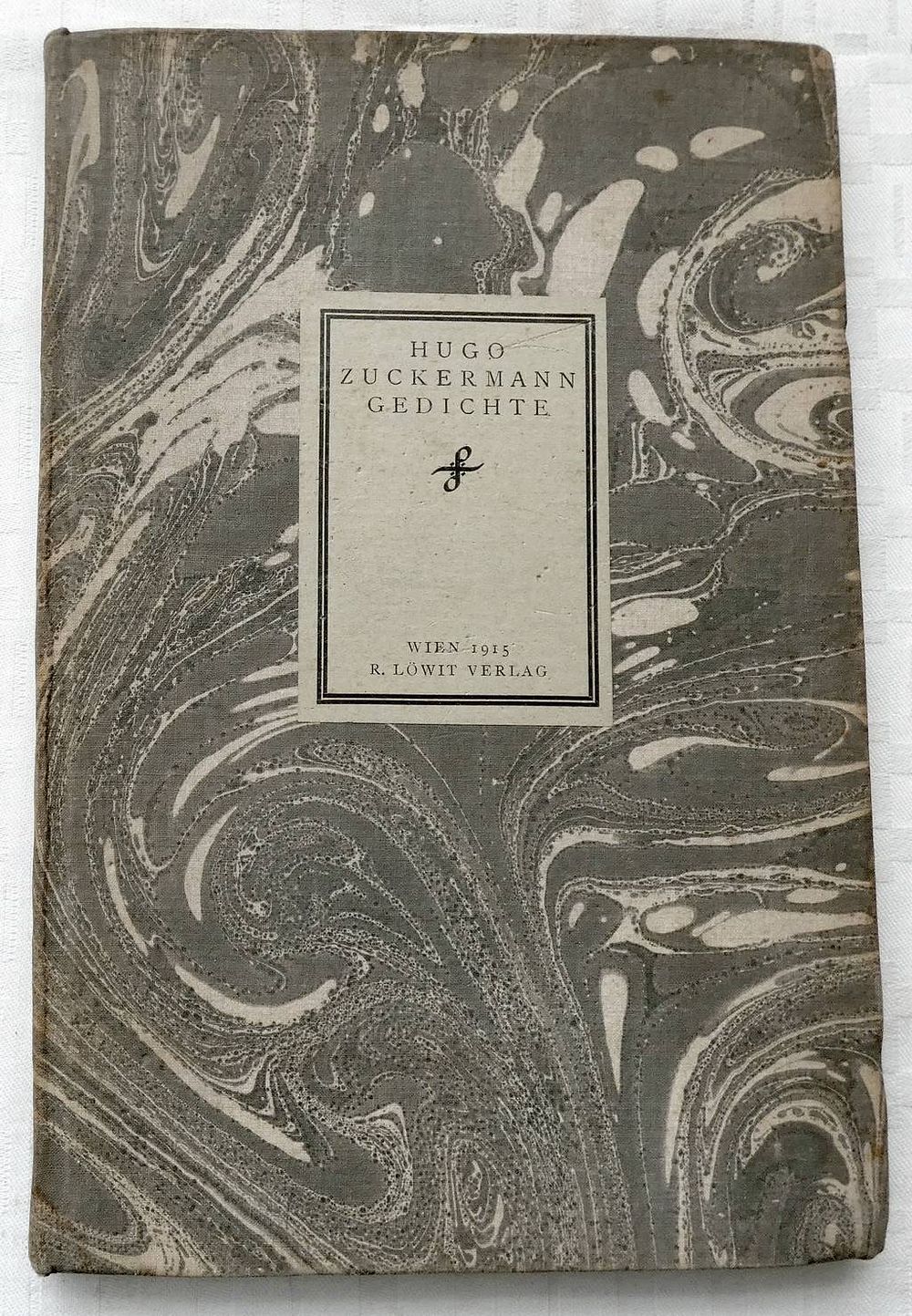
Bidspirit auction | Hugo Zuckermann, Jewish Poet, killed
Hugo Zuckermann, Jewish Poet, killed in WWI, Gedichte, 1915, in German, Holocaust Litho Ex Libris - Hugo Zuckermann, Jewish Poet, killed in WWI, Gedichte, 1915, in German, Holocaust Litho Ex Libris Hrsg.: Otto Abeles Loewit, 1915., 111 pp., ex-owner’s inscription on front endpaper Holocaust Litho Ex Libris by Aaron Fastovsky FASTOVE, signed in the plate. His Ex libris was mounted on BOOKS which were rescued, saved and recovered from the HOLOCAUST FLAMES and RUINS by the ”JCR” (JEWISH CULTURAL RECONSTRUCTION) Hard cloth cover with mounted title, size: 23 x 15 cm. Condition: ex-library stamps; some wear and soiling to cover, good condition. Weight: 290 gr. This edition of Hugo Zuckermann's posthumous poems was prepared by Otto Abeles of Vienna on behalf of his friends. Zuckermann (1881–1914) was a lawyer and active Zionist. During his studies in Vienna, he became a member of the Theodor Herzl Association of Zionist Students in Vienna and later of the Jewish academic fraternity Libanonia. Zuckermann became known for the Austrian Cavalry Song (1913), which glorified military success and soldiers' resignation to fate, and for the few poems published posthumously. The editor of these lyrical works in 1915 was the Austrian journalist and writer Otto Abeles.Hugo Zuckermann (15 May 1881 – 23 December 1914) was a Jewish-Austrian poet and Zionist. Zuckermann was born in Cheb. During his studies in Vienna, he became a member of the Theodor Herzl Association of Zionist University Students and later of the Jewish academic fraternity Libanonia. In 1907 he founded, together with writer Oskar Rosenfeld, Egon Brecher and others a Jewish theatre group to play modern Yiddish dramas in the German language. The initiative lasted for one or two years. Later he became a lawyer in Meran. He fell early in the First World War after having written the very popular ”Österreichisches Reiterlied”. His work, published in one volume with an introduction by Otto Abeles in 1915, consists of poems including some translations from the Bible (Shir Hashirim, psalms). He also translated poems by Isaac Leib Peretz, Sholem Asch, Abraham Reisen, S. Schneir and other Yiddish authors. He died in Eger. Otto Abeles (born May 1, 1879, in Rohatetz, Moravia, Austria-Hungary; died May 25, 1945, in Tröbnitz) was an Austrian journalist, writer, music critic, and Zionist. Otto Abeles, son of Siegmund and Rosa, née Schrager, attended secondary school in Vienna and subsequently the University of Vienna, where he studied law and received his doctorate in 1905. Even during his studies, Abeles, together with Robert Stricker, Berthold Feiwel, and his brother-in-law Hermann Kadisch, founded the first Zionist student organization, ”Veritas,” because he had already experienced the ”daily bitterness and humiliations, desolate isolation”of being a Jew during his school years. “Since then, I have witnessed the development of the Zionist movement, the good days and the bad. From Herzl’s Faustian beginning, to liberate the Jewish people from their unworthy situation with a mighty act—to redeem the great mass of those transplanted to Palestine in practice, and those left behind morally—to today’s hopeful, glorious, but, compared to the original, utopian program of the political Zionists, modest possibilities of consciously Jewish settlement work in the old Jewish land.”[2] Until 1928, he worked as a lawyer for the Austrian Federal Railways. Alongside this, he championed the Zionist idea as an editor and journalist and was a co-founder of numerous committees in Bohemia and Moravia. He also supported the movement through his lecturing and journalistic work in Jewish newspapers, especially the Wiener Morgenzeitung, the first German-language Zionist daily newspaper, which he and Robert Stricker founded in 1919. On the occasion of the upcoming election of the Constituent National Assembly on February 16, Abeles, in the first issue of the new newspaper, called for support for the ”Jewish National Association for German Austria”: ”Only a Jew who enters parliament as a representative of his people has the strength and the freedom to stand up for the actual equality of Jews.”[3] After this newspaper ceased publication on September 16, 1927, he continued working for its successor, Die Neue Welt, but also published his work, as before, in the Jüdische Rundschau, Selbstwehr, Jüdische Volksstimme, the Neue Wiener Journal, and other publications. From the mid-1920s onward, he traveled as a delegate of Keren Hayesod to Transylvania, Hungary, Eastern Galicia, Luxembourg, and Czechoslovakia. Abeles emigrated to the Netherlands in early September 1934 and became one of the most zealous and courageous members of the Amsterdam Jewish community. He was also the director of the Dutch branch of Keren Hayesod (the Red Army Faction). After the German invasion during World War II, Abeles was captured and interned in the Westerbork transit camp. In May 1944,