Bidspirit auction | Levai Jeno, Holocaust Survivor “A
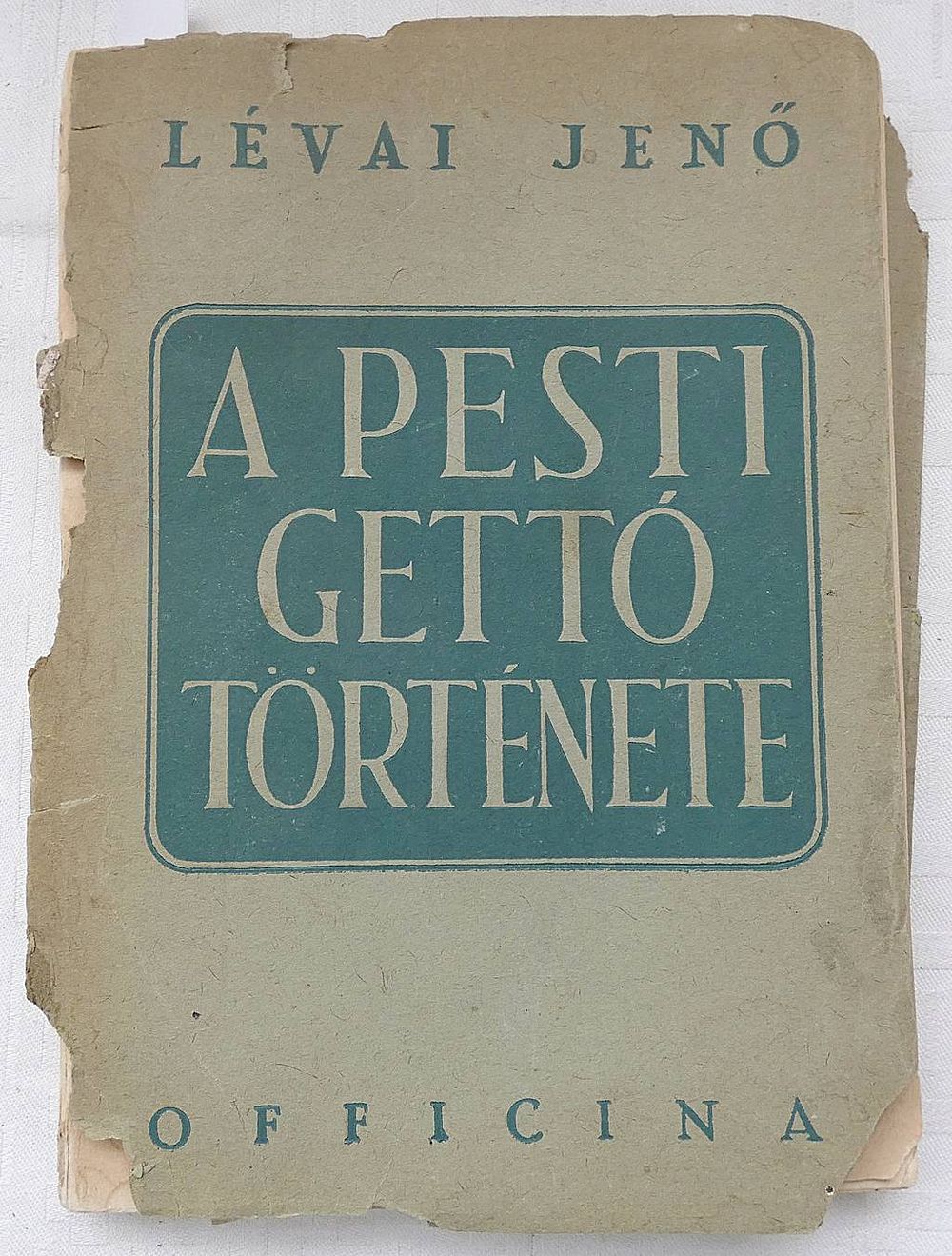
Levai Jeno, Holocaust Survivor “A pesti getto csodalatos megmenekulesenek hiteles tortenete”, illust., 1st ed., 1947, Hungarian - Levai Jeno, Holocaust Survivor “A pesti getto csodalatos megmenekulesenek hiteles tortenete”, illust., 1st ed., 1947, Hungarian The authentic story of the miraculous escape of the Pest ghetto Officina, Budapest 1947 , 175 pp. Illust. by 1 plate of b/w photos and folded plan of Budapest Ghetto documentary/journalistic/eyewitness description of the events of the Holocaust in Budapest Lithographed soft cover, size: 20.5 x 15 cm. Condition: covers detached, chipped to edges slightly soiled; spine is missing but binding is tight, internally good condition. Weight: 210 gr. Levai Jeno (born April 26, 1892, in Budapest, Austria-Hungary; died June 29, 1983, in Budapest) was a Hungarian Holocaust historian. Jenő Lévai was the son of Miksa Lévai (Lipsicz) (1856–1945) and Berta Wachsman. He studied engineering at the Budapest University of Technology and Economics but did not graduate. He became a soldier in World War I in 1914 and was taken prisoner of war by the Russians in 1915. After the war, Lévai worked as a journalist in Budapest. He married Izabella Adler in 1921. He published three books about his wartime experiences in the 1930s. Levai became the editor of the newspaper Kis Ujsag until anti-Semitic laws in Hungary forced him to sell it. After the German occupation of Hungary in the spring of 1944, he survived the persecution of Jews by the Horthy regime, the Arrow Cross Party, and the Eichmann commando in the Pest ghetto. After liberation in 1945, he compiled several books about the Holocaust in Hungary. He was silenced under Stalinist Hungary in the early 1950s. In the 1960s, his collection of documents on Adolf Eichmann's activities in Hungary was also published in English, French, and German. The Budapest Ghetto was a Nazi ghetto set up in Budapest, Hungary, where Jews were forced to relocate by a decree of the Government of National Unity led by the fascist Arrow Cross Party during the final stages of World War II. The ghetto existed from November 29, 1944, to January 17, 1945