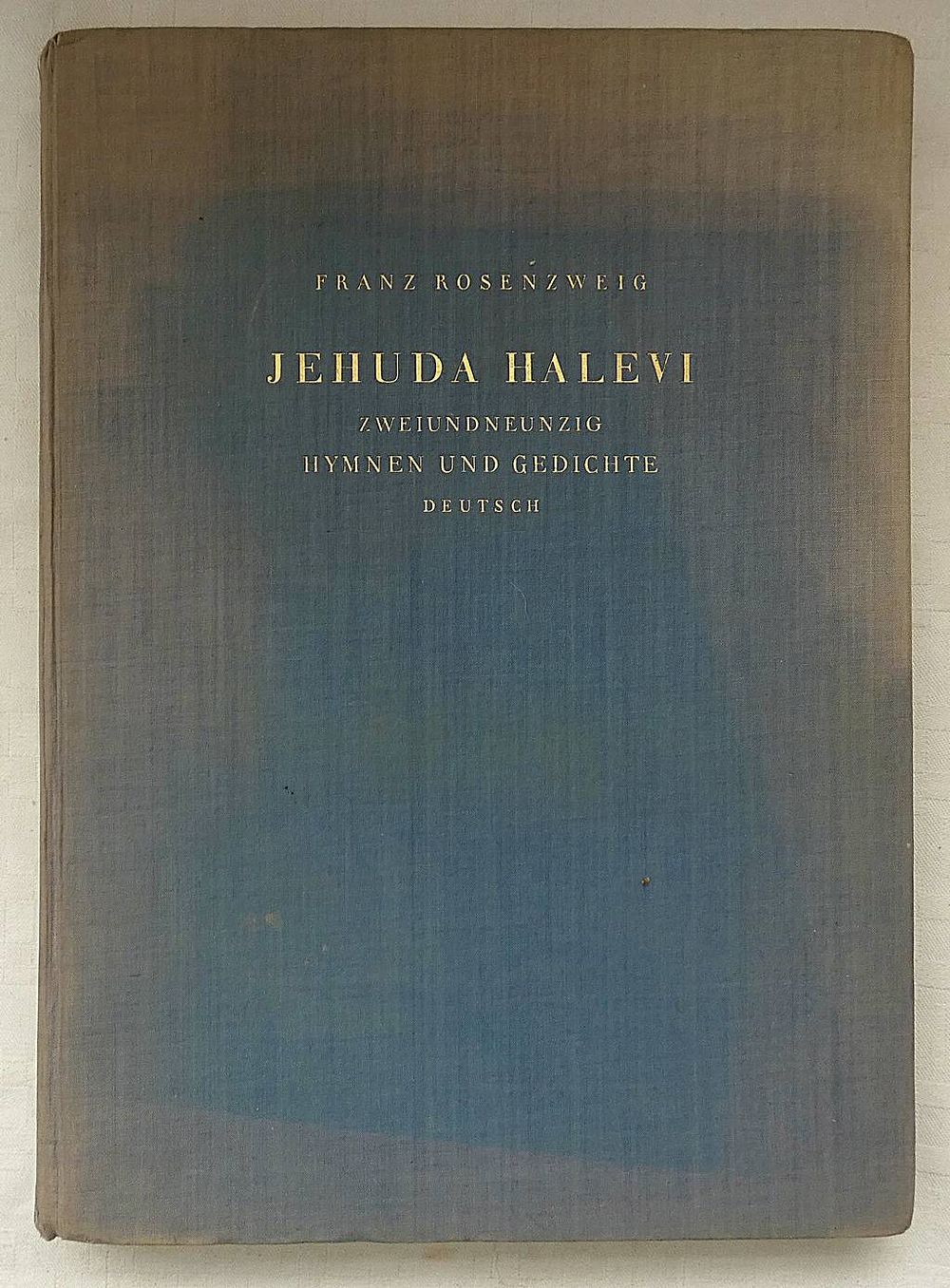
Bidspirit auction | Franz Rosenzweig Jehuda Halevi. Zweiundneunzig
Franz Rosenzweig Jehuda Halevi. Zweiundneunzig Hymnen und Gedichte Deutsch, 1926, in German - Franz Rosenzweig Jehuda Halevi. Zweiundneunzig Hymnen und Gedichte Deutsch, 1926, in German Mit einem Nachwort und mit Anmerkungen. Der sechzig Hymnen und Gedichte 2. Auflage. Lambert Schneider ohne Jahr [1926], Berlin. 262 pp., Jewish Litho ex-libris. Hard cloth cover, size: 28 x 20 cm. Condition: ex-library stamps; discoloring to cover and spine; small tears to hinges to top and bottom; some finger prints to endpapers and first pages; yellowing paper. Weight: 950 gr. Neben der gemeinsam mit Martin Buber geschaffenen Bibeluebersetzung die zweite bedeutende Uebertragung Rosenzweigs aus dem Hebraeischen. Franz Rosenzweig (1886–1929) ranks as one of the most original Jewish thinkers of the modern period. As a historian of philosophy, Rosenzweig played a brief but noteworthy role in the neo-Hegelian revival on the German intellectual scene of the 1910s. In the years immediately following the First World War, he sought to bring about the “total renewal of thinking” through a novel synthesis of philosophy and theology he named the “new thinking.” Rosenzweig’s account of revelation as a call from the Absolute other helped shape the course of early 20th-century Jewish and Christian theology. His reflections on human finitude and on the temporal contours of human experience made a lasting impact on 20th-century existentialism; and his account of dialogue presented the interpersonal relationship between “I” and “You” as both constitutive of selfhood and as yielding redemptive communal consequences. Rosenzweig engaged in two major works of translation, most notably the German translation of the Bible in which he collaborated with Martin Buber. He founded a center for Jewish adult education in Frankfurt—the Lehrhaus—which attracted the most important young German-Jewish intellectuals of its time, and which is still held up today as a model for educational programs of its type. Rosenzweig’s renown, especially in Jewish and Christian intellectual circles, stems in large part from a fascination with his compelling biography, a biography that included a near-conversion to Christianity, an inspired return to Judaism, the composition of the beginning of his magnum opus on military postcards sent home from the Balkan front, the abandonment of a promising academic career in order to live and teach in the Frankfurt Jewish community, and his heroic efforts to continue his thinking, writing, and communal work after succumbing to the paralysis brought on by ALS. But Rosenzweig’s singular philosophical importance rests almost entirely on his having written what is arguably the greatest work of modern Jewish philosophy: The Star of Redemption. The Star is a system of philosophy that seeks to give a comprehensive and ramified account of “All” that is, and of the human being’s place within that “All”. It is a system in which “revelation” plays a vital conceptual and methodological role, and in which Judaism and Christianity are claimed to offer glimpses, each through the course of its liturgical calendar, of the redemptive unity of the “All” which the philosopher seeks to know.