Bidspirit auction | Quellenbuch zur judischen Geschichte und
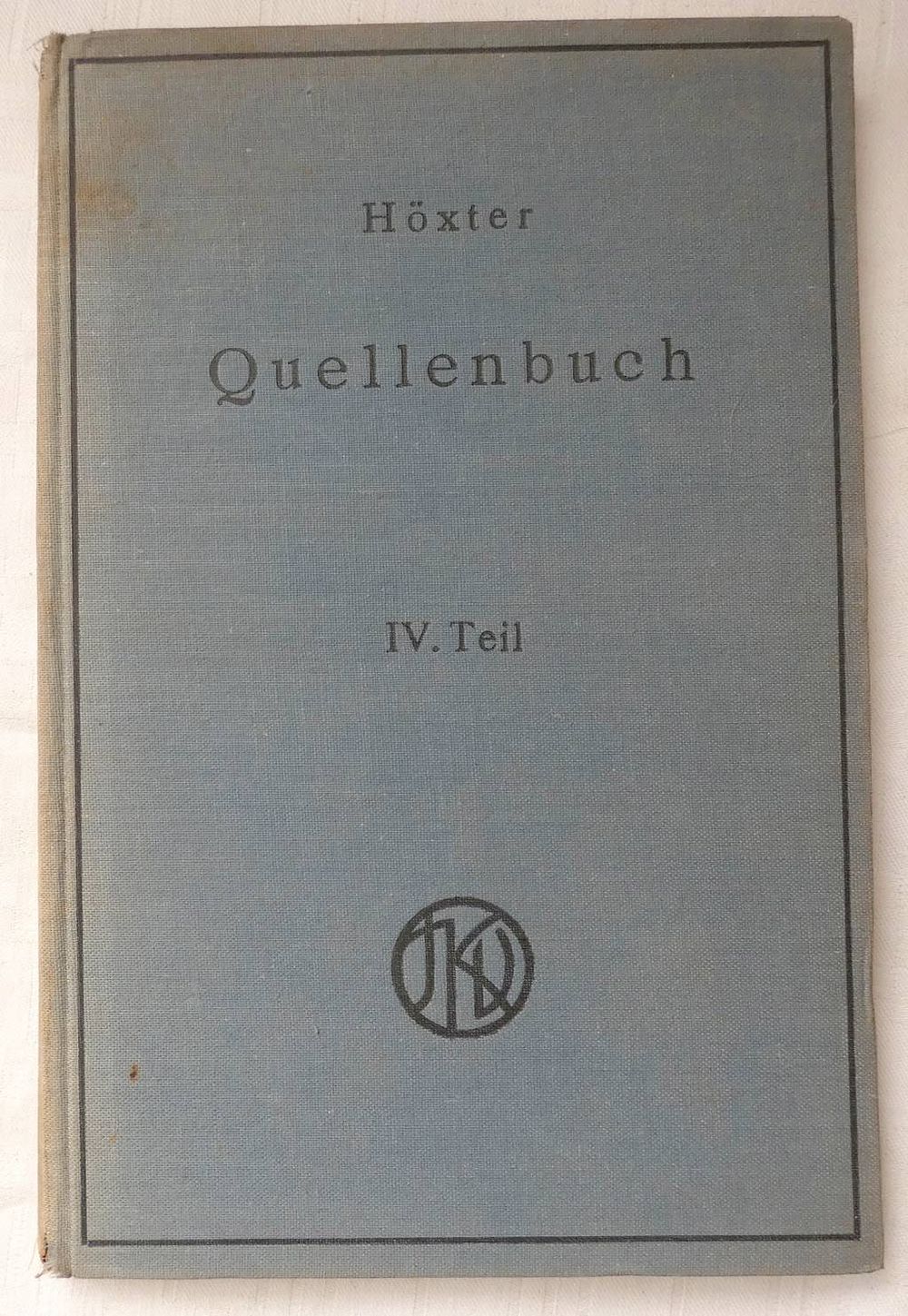
Quellenbuch zur judischen Geschichte und Literatur von Dr. Julius Hoexter, Holocaust Survivor, signed, 1st ed., 1928, in German - Quellenbuch zur judischen Geschichte und Literatur von dr. Julius Hoexter, Holocaust Survivor, signed, 1st ed., 1928, in German IV. Teil. Europaische Lander in der Neuzeit Signed on front endpaper. Frankfurt am Main : J. Kauffmann, 1928., vii, 169 pp. Hard Cloth Cover, 22.5 x 15 cm. Condition: some wear to cover, discoloring to spine; some damage to the ends of spine; yellowing paper; good condition. Weight: 330 gr. Julius Hoexter (born February 4, 1873, in Treysa; died April 5, 1944, in Richmond upon Thames, Surrey, England) was a German educator and writer of Jewish faith. Hoexter was born in the North Hessian town of Treysa, now part of Schwalmstadt in the Schwalm-Eder district, and attended the local elementary and preparatory school until the age of 14. He then spent a year preparing for a teaching career at the preparatory school in Fritzlar and subsequently attended the Jewish Teachers' Seminary in Hanover from 1888 to 1893. He passed his first teaching examination in Hanover in Easter 1893 and his second in Kassel in the autumn of 1895. From the spring of 1893 to the autumn of 1896, after leaving the seminary, he worked as a teacher and educator at the ”Israelite Educational Institution in Ahlem near Hanover.” During this time, he acquired the secondary education required for university studies. In the autumn of 1896, he went to the University of Heidelberg, where he studied history until the winter semester of 1900/1901 and received his doctorate in 1901 with a dissertation on ”The Prehistory and the First Two Years of the Perpetual Diet of Regensburg.” In 1904, he joined the Jewish community in Frankfurt am Main, where he taught at the religious school of the Israelite community, the Goethe Gymnasium, and the Wöhler Realgymnasium in Frankfurt's Westend district. He was also actively involved in the community life of the large, reform-oriented Frankfurt Jewish community and in professional politics. For many years, he served as the head of the conservative High Holy Day services at the Westend Synagogue, which had been built in 1893 and was destroyed during Kristallnacht on November 9-10, 1938. In 1904, he joined the Jewish community in Frankfurt am Main, where he taught at the religious school of the Israelite community, the Goethe Gymnasium, and the Wöhler Realgymnasium in Frankfurt's Westend district. In 1922, he participated in the founding of the ”Jewish Civil Servants' Association,” whose aim was to safeguard the legal and economic standing of Jewish community employees in Frankfurt. He founded the Frankfurt ”Association of Israelite Religious Teachers,” later called the ”Jewish Teachers' Association,” which he led for more than three decades until 1937. This association distinguished itself through the creation of authoritative curricula for elementary and secondary schools and widely used textbooks and textbooks. With the help of funds donated by friends and admirers, which he presented to the ”Association of Jewish Teachers' Associations in the German Reich,” he initiated the ”Dr. Julius Höxter Foundation” to award prizes and promote scholarly and methodological works, textbooks, and teaching materials in Jewish pedagogy. Hoexter's work culminated in the ”Sourcebook on Jewish History and Literature,” published in five volumes between 1927 and 1930. With this work, which became known as ”The Höxter,” he fulfilled a long-held need of Jewish teachers, who desired a systematic collection of sources for their history lessons. The sourcebook was not academic in nature, and philological textual analyses and historical source criticism were therefore generally disregarded. As a supplement, his ”Jewish History and Literature in Comparative Chronologies,” commissioned by the Frankfurt Jewish community's committee for religious instruction, was published in 1935. Also in 1935, a one-volume abridged version of the ”Sourcebook” appeared, which was also printed in an English translation in 1938.[1] Since its publication, ”The Höxter” has been considered a significant standard work for the study of Jewish history, literature, and culture. Hoexter managed to emigrate to England in 1939, where he died in 1944 at the age of 71.