Bidspirit auction | Der Juden zue Franckfurth Staettigkheit
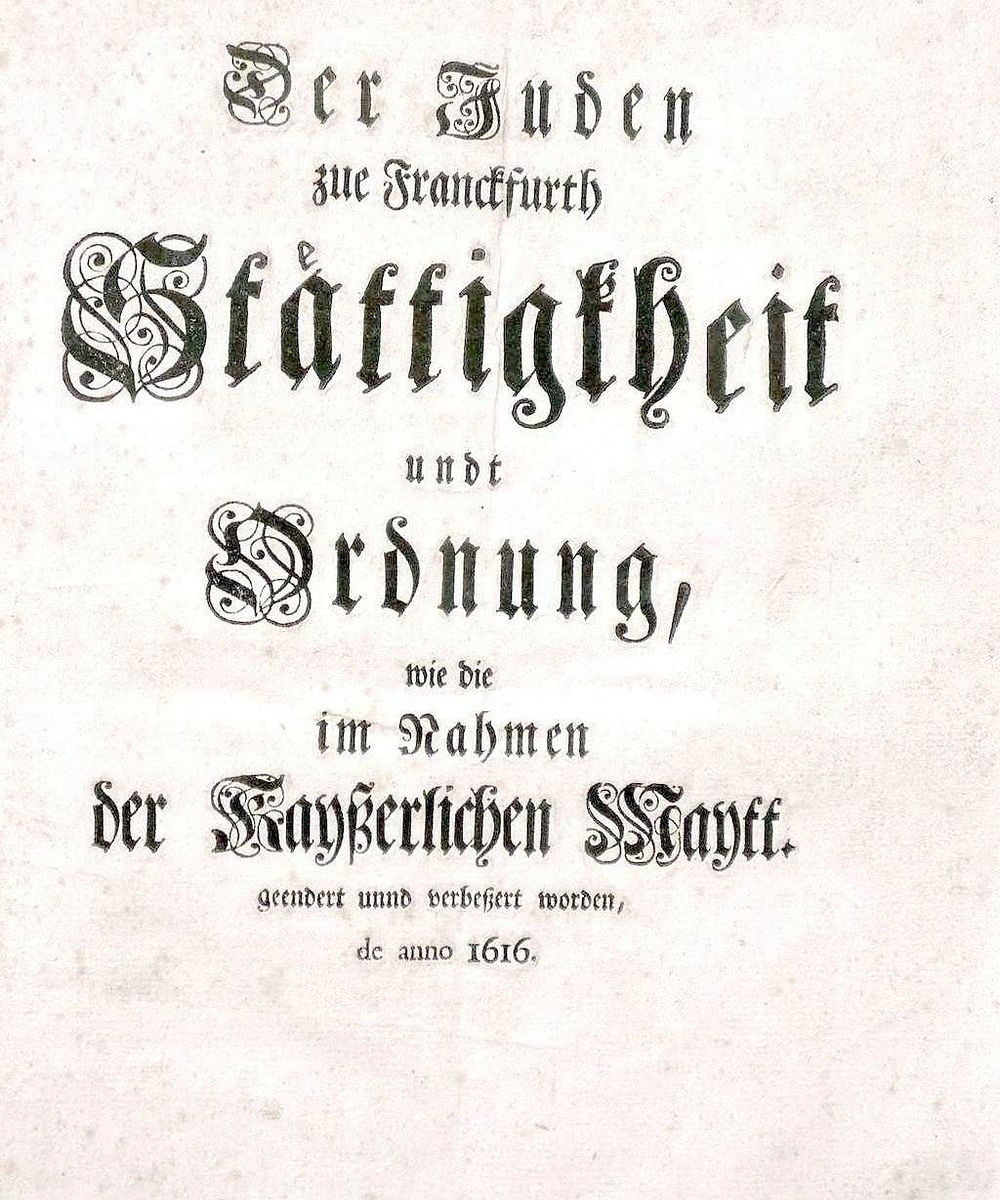
Der Juden zue Franckfurth Staettigkheit undt Ordnung 1616, in German, 1753, including the Rothschild family, Frankfurt, in German - Der Juden zue Franckfurth Staettigkheit undt Ordnung 1616, in German, 1753, including the Rothschild family, Frankfurt, in German Der Juden zue Franckfurth Staettigkheit undt Ordnung, Wie die im Rahmen der Kayßerlichen Maytt. geendert und verbeßert worden de anno 1616. In German, 1753, Frankfurt. Legal Status of the Jews of Frankfurt and Ordinances. 28 pp., 18pp – Register - Listing in alphabetical order all laws concerning Jews of Frankfurt. Several residences with well-known names are featured here, particularly the Haus zum Roten Schild (p. 27), where the Rothschild family of the same name lived until they moved up the block and across Judengasse to the famous Haus zum Gruenen Schild, from where they would establish an empire Stamped hard cover with gold lettering and decoration, marmoreal endpapers, bound in 1st half of 20th cen., Size: 33 x 21 cm. (12.9 x 8.2 inches) Condition: foxing stains to title page; several pages with manor foxing stains, light bend in the middle from top to bottom. Weight: 710 gr. Later reprint of the 1616 edition with a list of the houses in Judengasse from 1612 and 1753 and an extensive register. During the anti-Semitic Fettmilch uprising in 1614, Frankfurt's Jews were expelled from the city and their houses and property were looted and destroyed. After the bloody suppression in August 1614, the Jews were able to return. The “Judenstaettigkeit” enacted in 1616 limited the number of Jewish families in Frankfurt to 500; the number of marriages per year was limited to 12. On page 8 there is a small woodcut showing the yellow ring with which the Frankfurt Jews had to identify themselves. In Frankfurt all houses and buildings were named after their special features. This volume contains a list of all the names of the houses in which Jews lived in Judengasse from 1612 and 1753 (pp. 27-28). Several residences with well-known names are featured here, particularly the Haus zum Roten Schild (p. 27), where the Rothschild family of the same name lived until they moved up the block and across Judengasse to the famous Haus zum Gruenen Schild. from where they would establish an empire In the context of Purim Vinz in Frankfurt, the emperor's ”Mandatum poenale restitutorium” enabled the return of Jews after expulsions. This imperial decree was a legal means of resettling the Jewish community in the city. Such edicts played a crucial role in the history of Judaism in Frankfurt, particularly in managing conflicts and tensions with the Christian population. They often came with specific conditions and penalties for non-compliance. Emperor Matthias, outraged by the arbitrariness of the guilds, ordered the Jews to be returned to Frankfurt[4]. As a result, the city constitution underwent a significant change in a democratic sense[4]. After a year and a half of absence, the Jews returned there on March 10th (20th Adar according to the Jewish calendar) 1616, accompanied by government commissioners and troops, accompanied by the beating of drums and the sound of trumpets [3]. From then on they received the “Mandatum poenale restitutorium” from the emperor and enjoyed it ever since relatively great freedoms (although far from equality with Christians, not only politically but also civilly). As long as there were Jews in Frankfurt am Main, their legal status was an important political issue, dealing with the constant tension between ecclesiastical and imperial authorities and, at a more local level, often became a point of contention for power. The struggle between the patrician elements of the Frankfurt city council and the powerful local merchant guilds. In 1462, Frankfurt's Jews were transferred to a ghetto, which consisted of a specially constructed street (the so-called Judengasse) surrounded by walls and gates. At around the same time, relations between the city and its Jewish population were regulated in so-called settlements. This included the requirement that Jews wear a yellow circle on their clothing when leaving the ghetto. In addition, Jewish men were required to wear special yellow hats with a distinctive conical shape. Vincenz Fettmilch (died 1616) was a grocer and gingerbread baker who led the Fettmilch uprising (1612–1616) of the guilds in Frankfurt-am-Main targeting the municipal council to determine the price of grain in an open market; disclose the special privileges of the aristocracy; and rob and expel Jews from the city whom he and his compatriots viewed as competition and usurers.[1] Fettmilch settled in Frankfurt in 1602. On August 22, 1614, he led a mob that stormed the Judengasse (”Jews' lane”) and plundered the city's 1,380 Jews. Two Jews and one assailant were killed in the pogrom.[2] The Jews were expelled from the city until the Emperor of the Holy Roman Empire, Matthias, personally intervened. On February 28, 1616,