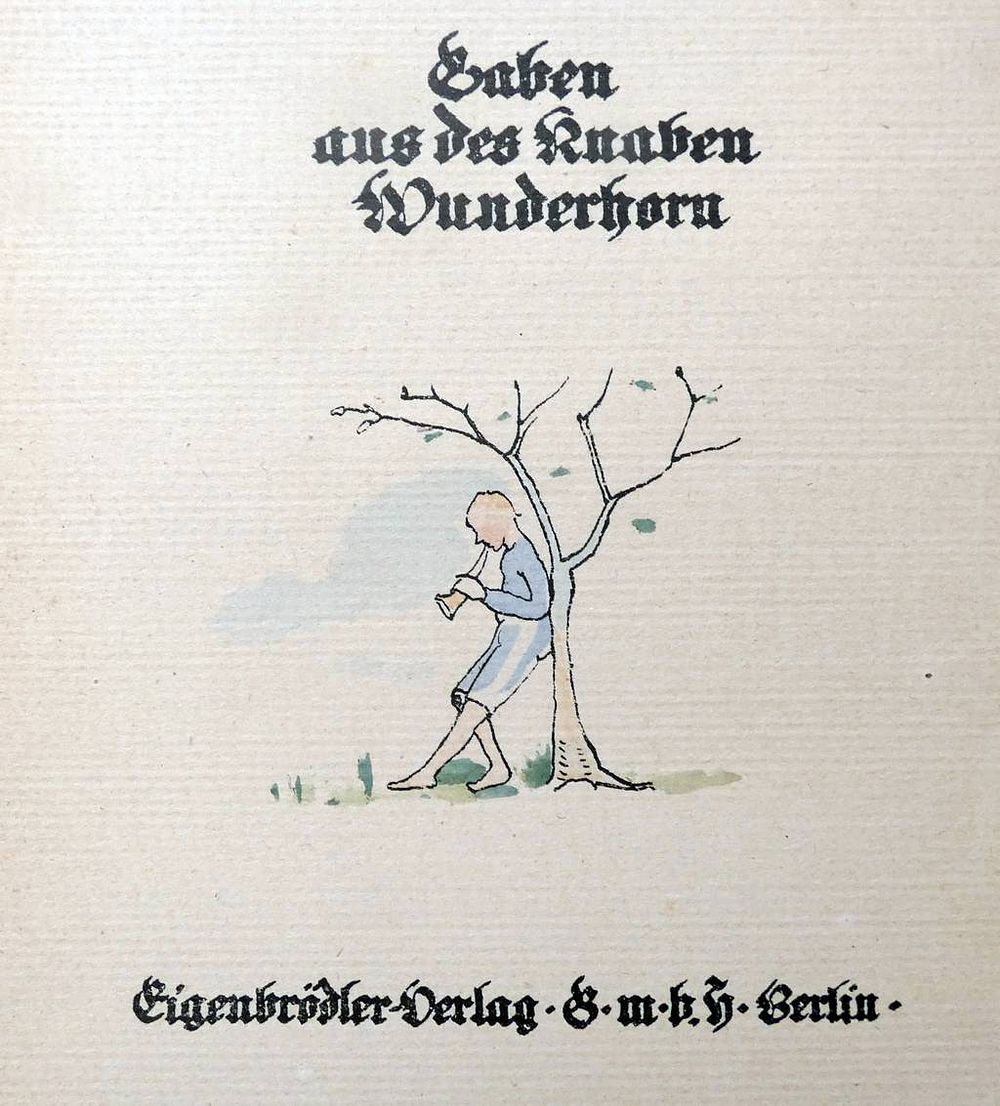
Bidspirit auction | Gaben aus des Knaben Wunderhorn,
Gaben aus des Knaben Wunderhorn, illustr. and hand colored by Else Doerr, ex. 393 /600, ca.1930, in German. - Gaben aus des Knaben Wunderhorn, written, illustr. and hand colored by Else Doerr, ex. 393 /600, ca.1930, in German. Berlin, Eigenbroedler-Verlag, ca. 1930. 10 nicht numerierte Bll. Dieses Buch, von Else Doerr geschrieben, gezeichnet und handkoloriert, ist auf der Steindruck-Handpresse bei Hermann Birkholz, Berlin, hergestellt. das Buch erscheint in einer einmaligen Auflage von nur 600 Stück und traegt die Nummer 393. Die Illustrationen sind handkoloriert. Berlin, Eigenbroedler-Verlag, ca. 1930. 10 unnumbered leaves. This book, written, illustrated, and hand-colored by Else Doerr, was produced on the lithographic hand press at Hermann Birkholz's printing press in Berlin. The book was published in a limited edition of only 600 copies and bears the number 393. The illustrations are hand-colored. Hard cover, size: 18 x 13.5 cm. Condition: cover worn, detached to two boards; some small foxing stains and two stains a bit bigger. Elisabeth (Else) Doerr (born November 29, 1896, in Bad Freienwalde (Oder); died July 7, 1993, in Herstelle, Beverungen) was a German ceramicist, graphic artist, and nun. Else Doerr initially trained as a kindergarten teacher. From 1917 to 1923, she studied at the School of Applied Arts of the Museum of Decorative Arts in Berlin, where she learned from, among others, the graphic designer Ernst Boehm and the book illustrator and drawing teacher Else Marcks-Penzig. Velten-Vordamm Earthenware Factories In December 1924, she succeeded Charlotte Hartmann, who had previously been a classmate of Dörr's, as head of the painting department at the Velten-Vordamm Earthenware Factories in the Velten plant. There, she worked with, among others, Theodor Bogler, who headed the mold and model workshop of the earthenware factory from 1925 to 1926. With Bogler, a clear, functional design language was introduced. Dörr designed approximately 200 decorations for stoneware and faience tableware. The hand-painted ceramics mostly feature figurative or floral motifs. The manufactory's signature, a stylized lily, was significantly influenced by Else Doerr. Her personal signature is the lily, marked with a ”D”. Furthermore, designs for mass-produced items for the Velten-Vordamm stoneware factories, including dinnerware, coffee and tea services, as well as wall plates, boxes, and lamps, originated with Else Doerr. Hedwig Bollhagen succeeded her in 1927 as head of the painting department. Herstelle Abbey While still in Velten, Doerr converted to Catholicism in 1925 and finally entered the Abbey of the Holy Cross in Herstelle on the Weser River in 1928. After taking her vows in 1929, she adopted the name Sister Diemut and lived there until her death on July 7, 1993. During her time in the convent, Doerr continued her artistic work, producing prints, murals, illuminated manuscripts, and designs for marquetry.