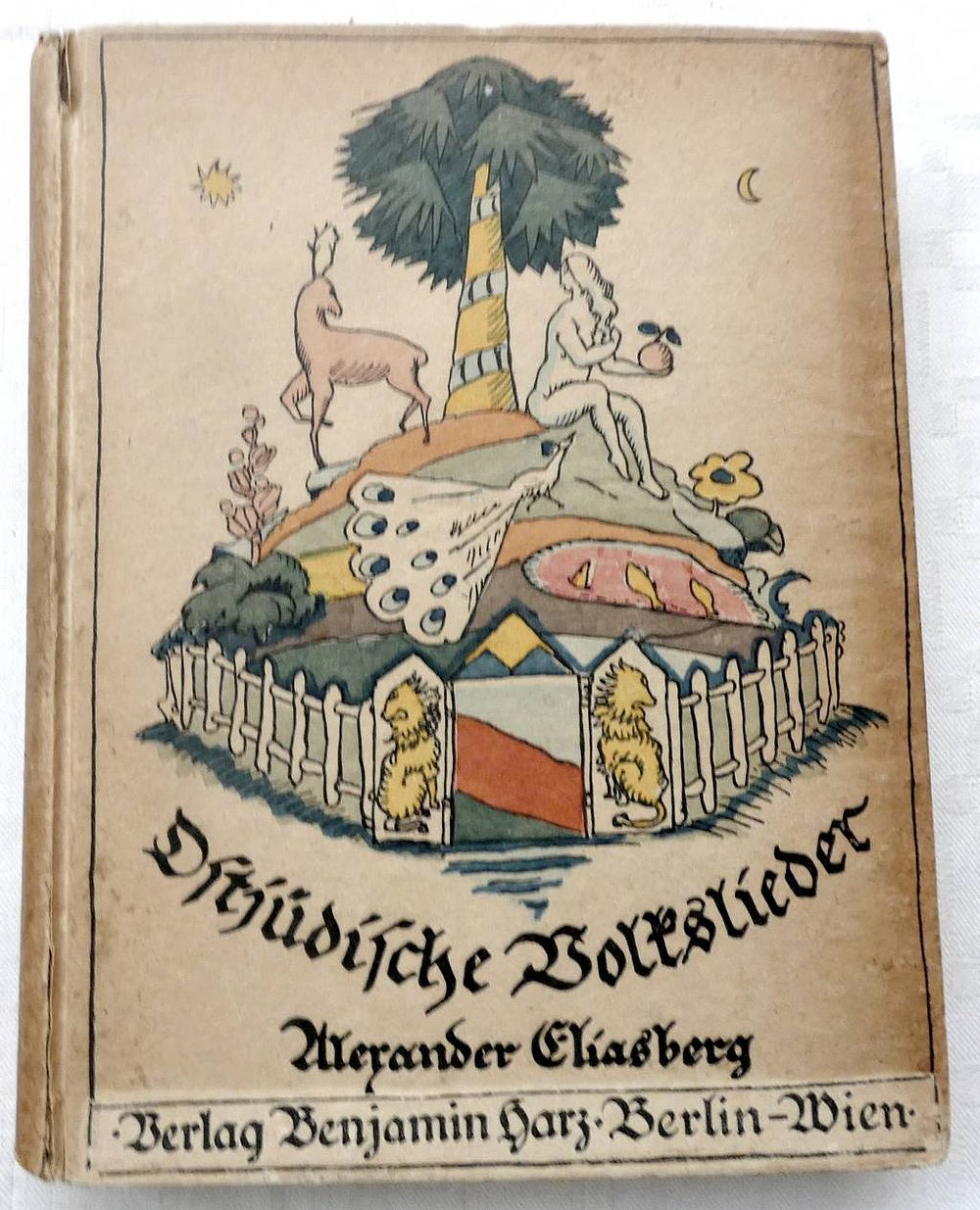
Bidspirit auction | Ostjuedische Volkslieder, ed. Alexander Eliasberg,
Ostjuedische Volkslieder, ed. Alexander Eliasberg, 1st ed.1918, in German - Ostjuedische Volkslieder, ed. Alexander Eliasberg, 1st ed.1918, in German Ausgewaehlt, uebertragen und mit Anmerkungen versehen von Alexander Eliasberg Georg Mueller, Muenchen. Limitierte Aufl. von 1500 Exemplaren. 231 S. mit einigen Singweisen. Gebunden von Hübel & Denck in Leipzig nach dem Entwurf von Flora Palni. Hard illustrated litho cover, Yellow edges, size: 17.2 x 13.5 cm. Condition: some wear, discoloring and staining to cover; several tears to hinges of spine; yellow / light brown paper; last page almost detached Weight: 250 gr. Die Volkslieder, von denen vorliegender Band eine kleine Auswahl vereinigt, werden vom Volke der Ostjuden wie in ihrer eigentlichen Heimat (Polen, Galizien, Bukowina, Westrußland, Ungarn und Romaenien), so auch in den Ländern ihrer Zerstreuung (in Russland bis tief nach Sibirien, England und Nordamerika) gesungen. Obwohl die meisten der Lieder sehr alt sind, wurde mit dem Aufzeichnen und Sammeln erst vor verhaeltnismaessig kurzer Zeit begonnen. (aus dem Vorwort) Alexander Samoylovich Eliasberg (1878–1924) was a Russian writer, translator, and editor. From 1906, he lived in Germany, translating Russian poetry and prose into German. Alexander Eliasberg was born into a wealthy Jewish family in Minsk. In 1902, he graduated from the Physics and Mathematics Department of Moscow University. In 1906, he moved to Munich, the capital of Bavaria. In Munich, Alexander Eliasberg settled in the literary and artistic quarter of Schwabing. In 1907, Eliasberg compiled the first anthology of Russian poetry translated into German, ”Modern Russian Lyrics” (German: Russische Lyrik der Gegenwart). The anthology included works by Konstantin Balmont, Valery Bryusov, Ivan Bunin, Zinaida Gippius, Nikolai Minsky, and Fyodor Sologub. To compile the collection and secure their consent, he began corresponding with the authors. This led to a correspondence with the Russian poets of the time, which later developed into trusting, friendly relationships with many of them. ”I received your letter with an attached translation of my 'Appeal to the Ocean.' Your translation is superb. Not only is it truly excellent, but it seems to me that for the first time I am seeing a true translator, one who senses not only the letter of the text but also all the nuances of my verse...” — K. Balmont, March 18, 1907 The anthology was designed by Alexander Eliasberg's wife, Zinaida Nikolaevna Vasilyeva, a graduate of Heinrich Knirr's private art school. At the same time, Eliasberg began his collaboration with Vesy, a scholarly, literary, critical, and bibliographical monthly magazine published in Moscow. Issue 9 of Vesy in 1907 published ”The Monastery Shepherd's Tale” by the Austrian writer Max Mell, translated by Eliasberg, along with his article on Mell and Christian Morgenstern (both were then little-known authors not only in Russia but also in Germany). In 1908–1909, he essentially became the magazine's German correspondent, regularly contributing essays on contemporary German literature to the pages of Vesy.[2] During his two years of collaboration with Vesy, Eliasberg introduced Russian readers to such German writers as Frank Wedekind, Richard Schaukal, and Peter Hille. After the magazine's closure in 1909, he began working with the journal Russkaya Mysl. There, he continued to introduce readers to German literature. He wrote articles on individual authors (Detlev von Lilienkron, Max Brod) and translations (M. Brod's novella ”The Czech Maid”). Eliasberg's articles in Vesy and Russkaya Mysl provide a panorama of German literature from 1908 to 1913. [2] Simultaneously with his contributions to Vesy and Russkaya Mysl, Eliasberg also published extensively in Germany. Eliasberg's translations were recognized in pre-war and Weimar Germany as exemplary in their precision and impeccable style. ”During his 18 years abroad,” reported the Chronicle of the House of Writers (1922, nos. 8-9), ”Eliasberg translated approximately 70 volumes of Russian authors and compiled the anthologies Russian Literature in Portraits (Munich, 1922, 2nd ed. 1923) and Gallery of Russian Literature (Munich, 1922), which were perceived as a kind of encyclopedia; appearing in their pages meant gaining fame and recognition not only in Germany.”[4] He translated not only contemporary Russian poetry but also prose (from Pushkin to Chekhov). Eliasberg also translated works by German authors into Yiddish. At the end of 1922, his wife, the artist Z. N. Vasilyeva, became embroiled in a high-profile scandal. After making several public statements (on the street) that were interpreted as anti-German, she was brought to trial, found guilty, and sentenced to five months in prison. Eliasberg and her son were forced to leave Munich and move to Berlin. He died in Berlin on July 26, 1924, of a heart attack.