Bidspirit auction | Heinrich Heine und der Neu-Israelitismus.
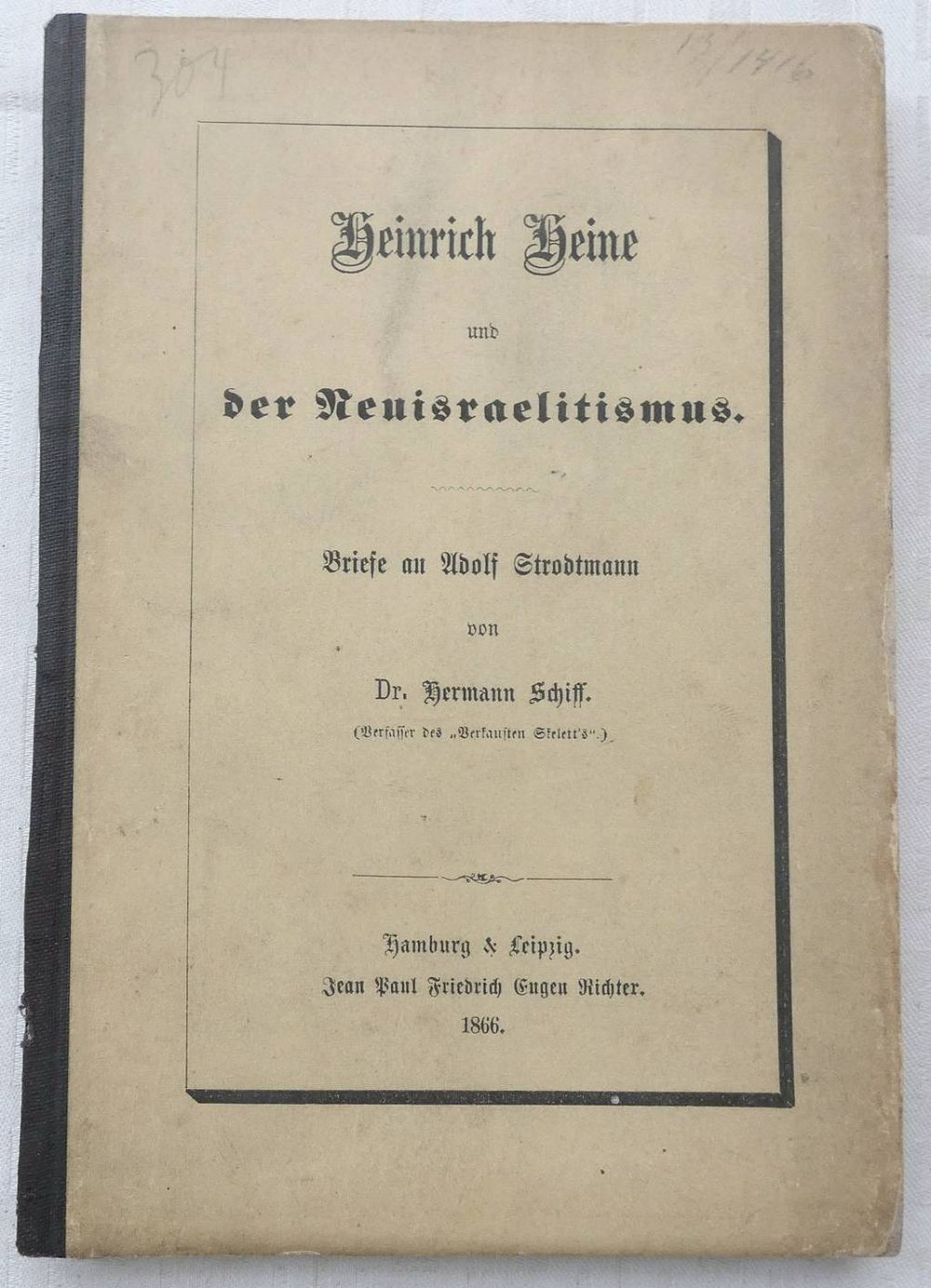
Heinrich Heine und der Neu-Israelitismus. Briefe an Adolf Strodmann von Hermann Schiff, 1st ed. 1866, in German - Heinrich Heine und der Neu-Israelitismus. Briefe an Adolf Strodmann von Hermann Schiff, 1st ed. 1866, in German Hamburg & Leipzig, Jean Paul Friedrich Engen Richter, 1866., 107 pp. not cut copy Hard cover, size: 18.5 x 13 cm. Condition: some wear, soiling and rubbing to cover’ yellow/ light brown paper to endpapers; very small damping stain near edge to several last pages. Weight: 170 gr. Schiff attempts to demonstrate that discussions about Heine cannot be reduced to either ”he's just a German poet” or ”he's just a Jewish author”—because his biography, the era of emancipation, and European stereotypes constantly intersect, and it is at this intersection that Heine's ”scandalous” image is born. The work is dedicated to Heinrich Heine and so-called ”neo-Israelitism”—a polemical concept of the mid-19th century. The format is letters to Adolf Strodtmann, a renowned publicist and publisher of Heine. The author is Hermann Schiff, a journalist and critic who actively participated in Jewish and literary debates of the 1860s. This polemical pamphlet takes the form of ”letters” (Briefe)—the author's addresses to Adolf Strodtmann (Heine's first major biographer). Schiff attempts to demonstrate that the discussion of Heine cannot be reduced to either ”he's just a German poet” or ”he's just a Jewish author”—because his biography, the era of emancipation, and European stereotypes constantly intersect, and it is at this intersection that Heine's ”scandalous” image is born. The author is Hermann Schiff (1801–1867), a German writer and publicist (incidentally, from Heine's circle/family). The book was published 10 years after Heine's death (1856) and hits the nerve of the era: debates rage about ”which Heine”—a German poet, a Jewish author, a ”renegade,” a ”baptized Jew”—and how to interpret the Jewish theme in his biography and texts. In the 19th century, the term ”Neuisraelitismus” was often used journalistically and polemically: as a label for the ”new Israelism” (new Jewish identity/self-organization/emancipation), sometimes with a hint of mockery or accusation. In Schiff, this is precisely the theme of the debate about Heine: to what extent does his Jewish origins, Jewish milieu, and the ”Jewish question” really influence his image, his writings, and their reception. This is not an ”academic treatise,” but a series of letter-essays: the author argues, clarifies facts, provides examples, and makes lyrical/sarcastic digressions—a typical genre of journalism of the 1860s. In terms of content (judging by the text and characteristic fragments), the sections are roughly as follows: Biographical framework and Heine's ”family-Jewish context” At the beginning, there are many genealogical/family details and ”what it was like in Jewish Hamburg” to show the milieu Heine came from (the text even mentions the family branches). Everyday life, religious norms, and social psychology of German Jews There are large sections where Schiff explains specific customs/norms (for example, about kashrut and the need for ”double” dishes, etc.)—not as an ethnographer, but as a journalist who wants to show the everyday and psychological ”friction” created by a traditional environment. The ”rupture/assimilation/border crossing” plot There are discussions of themes like religious marriage and divorce, and explanations of details like the arba-kanfot/tzitzit (the text explains the ”Arbekanfes” as an element of prescribed clothing/sign of the law). This is important for the author's thesis: the conflict between ”law/ritual” and modern life. Schiff discusses Heine's positions on art/literature (for example, his comments on artists, illustrations, etc.) and portrays Heine as a man who is simultaneously ironic and principled, ”too German-conscientious” in literature. There are polemical pages about the portrayal of Jews in the classics (The Merchant of Venice—Antonio, Bassanio, Shylock, and others—is directly examined), and the tone is harsh: the author attacks the moral roles of the characters and how the reader is accustomed to justifying them. (archive.org) This plays into the book's main theme: cultural stereotypes constantly surface around Heine and the ”Jewish question,” and they must be dealt with honestly. Hermann Schiff (geboren als David Baer Schiff 1. Mai 1801 in Hamburg; gestorben 1. April 1867 ebenda) war ein deutscher Schriftsteller. Hermann Schiff war ein Vetter Heinrich Heines. Nach seinem Philosophie-Studium in Goettingen, Berlin und Jena (mit Promotion 1825) beschaeftigte er sich mit Musik und Literatur. Er siedelte nach Leipzig über, wo er die Literaturzeitschrift Der Dichterspiegel redigierte. Danach zog er nach Berlin, wo er an verschiedenen Zeitschriften mitarbeitete. Im Jahr 1835 kehrte er nach Hamburg zurueck. Hier war er als Journalist taetig. Um den Lebensunterhalt zu bestreiten,