Bidspirit auction | Theodor Lessing “Hindenburg”, 1st ed.,
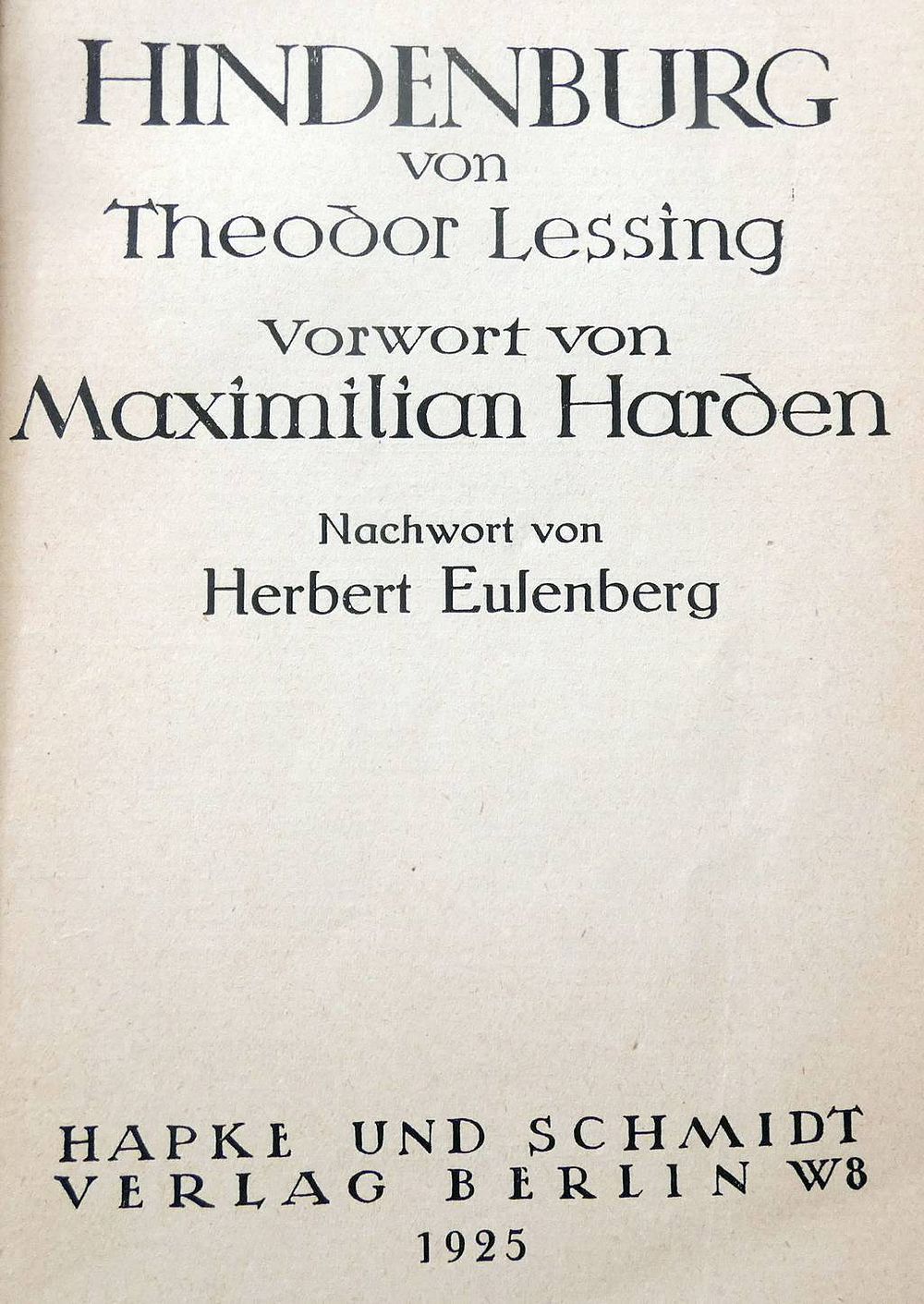
Theodor Lessing “Hindenburg”, 1st ed., 1925, In German, Berlin - Theodor Lessing “Hindenburg”, 1st ed., 1925, In German, Berlin Mit einem Vorwort von Maximilian Harden und einem Nachwort von Herbert Eulenberg. Berlin: Hapke und Schmidt, 1925. 39 Seiten, Soft cover, 21.2 x 14 cm. Condition: some wear, cracks; small tears to spine; yellow paper Karl Theodor Richard Lessing (8 February 1872 – 31 August 1933) was a German philosopher. He is known for opposing the rise of Hindenburg as president of the Weimar Republic and for his classic on Jewish self-hatred (Der jüdische Selbsthaß), a book which he published in 1930, three years before Adolf Hitler came to power, in which he tried to explain the phenomenon of Jewish intellectuals who incited antisemitism against the Jewish people and who regarded Judaism as the source of evil in the world. Lessing's political ideals, as well as his Zionism made him a very controversial person during the rise of Nazi Germany. He fled to Czechoslovakia where he lived in Marienbad in the villa of a local social democratic politician. On the night of 30 August 1933, he was assassinated by Sudeten German Nazi sympathizers. Lessing was shot through a window of the villa where he lived. His assassins were German Nazis from Sudetenland, Rudolf Max Eckert, Rudolf Zischka and Karl Hönl. They fled to Nazi Germany after the assassination Paul Ludwig Hans Anton von Beneckendorff und von Hindenburg[a] (2 October 1847 – 2 August 1934) was a German military officer and statesman who led the Imperial German Army during World War I and later became President of Germany from 1925 until his death in 1934. He played a key role in the Nazi seizure of power in 1933 through his appointment of Adolf Hitler as Chancellor of Germany. Maximilian Harden (born Felix Ernst Witkowski,[1] 20 October 1861 – 30 October 1927) was an influential German journalist and editor Born the son of a Jewish merchant in Berlin, he attended the Französisches Gymnasium until he began to train as an actor and joined a traveling theatre troupe. In 1878 Harden converted to Protestantism and started his journalistic career as a theatre critic in 1884. He also published political essays under the pseudonym Apostata in several liberal newspapers like the Berliner Tageblatt edited by Rudolf Mosse. Commencing from 1892, Harden published the journal Die Zukunft (The Future) [2] in Berlin. His baroque style was mocked by former friend Karl Kraus, who wrote a satire on ”translations from Harden Max Herbert Eulenberg (25 January, 1876–4 September, 1949), was a German poet and author born in Cologne-Mülheim, Germany. He was married from 1904 to Hedda Eulenberg.