Bidspirit auction | Die Moment-Photographie Dargestellt von Ludwig
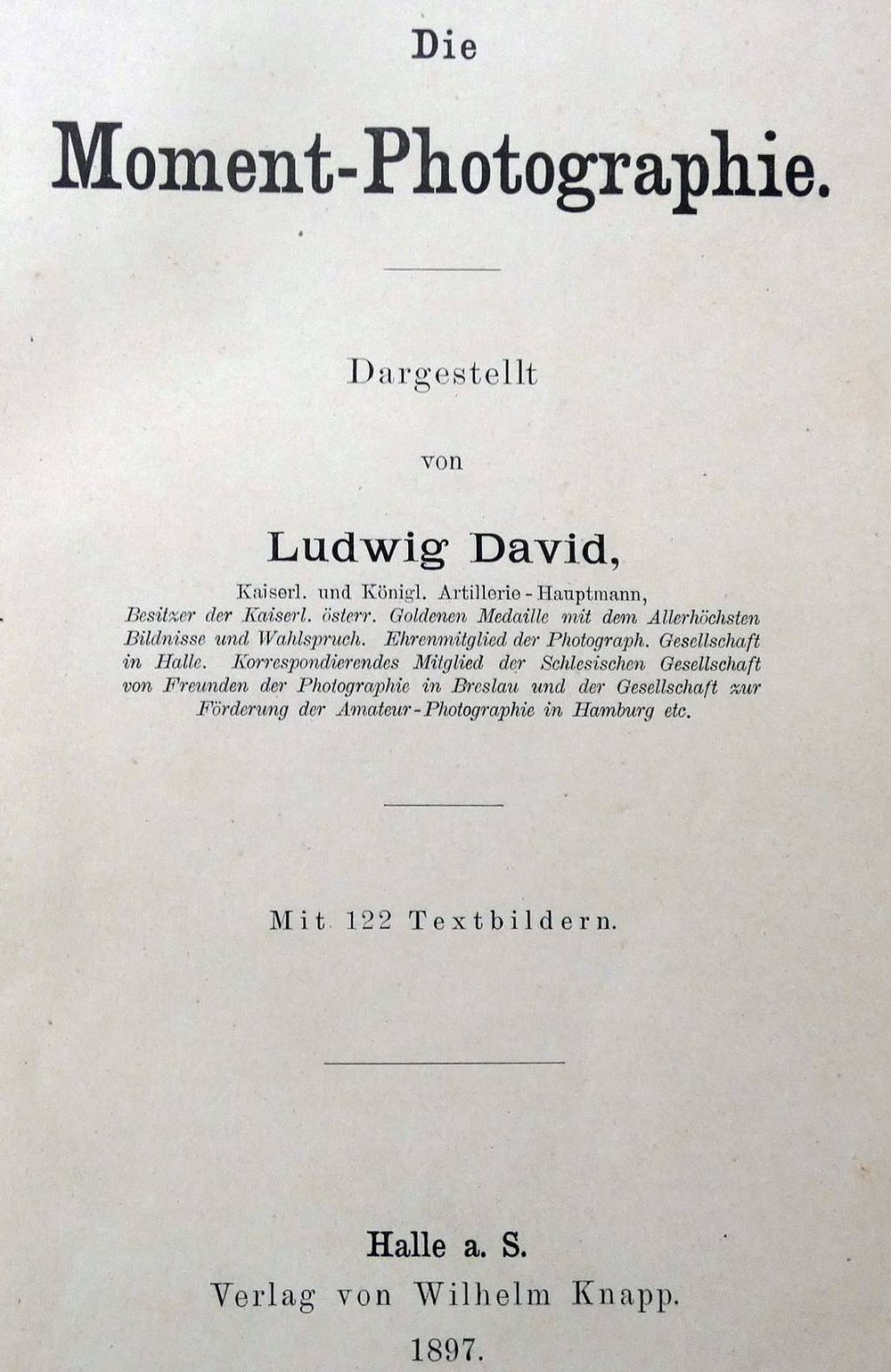
Die Moment-Photographie Dargestellt von Ludwig David, 1897, in German - Die Moment-Photographie Dargestellt von Ludwig David, 1897, in German Halle a. S., Verlag von Wilhelm Knapp, VIII, 241 Seiten, Mit 122 Textbildern Hard cover, size: 21 x 14 cm. Condition: some wear and rubbing to cover; tear to front hinge of spine; worm holes to rear cover and some worm holes to last half of pages. Weight: 560 gr. Ludwig David (1856–1930), Photographer, Phototechnician, and Officer David Ludwig, photographer, phototechnician, and officer. Born in Breslau, Prussia (Wrocław, Poland), March 5, 1856; died in Berlin (Germany), December 22, 1930. He attended the Gymnasium (grammar school) and the Higher Trade School in Breslau and became interested in physics and photochemistry at a young age. In 1881, he became a lieutenant in the field artillery in Vienna, pursued an officer's career in various garrisons throughout the Austro-Hungarian Empire, and in 1890 took over the leadership of the photographic department of the Technical Military Committee in Vienna, later commanding the 14th Field Howitzer Regiment. He left military service as a colonel in 1913 and received the rank of major general in 1917. Around 1882, he began taking photographs and in 1884/85 constructed a salon and travel camera, which was manufactured by the Viennese firm R. Lechner (Wilh. Müller). In 1890/91, he completed a course at the Graphic Arts Training and Research Institute in Vienna, where he focused on refining the gelatin emulsion process and perfecting instant photography. He achieved particular renown through the publication of what was then the most important ”Guide for Beginners in Photography and Aid for Advanced Photographers” in the German-speaking world (1890, later retitled ”Guide to Photography”), which reached a total circulation of 810,000 copies by 1931. He also explored technical and artistic aspects of photography and published works in these fields. In 1895, based on the experiences of the art photographer Hans Watzek, he developed a study camera for the 30 x 40 cm format. D. received several awards and was a member of numerous national and international societies, including the Photographic Society in Vienna from 1882, the Club of Amateur Photographers (later the Camera Club) in Vienna from its founding in 1887, and the Linked Ring in London from 1896. Between 1884 and 1912, his work was featured in over 40 exhibitions in Austria and other European countries. As an amateur, he photographed the countryside and its people, including during his travels in the Austrian lands, the Balkans, and later in Germany and the Netherlands. He also photographed military subjects in the areas where he was stationed or participated in maneuvers. D. initially worked primarily in a documentary style, but in the 1890s, his portraits and landscape and nature studies moved closer to pictorialism, with some of his photographs occasionally being produced as high-quality prints, particularly gum bichromate prints. His photographs were published in journals such as ”Anleitung zur Herstellung von Moment-Photographien” (Guide to Taking Snapshot Photographs), edited by Josef Maria Eder (2nd edition, 1887), ”Photographische Correspondenz” (1885ff.), ”Photographische Rundschau” (1887ff.), ”Wiener photographische Blätter” (1894ff.), ”Das Atelier des Photographen” (1896), and ”Photographisches Centralblatt” (1899ff.). D. was made a Knight of the Order of Franz Joseph in 1908 and a Knight of the Order of the Iron Crown, Third Class, in 1914.