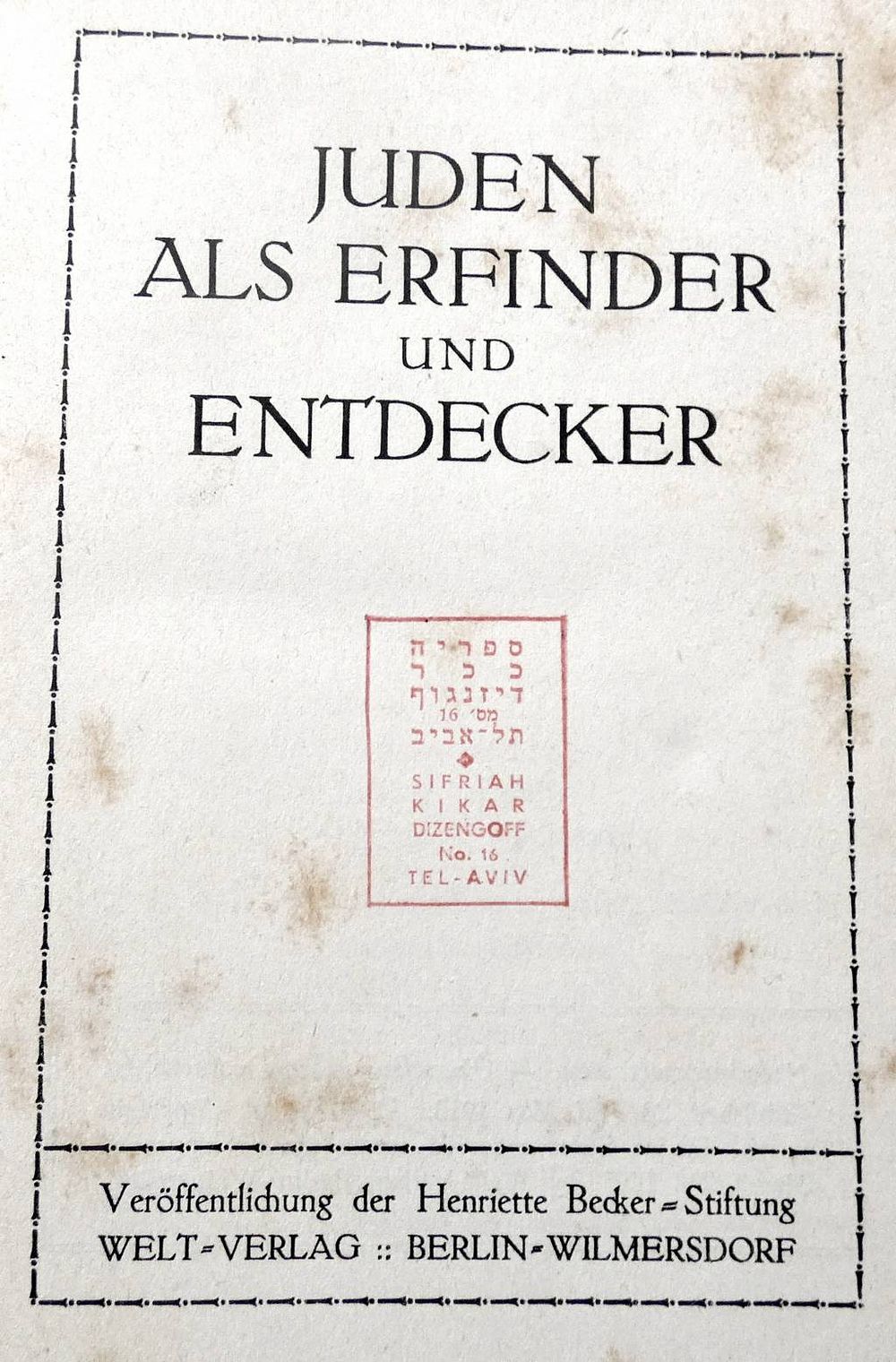
Bidspirit auction | Juden als Erfinder und Entdecker,
Juden als Erfinder und Entdecker, Vorwort von Nathan Birnbaum, illust., 1913, In German. - Juden als Erfinder und Entdecker, Vorwort von Nathan Birnbaum, illust., 1913, In German. Veroeffentlichung der Henriette Becker-Stiftung. Editor: Ernst Heppner Welt-Verlag, Berlin 1913. 126 pp., illustr. with many portraits Hard cover, Size: 24 x 16 cm. Condition: wear and rubbing to cover, corners bumped; many pages with foxing stains. Weight: 355 gr. Ernst Heppner (born September 4, 1891, in Koschmin, Province of Posen; died December 16, 1973, in Jerusalem) was a German physician. Ernst Heppner was the son of a district rabbi with a doctorate. He studied medicine at the universities of Munich, Berlin, and Heidelberg. With the outbreak of the First World War, he interrupted his studies and served as a volunteer in Berlin, including as a physician in military hospitals. He then completed his medical studies at the University of Berlin in 1915, receiving his medical license. In 1918, Heppner became a senior physician. He completed surgical training at several hospitals, including as an assistant physician at the Jewish Hospital in Berlin. In 1919, Heppner married and moved to Hamburg. He received his doctorate from the University of Hamburg that same year. In 1921, he obtained a position as an assistant to Hermann Kümmell in the First Surgical Department of the Hamburg-Eppendorf Hospital. At the University of Hamburg, he worked as the first assistant at the Institute of Anatomy. He obtained another position at the Jerusalem Deaconess House, where he worked as a gynecologist until 1923. In 1924, Heppner completed his medical training. He established his own practice in Eppendorf as a specialist in surgery and gynecology. The practice was located at Lenhartzstraße 1. In 1928, he purchased the practice of Dr. Ludwig Seeligmann, located at Esplanade 88. In the same year, he was approved as a gynecologist by the local health insurance fund and received an offer to purchase a building plot in Wandsbek-Marienthal. Heppner accepted the offer and moved there in 1929 with his wife and three children. The house was located at Rennbahnstraße 48, now Bovestraße 44. Due to the success of his practice, Heppner opened a second branch. This medical practice in Wandsbek was located at Schloßstraße 32. Due to the boycott of Jewish businesses, members of the SA placed a poster in the front garden of Heppner's house on April 1, 1933. ”Don't entrust German health to Jewish doctors!” it read. Heppner demanded permission to photograph the poster, an unusually courageous act. The resulting photograph, now privately owned, is considered unique in Hamburg. Because he was classified as a ”non-Aryan,” Heppner's license to practice under the national health insurance system was revoked two months later. Until then, Heppner's private practice had been frequently visited by the wives of high-ranking civil servants. Since government offices were instructed not to pay bills from Jewish doctors, Heppner lost another important source of income. As his earnings were no longer sufficient to support himself, Heppner was forced to sell his household goods, which consisted of valuable furniture, carpets, and an art collection, at a loss. The family's house and property were auctioned off two months later. In February 1934, Ernst Heppner, his wife, and children had to leave their home in Marienthal. They moved into a small apartment at Hansastraße 38. The doctor saw only a few patients there. Heppner had already become involved with Zionism in the 1920s and had traveled to Palestine with his wife. Due to the difficult situation, he intensified his efforts to emigrate there. However, he lacked sufficient funds to obtain an entry certificate. Heppner also still owed taxes. The tax office eventually granted Heppner a loan. After the Jewish Agency for Israel issued a free ”certificate of honor” and Heppner's father financially supported the project, the family was able to leave Hamburg in September 1934. Emigration and Temporary Return to Germany The family moved to Jerusalem. Ernst Heppner opened a small practice there in a two-room apartment. However, his income was insufficient to support his family. Heppner therefore worked temporarily as a doctor on ships traveling between Haifa and Trieste. He also practiced in several hospitals. Heppner's wife took on household chores and kitchen duties while he cared for the children. She thus made a significant contribution to the family's livelihood. Even in Germany, Ernst Heppner suffered from mental health problems due to the persecution of Jews. Because the family's situation in Jerusalem was constantly tense, Heppner developed depression. In 1939/40, he went to Belgium. There, he obtained forged documents to enable his sister and her family to leave Germany. Heppner's financial situation improved in 1945/46. However,