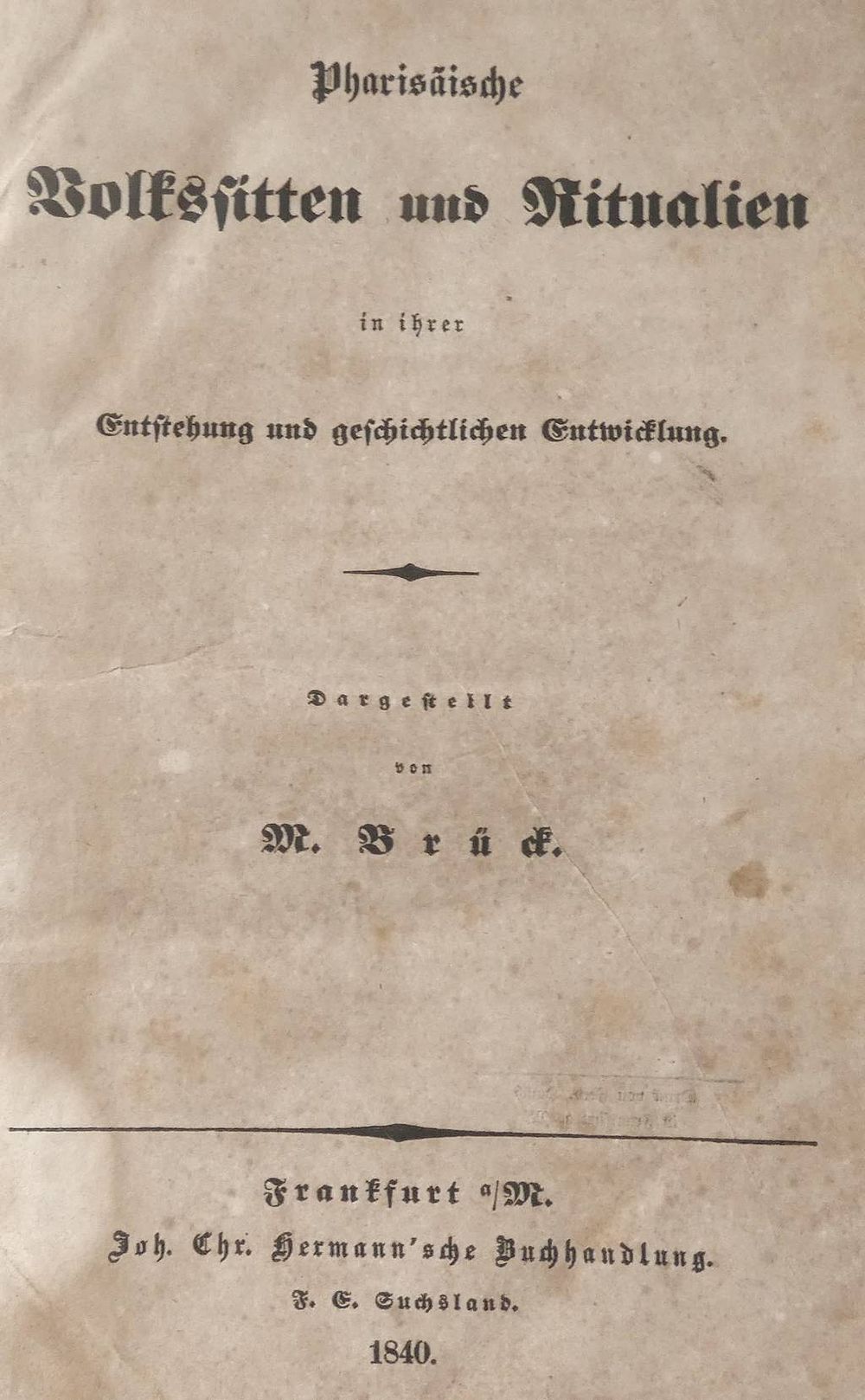
Bidspirit auction | Pharisaeische Volkssitten und Ritualien in
Pharisaeische Volkssitten und Ritualien in ihrer Entstehung und geschichtlichen Entwicklung von Moses Brueck, 1840, in German - Pharisaeische Volkssitten und Ritualien in ihrer Entstehung und geschichtlichen Entwicklung von Moses Brueck, 1840, in German Frankfur a.M., Joh. Chr. Hermann, 1840., 162 pp. Half leather hard cover, size: 20 x 13 cm. Condition: some wear to cover, rubbing to edges and spine; pages 7-10 repaired to front edge, text a bit affected; dark and damping stains to all pages. Weight: 185 gr. Moses Brueck, Hungarian theological writer; born about 1812 in Prerau, Moravia; died in 1849. He studied at Prague, and, as he could find no position as tutor in Moravia, went to Hungary. On the outbreak of the Revolution of 1848 he enlisted in Gross-Becskerek on the side of Hungarian independence, became a Honvéd officer, died at Hód-Mezö-Vásárhely, and was buried with full military honors in the Jewish cemetery there. Bruck was one of the most enthusiastic supporters of the Reform movement, and was among the pioneers of modern Jewish theological literature. He wrote ”Die Reform des Judenthums”; but especially his ”Rabbinische Ceremonialgebräuche” and ”Pharisäische Volkssitten und Ritualien” are of great value to the student of Jewish customs and practises, and were favorably criticized by Geiger (”Wissenschaftliche Zeitschrift,” iii. 426) and Fürst (”Allg. Zeit. des Judenthums,” i. 324), and were widely read. ”Pharisaic Folk Customs and Rituals in Their Origin and Historical Development” is the title of a historical work by Moses Brück from 1840. It illuminates the origin and historical development of Jewish traditions and customs, particularly those of the Pharisees, which laid the foundations of modern rabbinic Judaism, from oral tradition through the Mishnah to later texts. The work explains how these traditions evolved from daily life and religious obligations. Key points of the work and its subject: Origin: The book explains that many rituals do not originate directly from the Torah but developed over time from the interpretation and application of the laws (Halacha). Pharisees: They were an influential Jewish group during the Second Temple period who believed in the resurrection of the dead and the existence of spirits, and who emphasized the importance of oral tradition. Oral Tradition (Torah Shebe'alpeh): Brück illuminates how these oral laws and customs (e.g., dietary laws, prayer times, Sabbath rules) were passed down from generation to generation and played a central role in daily life. Development: The collection and codification of these traditions later led to the Mishnah (c. 200 CE) and the Talmud, making Pharisaic customs the fundamental pillars of rabbinic Judaism. Examples of Rituals: The work examines practices such as circumcision (Berit milah) and other everyday religious customs that arose from the beliefs and lives of the Pharisees. In summary, the aim is to understand the deep historical roots of Jewish popular piety, which was significantly shaped by the Pharisees and continues to influence religious life today.