Bidspirit auction | Adalbert Stifter “Abdias”. Eine Erzaehlung,
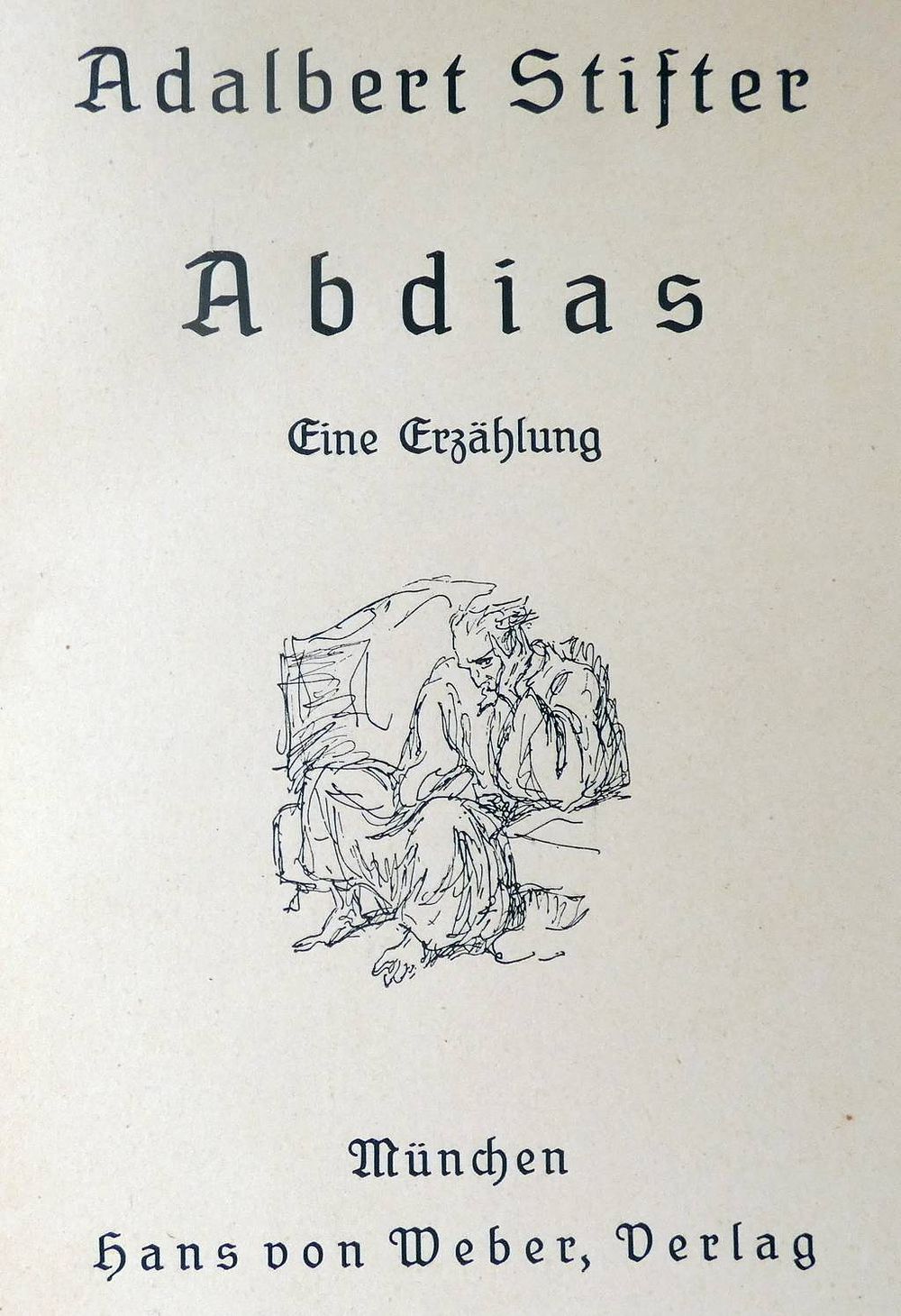
Adalbert Stifter “Abdias”. Eine Erzaehlung, illustr. Franz Kolbrand, 1923, in German - Adalbert Stifter “Abdias”. Eine Erzaehlung, illustr. Franz Kolbrand, 1/650, 1923, in German Muenchen; Hans von Weber, 1923., 127 pp., Urzinkzeichnungen von Franz Kolbrand (Original zinc drawings) limited edition of 650 copies Hardcover, size: 25.5 x 18 cm. Condition: cover worn, rubbed, stained; spine damaged but binding still tight; minor stains. Weight: 560 gr. Als 18. Dreiangeldruck wurde ”Abdias” mit Urzinkzeichnungen von Franz Kolbrand bei der Verlagsanstalt vorm. G. J. Manz, A. G. in München in einer Auflage von 650 Exemplaren gedruckt. Adalbert Stifter (German: [ˈʃtɪftɐ]; 23 October 1805 – 28 January 1868) was a Bohemian-Austrian writer, poet, painter, and pedagogue. He was notable for the vivid natural landscapes depicted in his writing and has long been popular in the German-speaking world. Franz Xaver Kolbrand (born April 20, 1892, in Eichstätt; died December 18, 1952, in Berlin-Zehlendorf) was a German graphic artist, designer, poster artist, and, above all, book illustrator. His parents were the gunsmith and mechanic Franz Kolbrand (senior) and his wife Wilhelmine, née Schwarzbeck. His father built the first high-wheel bicycle in Eichstätt in 1880, based on his own designs. After attending elementary school and six years of the humanistic gymnasium in Eichstätt, he enrolled at the Academy of Fine Arts in Munich in May 1912, where he studied under Friedrich Wirnhier, Maximilian Dasio, and Robert Engels. As early as the following year, 1913, he was allowed to create illustrations for a book for the first time. After the outbreak of the First World War, Kolbrand was drafted in November 1914 and sent to the front, where he suffered a gunshot wound to the lung. After being drafted again in April 1916, he was severely wounded once more in the Vosges Mountains. He was then employed as a secret draftsman with the 6th Army High Command (AOK 6). After the war, he quickly became a highly regarded book illustrator, particularly working for the renowned Munich publisher Hans von Weber. Around 1921, he also provided designs for toys, which were produced by the inmates of the Rebdorf workhouse, the former Augustinian Canons' monastery near Eichstätt. Other works, most of which were destroyed in their original form during the Second World War, included, with regard to his hometown, the design of an Eichstätt coin in 1922, the design for a war memorial in Mühlheim in 1924, the coat of arms design for the Eichstätt university professor Matthias Ehrenfried in 1924, and the creation of the memorial plaque for the fallen at the former teacher training college in Eichstätt in 1926. In 1925, he moved to Weihenstephan, where he founded a school for floral design and, from 1926, directed the advanced courses in floral design. In 1926, he was awarded first prize in a coin design competition held by the Reich Ministry of Finance. After 1928, he moved to Berlin. Here, he was able to fully develop his artistic talents. Although he never became politically active, he was entrusted with the artistic direction of international congresses and contributed artistically to the 1936 Olympic Games. He was also a sought-after lecturer and wrote for specialist journals. His first major work—adorned with his own drawings—was published in 1937 by the Reichsnährstand publishing house in Berlin under the title ”Greenery and Floral Decorations: Customs, Festival Design, and Festive Decorations.” In 1940, Kolbrand was appointed by the German Adult Education Association in Berlin to organize the ”Layman's Arts” program for the Wehrmacht. He was responsible for establishing guidelines for corresponding courses for the German military stationed in Norway, recruiting suitable instructors, and procuring teaching materials, including for the preparation of an exhibition entitled ”Layman's Arts of German Soldiers” in Norway. During these years, he traveled to Denmark, Sweden, Norway, Lapland, Finland, Lithuania, Poland, and Russia. In postwar Berlin, he became a set designer at the ”Little Theatre” in Berlin-Zehlendorf and worked for an architectural firm, to which he supplied hundreds of designs; this likely explains the occasional, incorrect claim that he was an architect. One of his last major undertakings was a study trip across France. In 1952, the year of his death, his second and last major work, ”Europa windet den Kranz” (Europe Weaves the Wreath), a historical treatise on European floristry, was published and has been reprinted numerous times since. His works from the 1930s and 40s, representing the majority of his life's work, were lost in their original form during the turmoil of war and its immediate aftermath. His illustrated works fetch considerable prices in the antiquarian book market, attesting to the continued appreciation of his graphic work. The estate of Franz Kolbrand was bequeathed to the Historical Society of Eichstätt.