Bidspirit auction | Salomon Plessner “Sabbath Predigten fuer
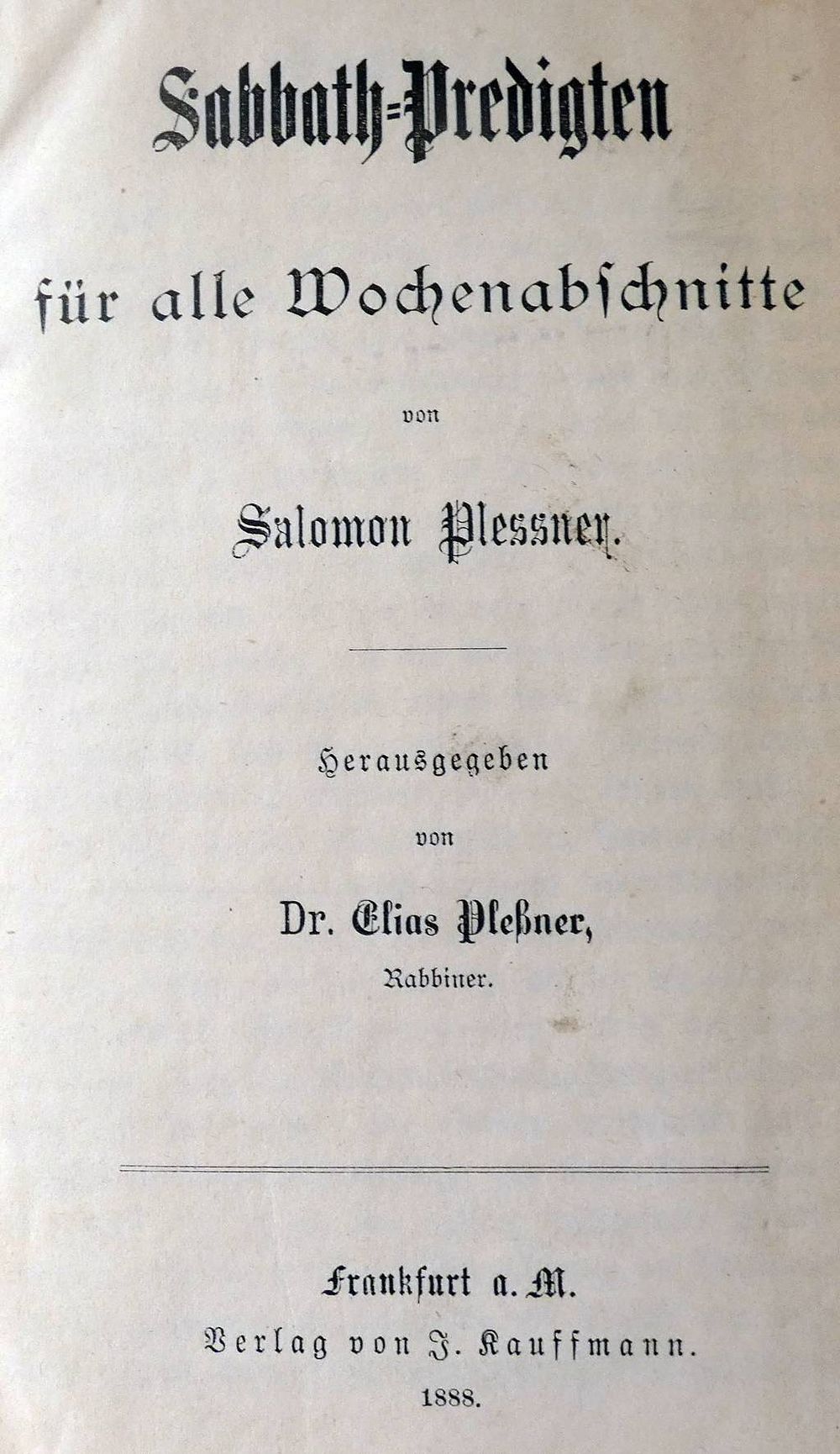
Salomon Plessner “Sabbath Predigten fuer alle Wochenabschnitte”, 1st ed., 1888, in German - Salomon Plessner “Sabbath Predigten fuer alle Wochenabschnitte”, 1st ed., 1888, in German an Hebrew Herausgegeben von Dr. Rabbiner Elias Plessner Nachgelassene Schriften von Salomon Pleßner. Erster Band: Predigten. Frankfurt a.M., Verlag von I. Kauffmann, IV, 734 pp. 1888. Hard calico cover, size: 23 x 15 cm. Condition: some wear to cover, rubbing to edges; some stains to edges, first pages and some other pages; damping to upper front edge. Salomon Plessner (23 April 1797 – 28 August 1883) was a German Jewish translator and maggid. Salomon Plessner was born in Breslau to Rabbi Yehuda Plesner, who died when Salomon was young. Having to support his mother and himself, Plessner engaged in business, but found time to study Hebrew, rabbinics, and German, under Wessely's influence. He published in 1819 a Hebrew translation of the Apocryphal additions to the Book of Esther, under the title Hosafah li-Megillat Ester, with a literary-historical introduction. Elias Plessner (born February 19, 1841, in Berlin; died March 30, 1898, in Ostrów) was a doctor, philosopher, and Jewish scholar. The son of the Jewish religious writer Salomon Plessner, he was a student of the Greater Poland tzaddik Elias Guttmacher. From 1867, he studied philosophy at the University of Berlin. He received his doctorate in 1870 from the University of Tübingen. From 1871 to 1872, he completed his rabbinical internship in Hanover, and from 1873 to 1885, he was rabbi in Rogoźno. In 1885, he succeeded Israel Meir Freimann as rabbi in Ostrów. From 1886, he taught Jewish studies at the Royal Gymnasium in Ostrów. At the same time, he also taught at a Jewish elementary school. In 1887, he co-founded the Ostrów Jewish Society of History and Literature. Author of works in the field of Jewish studies, including Stellung und Bedeutung der Frau bei den Hebraeern (The Position and Significance of Women among the Hebrews), Der Grabstein in seiner höheren Bedeutung (The Significance of Tombstones), and numerous works in Hebrew. He was an extremely respected figure. His funeral in Ostrów attracted many figures of various faiths. Among the distinguished rabbis who spoke at the mourning house, the new synagogue, and the now-defunct cemetery were Rabbi Landau of Raszków, Dr. Münz of Kępno, Dr. Bamberger of Ostrzeszów, Dr. Aron Heppner of Koźmin, Dr. Berger of Krotoszyn, Dr. Hirschfeld of Giessen, Dr. Bamberger of Śrem, and Dr. Auerbach of Rogoźno. Also present were a delegation from the Rogoźno community, the mayor of Ostrów, the Ostrów County Landrat, and the leader of the Ostrów Evangelicals, Pastor Berthold Harhausen.