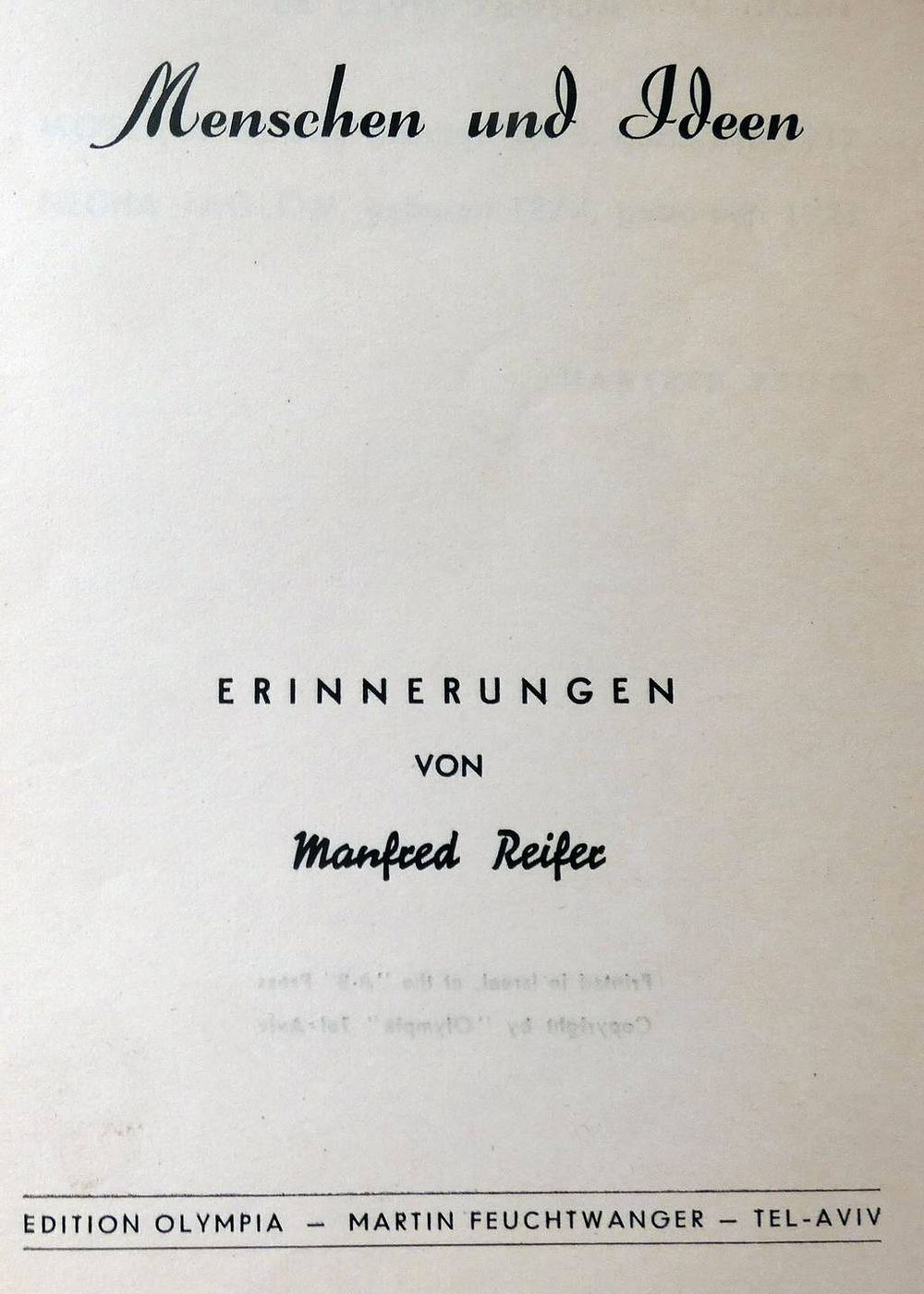
Bidspirit auction | Manfred Reifer “Menschen und Ideen.
Manfred Reifer “Menschen und Ideen. Erinnerungen”, illustr., 1st ed., ca. 1952, in German - Manfred Reifer “Menschen und Ideen. Erinnerungen”, illustr., 1st ed., ca. 1952, in German Tel-Aviv, Edition Olympia, ca.1953., 399 S. Erste Ausgabe. Dedication on front endpaper, 1952. Soft cover, 21 x 14.5 cm. Condition: covers detached, chipped to edges; spine is missing; binding is loose, detached to 3 blocks; light brown paper to endpapers; inside pages clean Weight: 470 gr. Manfred Reifer (German: Manfred Reifer; January 3, 1888 – March 21, 1952) was an Israeli journalist, writer, historian, and politician born in the Austro-Hungarian Empire. Reifer was born on January 3, 1888[1] to a religious Jewish family in the village of Banylib-Pydhirny in Bukovina, Ukraine, then part of the Austro-Hungarian Empire, and later moved to Chernivtsi. He grew up in a predominantly Yiddish- and Ukrainian-speaking environment. However, he published most of his writings in German, the spoken language of the educated Jews of Bukovina.[2] During World War I he served in the Austro-Hungarian army.[3] In 1921, he was elected to represent the Jews of Bukovina, along with Meir Avner and Rabbi Jacob Hoffman, at the 12th World Zionist Congress.[4] In 1926 he founded the weekly ”Neue Jüdische Rundschau” (German: ”New Jewish Review”).[2] In 1931 he was elected to the Romanian Parliament on behalf of the Romanian Jewish Party, and served in that position until 1932. In 1941, with the Soviet takeover of Bukovina, he was saved from the deportation of the Zionist activists in Bukovina to Siberia. Reifer suffered from a heart condition, and the authorities considered his health. After the Kingdom of Romania reconquered the region as part of Operation Barbarossa, Reifer was saved again. He was not sent to Transnistria, where the Jews from Bukovina and Bessarabia were deported, due to the same heart condition from which he suffered.[3] In 1942 he founded an aid fund for Jews deported to Siberia.[5] In 1943 he left Czernowitz for Bucharest, and in April 1944 he immigrated to Israel via Turkey.[6] He settled in Tel Aviv, where he died on March 21, 1952.