Bidspirit auction | Der Sohar Das heilige Buch
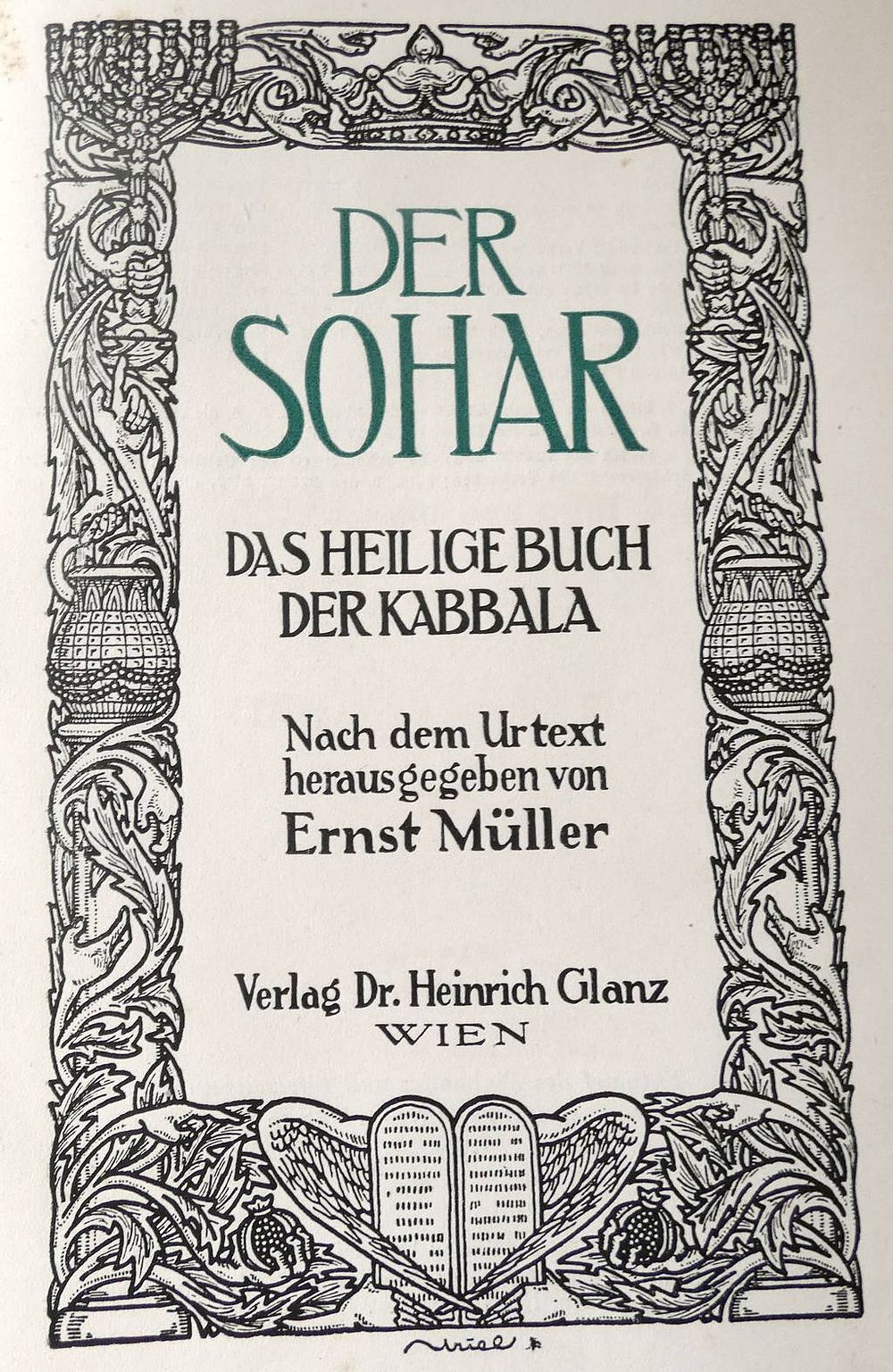
Der Sohar Das heilige Buch Der Kabbala, ed. Ernst Mueller, Holocaust survivor, Illust. by Uriel Birnbaum, Holocaust survivor, 1932, in German - Der Sohar Das heilige Buch Der Kabbala, ed. Ernst Mueller, Holocaust survivor, Illust. by Uriel Birnbaum, Holocaust survivor, 1932, in German Nach dem Urtext herausgegeben von Ernst Mueller, Der Sohar (Sefer ha-Zohar). Das heilige Buch Der Kabbala. Wien, Verlag Dr. Heinrich Glanz, 1932., 394, XI pp., Mit Titelzeichnung, 1 Tafel und Entwurf des Einbandes von Uriel Birnbaum. Original hard cover linen binding with gold-stamped cover vignette, gilt spine and colored top edge, size: 25 x 17.5 cm. Condition: covers started getting loose; spine damaged; tears to hinges of spine, repair strips near spine of endpapers.; some small foxing stains to endpapers Weight: 960 gr. Ernst Mueller (born November 21, 1880, in Mißlitz, Austria-Hungary; died August 5, 1954, in London) was an Austrian Zionist and anthroposophist. Müller was the son of Johanna Müller, née Brüll (1848–1922)[1] and the country doctor Isidor Israel Müller (1834–1915). Both of his grandparents' families were rabbis. He grew up with his two siblings, Clara and Edmund Müller, as the youngest son in a Jewish household.[2] Raised in his native Moravia, Müller wrote for Jewish newspapers as a schoolboy, advocating for Zionism. In 1897, he first met Theodor Herzl in Brno. In 1898, Müller's family moved to Vienna, where he began his studies and met Martin Buber in 1900. From then on, Müller wrote regularly for Die Welt, the Zionist central organ edited by Buber. At the age of 23, Müller became editor of the Zionist youth magazine Unsere Hoffnung (Our Hope). It was during this time that he met Hugo Bergmann—a classmate and friend of Franz Kafka—who later became a professor of philosophy and rector of the Hebrew University of Jerusalem.[3] After receiving his doctorate in philosophy in 1905 (dissertation: Problems of Consciousness[4]), he worked as a teacher in various locations, from 1907 in Palestine. A bout of malaria forced him to return to Vienna in 1909, where he joined the Theosophical Society, later the Anthroposophical Society, that same year, remaining affiliated with it until his death. In 1910, he met Rudolf Steiner in person, who advised him to take a position in a library. From 1911 onward, Müller worked in the library of the Jewish Community of Vienna, ultimately as its deputy director. His interests were wide-ranging: from Kabbalah, to which he dedicated his first book publications after the First World War, to music and mathematics, and even his own poetic endeavors. Throughout his life, Müller published in a wide variety of journals,[5] gave lectures and courses in Jewish and anthroposophical contexts, was involved in Christian-Jewish dialogue, and wrote numerous articles for the Jewish Encyclopedia.[6] He also worked as a translator: for example, his translations of poems by Chaim Nachman Bialik[7] and his translation of parts of the Zohar, which continues to be reprinted today, were published. He lived in Vienna and, after his emigration in 1939, in London, where he wrote one last book. From 1941 onward, he was married to Frieda Schorr (1900–1995[8]). The estate is in the archives of the Leo Baeck Institute New York Uriel Birnbaum (November 13, 1894, in Vienna − December 9, 1956, in Amersfoort, Netherlands) was an Austrian painter, caricaturist, writer and poet. Birnbaum was the youngest son of Nathan Birnbaum, a Jewish philosopher, and Rosa Korngut. Reportedly, his art education consisted of only one month at a Berlin art school in 1913.[1] He served in the Austro-Hungarian Common Army during World War I as a lieutenant in the k.u.k. Feldjäger Battalion No. 17,[2] and was severely injured during the Eleventh Battle of the Isonzo[3][4] where he completely lost one foot, and ”shattered” the other;[3] he used a wheelchair thereafter. He illustrated a number of books, including works of Edgar Allan Poe, Lewis Carroll's Through the Looking-Glass (Alice in the Looking Glass, Vienna, 1923), and his own Weltuntergang[5] (1921). Birnbaum survived the Nazi period at first due to the special status conferred to him by his non-Jewish wife (the Nazi concept of Schutze Mischehe, ”protected mix-race marriage”; German article here), and then by going into hiding from 1943 until the end of the war in 1945.