Bidspirit auction | Biblische Poesieen von Christoph Hoffmann,
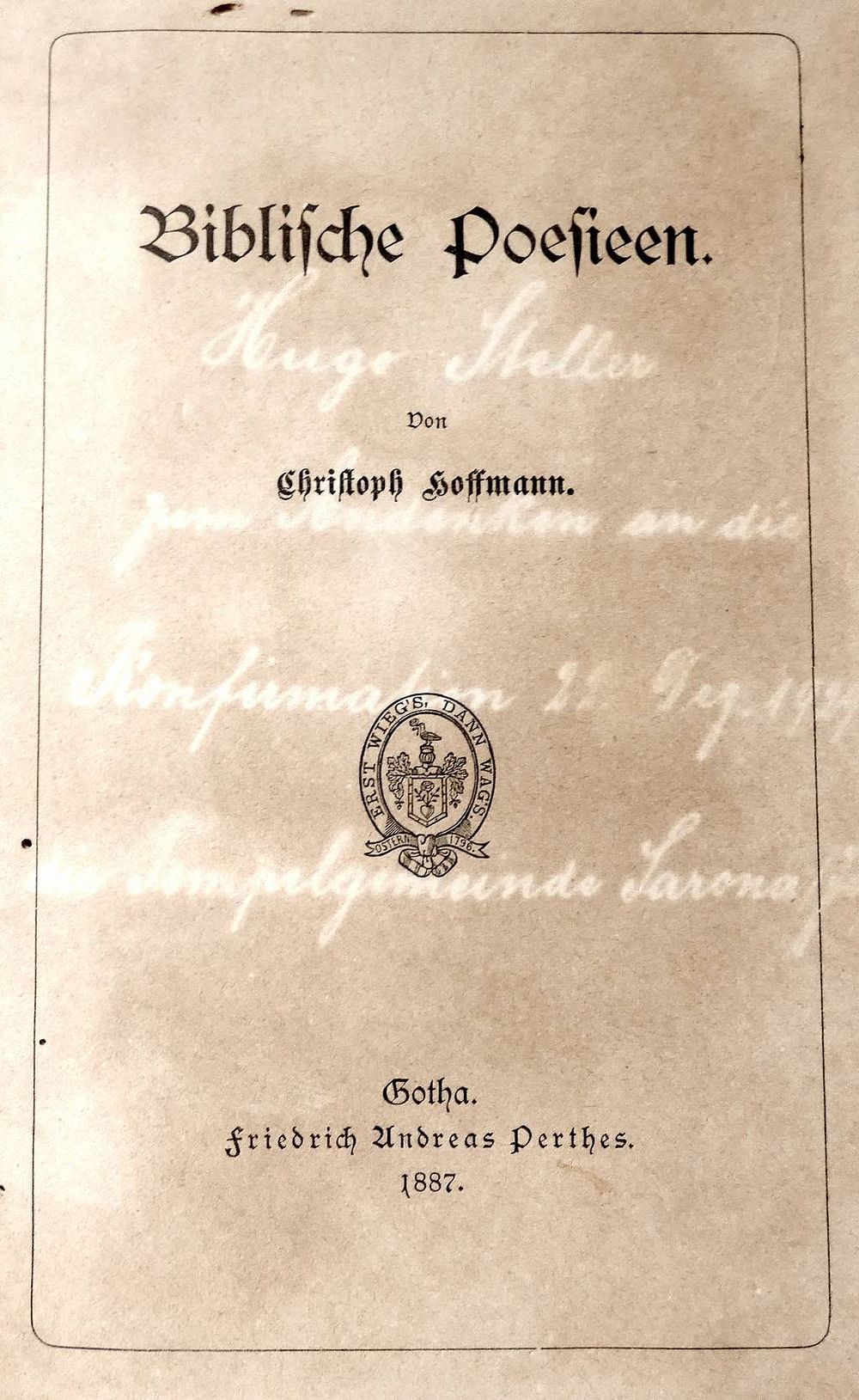
Biblische Poesieen von Christoph Hoffmann, 1887, in German, dedication. - Biblische Poesieen von Christoph Hoffmann, 1887, in German, dedication. Gotha, Friedrich Andreas Perthes, 1887, 117 pp. Dedication in German on front endpaper: Hugo Steller zum Andenken an die Konfirmation 22. Dez. 1929. Die Tempelgemeinde Sarona Jaffa. Hugo Steller in remembrance of the confirmation, December 22, 1929. The Temple Congregation of Sarona Jaffa. (Palestina) Hard calico cover, size: 21.5 x 14 cm. Condition: some wear, staining worm holes to cover; several worm holes to all pages; some foxing stains; yellow paper Weight: 230 gr. Sarona (Hebrew: שָׁרוֹנָה) is a neighborhood of Tel Aviv, Israel[1] which started as a German Templer colony in Ottoman Palestine in 1871.[2] It was one of the earliest modern villages established by Europeans in Ottoman Palestine. In July 1941, the British Mandate authorities deported 188 residents of Sarona, who were considered ardent Nazi sympathisers.[3] By the 2000s, the area had fallen into disrepair and was a haven for drug users. However, since 2003, the area has undergone massive renovation, which involved moving and relocating historical buildings before their restoration. The area is now a popular shopping district, as well as home to museums, cultural artifacts centering on its history, and IDF complexes Gottlob Christoph Jonathan Hoffmann (December 2, 1815 – December 8, 1885) was born in Leonberg in the Kingdom of Wuerttemberg, Germany. His parents were Beate Baumann (1774–1852) and Gottlieb Wilhelm Hoffmann (1771–1846), who was chairman of the Unitas Fratrum congregation in Korntal. Gottlieb's theological thinking was inspired by reading the works of Johann Albrecht Bengel, whose studies had led him to the conclusion that Christ would return in 1836. Christoph Hoffmann had a Pietist-Christian background and enjoyed a Christian education with the Brethren congregation in Korntal. As a young man he studied theology in Tübingen. An opponent of the much better known liberal theologian David Friedrich Strauss, Hoffmann was elected to the First National German Parliament, which met in Frankfurt am Main in 1848. The failure of his efforts to create a better Christian State through politics caused him to return to the roots of Christianity as expressed by Jesus. He became convinced that Jesus had been called for a radical change of attitude in people. The better state of being after such a change of attitude he saw as the Kingdom of God which was to be established. To this end he applied for the position of a missionary inspector with the Protestant St. Chrischona Pilgrim Mission of Basel in 1853, but left the position after two years. Hoffmann dedicated his life to collecting people striving for such a ”kingdom” and setting up communities in which their striving would express itself in daily life. Initially (1854) known as the Friends of Jerusalem, the group in June 1861 formed itself into an independent Christian religious organization known as Deutscher Tempel, its members identified themselves as Templars. In 1868 the Templars began to create settlements in Palestine. The Templars could buy in Jaffa some houses and land from failed colonists around George Adams, returning to the US in 1869. On 5 March 1869 also Peter Martin Metzler, a missionary of St. Chrischona and personal acquaintance of Hoffmann from his times at the Pilgrims' Mission, sold his Jaffa-based mission station, including an infirmary and most of his real estate and other enterprises to the new colonists, before he left Jaffa. While the Lutheran Evangelical State Church in Württemberg condemned and fought the Templars as apostates, the Prussian position was somewhat milder. Their settlement in the Holy Land found a warm support through Wilhelm Hoffmann (*1806–1873*), who was no apostate from the official church, like his younger brother Christoph.[4] Wilhelm Hoffmann served as one of the royal Prussian court preachers at the Supreme Parish and Collegiate Church in Berlin and was a co-founder and first president of Jerusalem's Association (German: Jerusalemsverein), a charitable organization founded on 2 December 1852 to support Samuel Gobat's effort as bishop of the Anglo-Prussian Bishopric of Jerusalem.[5] Between 1866 and 1869 Wilhelm Hoffmann dispatched his son Carl Hoffmann (1836–1903) as pastor of the German Protestant congregation of Jerusalem. Hoffmann fell out with the Temple Society's co-leader Georg David Hardegg (*1812–1879*), so that in June 1874 the Temple denomination underwent a schism with Hardegg and about a third of the Templars seceding from the Temple Society and later mostly returning to an official German Protestant church body.[6] Hoffmann died in the Templar settlement Rephaim near Jerusalem on December 8, 1885. Hoffmann's literary output focuses on his vision of a New Jerusalem,