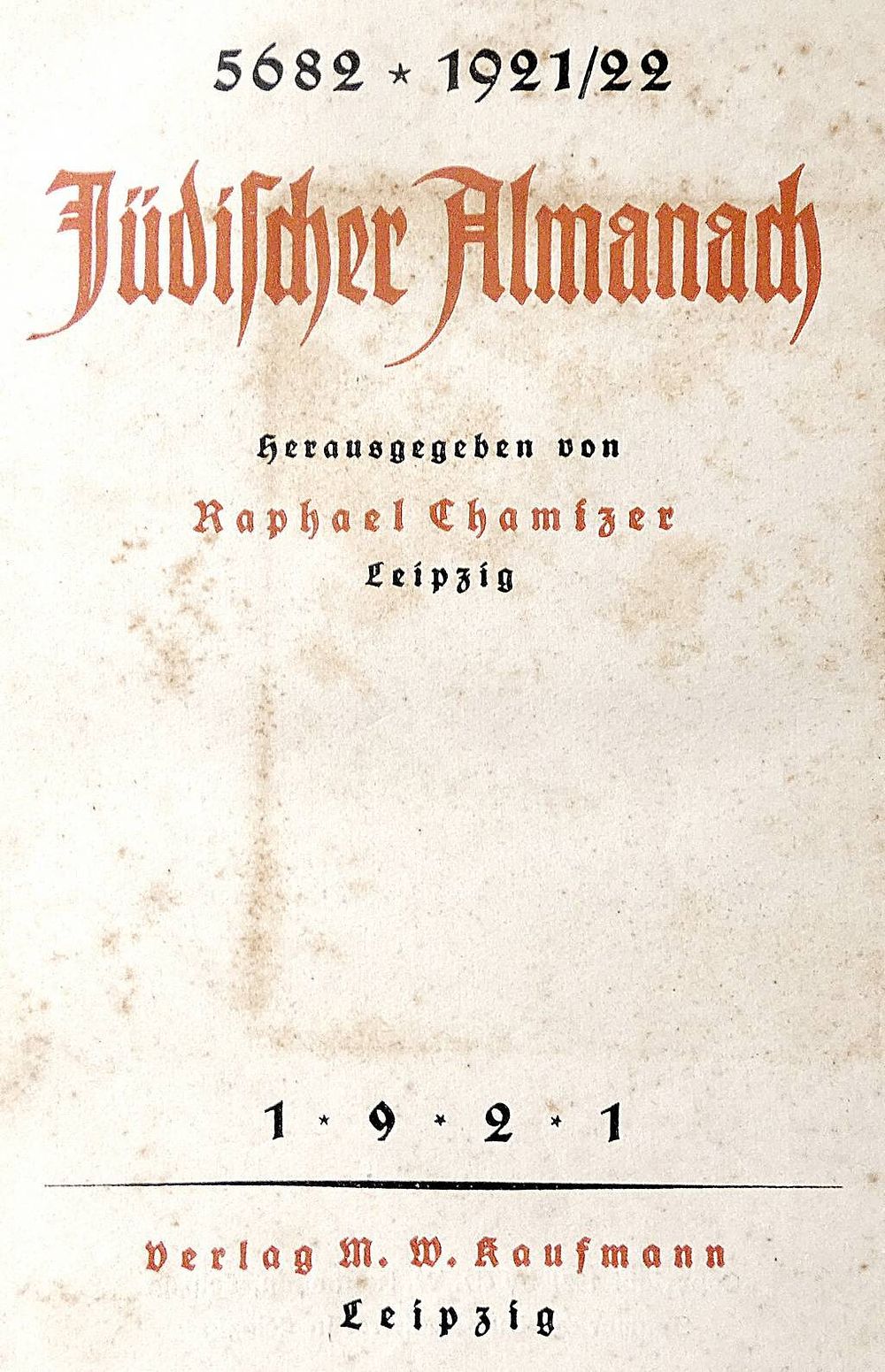
Bidspirit auction | Judischer Almanach. Ed. Raphael Chamizer,
Judischer Almanach. Ed. Raphael Chamizer, Holocaust Survivor, illust., 1921, in German - Judischer Almanach. 5682 1921/ 1922, Ed. Raphael Chamizer, Holocaust Survivor, illust., 1921, in German Leipzig Kaufmann, 1921. 308 S. illustrated by book decorations, facsimile of H. Heine, 10 pages Inscriptions in Hebrew on front (dedication) and rear endpapers Hard cover, size: 17 x 13 cm. Condition: cover worn, rubbed, stained; spine damaged – tears, rubbing; many pages with foxing stains. Weight: 350 gr. Raphael Chamizer (born March 10, 1882, in Leipzig; died October 28, 1957, in Tel Aviv) was a German-Israeli physician, illustrator, and sculptor. Raphael Chamizer was born on March 10, 1882, into a Jewish family in Leipzig, the son of the Orientalist Moritz Chamizer (1847–1917) and his wife Agnes, née Schwarz (1855–1916). He was the brother of the lawyer and chemical manufacturer Erwin Chamizer (1878–1916) and Lucie Löbl, who was murdered in the Holocaust. After attending the city's Realschule (a type of secondary school), Chamizer studied medicine at the University of Leipzig from 1902. He received his doctorate in 1908 with a dissertation on the physiological and pathological connection between the female mammary glands and the genital sphere, and opened his practice that same year at what was then Zöllnerstraße 4 (now Emil-Fuchs-Straße) in Leipzig. Later, he completed specialist training in internal medicine. He was a member of the Zionist Association in Leipzig and, in 1909, a delegate to the 9th Zionist Congress in Hamburg. In 1910, he married Ella Hadassah Schwarz from Eberswalde; the couple had two children. Raphael Chamizer was also active in the arts. Together with the Hebraist Mojzis Woskin-Nahartabi, he published the children's reader Liladenu, which he illustrated in an Orientalist Art Nouveau style and which followed in the tradition of the primer Guck in die Welt (Look into the World) published by the Leipzig Teachers' Association.[1] In 1921, he published an almanac and calendar with vignettes he designed himself for the Jewish year 5682, modeled on Berthold Feiwel's Jewish Almanac.[2] He returned from a trip to Florence in 1924 deeply impressed by Michelangelo's sculptures and decided to become a sculptor. He set up a studio in his Villa Najork at Bismarckstrasse 22 (today: Ferdinand-Lassalle-Strasse)[3] and, as a self-taught artist, primarily created busts in bronze, plaster, and marble. Despite initial doubts, he exhibited his works with the Leipzig Art Association, of which he was also a member,[4] for example, in April 1927 as part of the memorial exhibition for Lovis Corinth at the Museum of Fine Arts. In 1931, he moved into Max Klinger's former studio at Karl-Heine-Straße 6 for his sculptural work. With the decree on the licensing of physicians to practice with health insurance funds in the Third Reich, Chamizer lost his license to practice under the national health insurance system in 1935. In 1938, the family emigrated to Palestine and settled in Tel Aviv. His remaining property in Leipzig was auctioned off that same year. In Tel Aviv, Chamizer obtained a medical license and opened an internal medicine practice in 1940. A year later, his works were exhibited at the Tel Aviv Museum of Art.[5] In the early 1950s, Chamizer became seriously ill and had to give up his medical and artistic work. Raphael Chamizer died in Tel Aviv in 1957 (according to the legal historian Hubert Lang, in Haifa[6]). Of Chamizer's larger sculptural works, only two survive: the bronze sculpture Job (1936, Tel Aviv Museum of Art) and the sculpture Mourning (displayed for many years in the funeral hall of the New Jewish Cemetery in Leipzig, now in the private collection of a grandson). His son, Immanuel Chamizer (1913–1948), who died at the age of 35 in the 1948 Arab-Israeli War, was also an artist.[7] One of his grandsons is Dan Chamizer (born 1947), a very popular conceptual artist, radio and television presenter, journalist, and quiz show host in Israel