Bidspirit auction | Das Leben Muhammeds von Frants
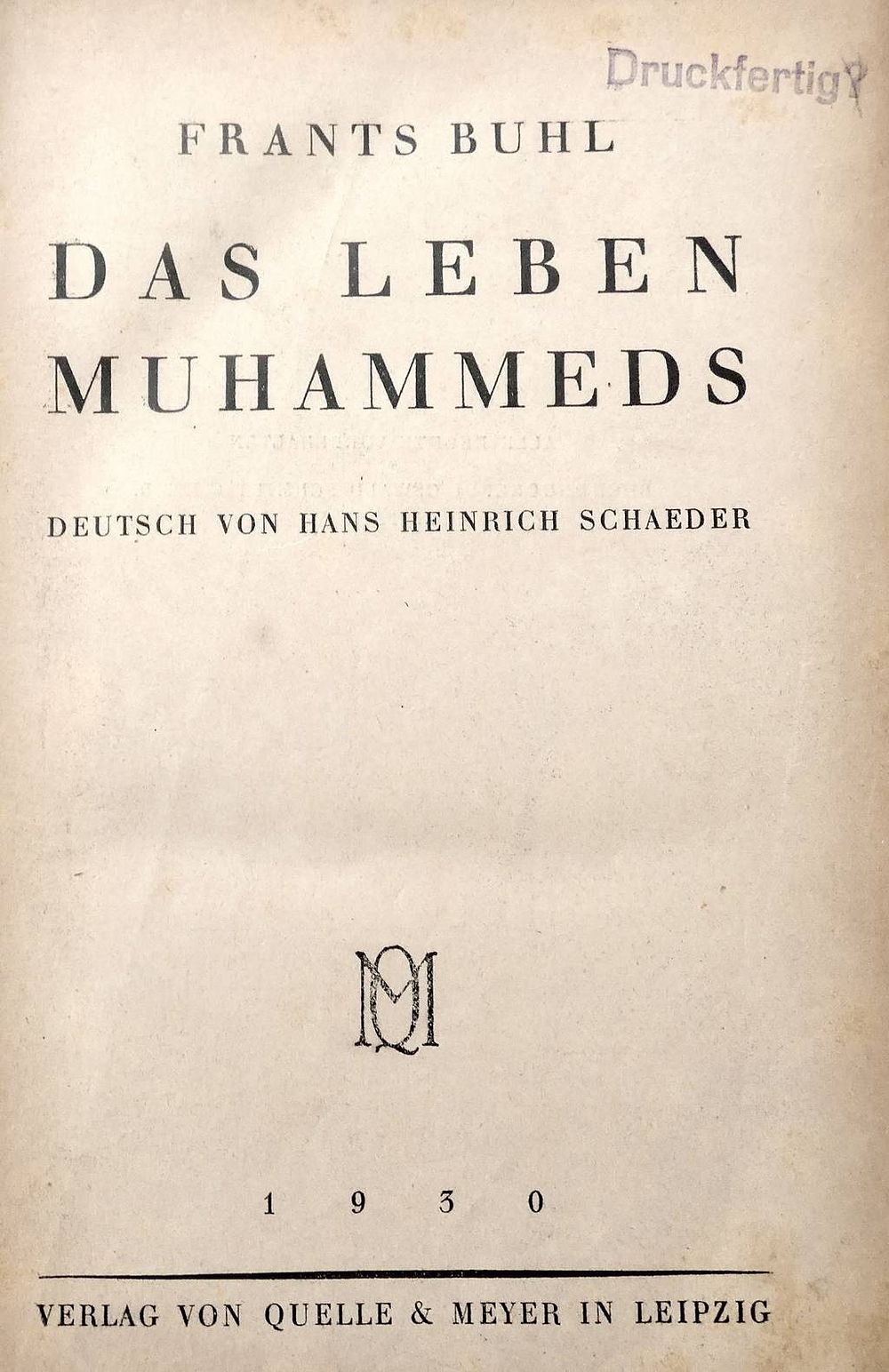
Das Leben Muhammeds von Frants Peder, 1st German ed., 1930, in German, Leipzig - Das Leben Muhammeds von Frants Peder, 1st German ed., 1930, in German, Leipzig Deutsch von H.H.Schaeder. Leipzig., Quelle & Meyer 1930. VIII, 379 pp. 1.Detsche Auflage des Daenischen Original Hard cover, size: 24 x16 cm. Condition: some wear and rubbing to edges of cover; some damage to the ends of spine; foxing stains to endpapers; pencil inscription to rear endpapers; a lot of pencil underlining; light brown/ brown fragile paper Weight: 740 gr. The book ”The Life of Muhammad” (”History of Muhammad”) is the most important biography of Muhammad. The Western French poet Frants Buhl wrote it in German in the 1930s. 1. Muhammad's early life The procession, located in Mexico, is the social milieu of Aravia during the sixth and seventh weeks, the goals of the journey, and his marriage to Khadija. 2. The beginning of the prophethood The first blood formation, the formation of religious studies, the reaction of Meccan society, and the persecution of the first followers. 3. The Meccan period Analysis of early Quranic suras, ideas of monotheism, ethics, and social justice. 4. Hijra and the Medicinal period Crossing to Medina, the connection between the two, Muhammad's political and religious roles, and understanding of the Jews and Christians. 5. Military and Diplomatic Alliance Badr, Uhud, the Trench, the Treaty of Hudaybiyyah, the capture of Mecca—all written as historical criticism, without religious apology. 6. Postnight and Death Description of the role of Muhammad as a religious leader, a historian, and a historical figure. Frants Peder William Meyer Buhl (born September 6, 1850, in Copenhagen; died September 24, 1932, in Hillerod/North Zealand, buried in Asminderod) was a Danish Orientalist and Old Testament scholar. Letter to Snouck (1927) Muhammedanismen som Verdensreligion (Mohammedanism as a World Religion, 1914) From 1868 to 1874, Frants Buhl studied theology and Oriental philology at the University of Copenhagen and received his doctorate in Semitic philology in 1878. From 1880 to 1882, he was a lecturer there, and from 1882 to 1890, he was a professor of Old Testament studies. He subsequently accepted a professorship at the University of Leipzig, where he remained until 1898, before returning to Copenhagen, where he held a professorship in Semitic languages until his death. In the academic year 1911/12, he served as rector of the university. Buhl contributed to the publication of the 13th edition (1915) and subsequent versions of Wilhelm Gesenius's Hebrew and Aramaic Dictionary of the Old Testament. For Rudolf Kittel's Biblia Hebraica, he edited the Book of Psalms and the Book of Esther (published in 1930 and 1935, respectively). In his article ”Poetry among the Israelites” (in the Real Encyclopedia for Protestant Theology and Church, Volume 4, 1898), he defined the literary genres and life situations of biblical poetics, thus anticipating the study of form criticism. His Canon and Text of the Old Testament was first published in German in 1891, translated into English by John Macpherson in 1892, and is considered one of his most influential works (see also Biblical Canon). In Danish, he wrote, among other works, Den gammeltestamentlige Skriftoverlevering (German translation 1885, English translation 1892), Det israelitiske Folks Historie (1892, 8th edition 1936), and Muhammeds Liv (”The Life of Muhammad,” 1903, 3rd edition of the German translation 1961). Buhl was a member of the Royal Danish Academy of Sciences from 1900. In 1899, he was awarded the Order of the Dannebrog.