Bidspirit auction | Egon Erwin Kisch “Geschichten aus
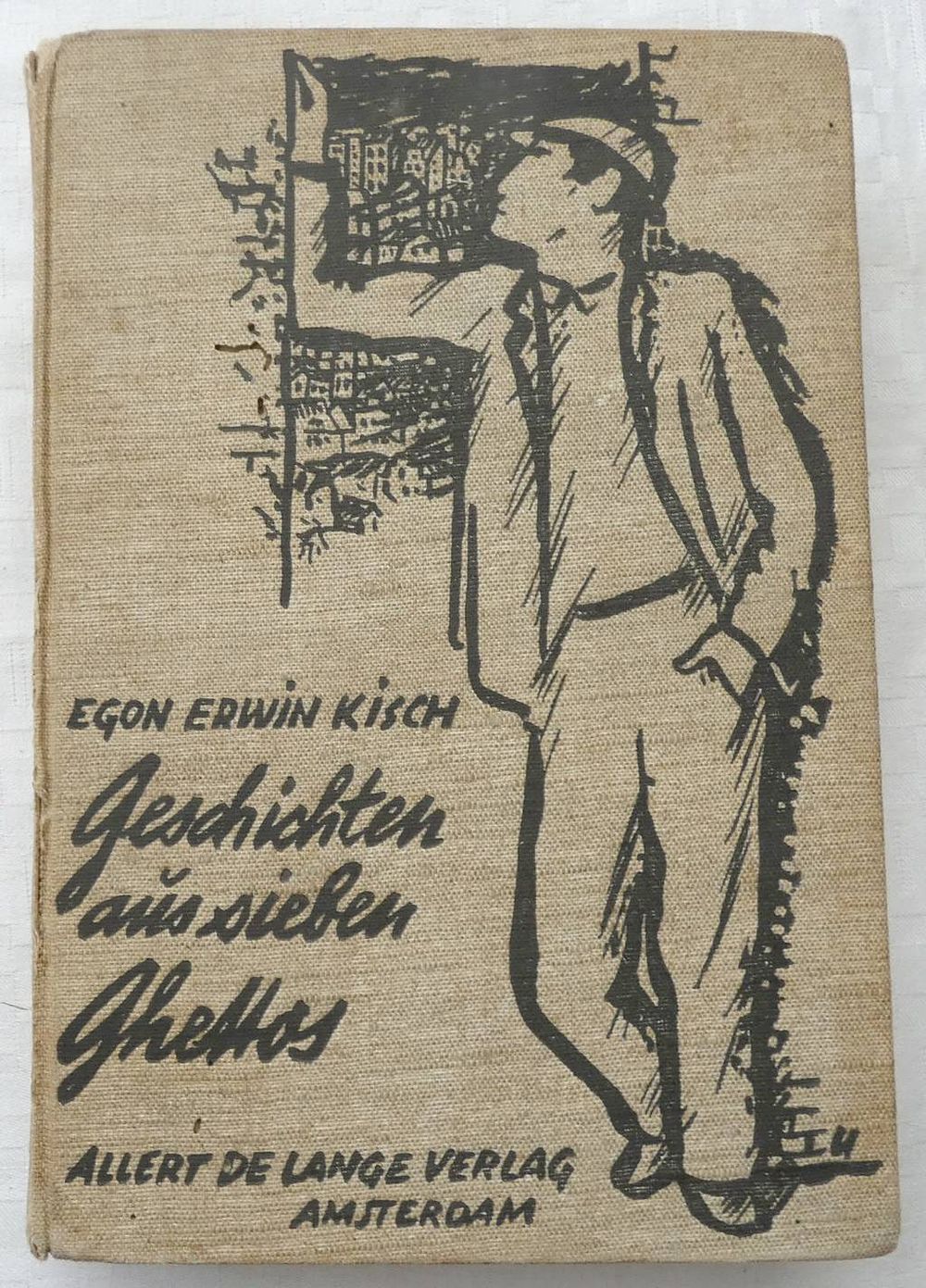
Egon Erwin Kisch “Geschichten aus sieben Ghettos”, illustr. by P. L. Urban, 1st ed.,1934, in German - Egon Erwin Kisch “Geschichten aus sieben Ghettos”, illustr. by P. L. Urban, 1st ed.,1934, in German Amsterdam, Verlag Allert de Lange, 1934., 217 S., 1. Auflage, Einband und Zeichnungen von P. L. Urban. Hard illustrated cloth cover, size: 24 x 16.5 cm. Condition: cover worn, stained, rubbed; tears to front hinge of spine; light damage to the ends of spine; foxing stains to edges and most of pages; some worm holes to covers, first and last pages. Weight: 560 gr. Inhalt u.a.: Schime Kosiner verkauft ein Grundstück - Romanze von den bagdad-Juden - Die Messe des jack Oplatka - Der kabbalistische Erzschelm - Den Golem Wiederzuerwecken Egon Erwin Kisch (29 April 1885 – 31 March 1948) was an Austro-Hungarian and Czechoslovak writer and journalist, who wrote in German. He styled himself Der Rasende Reporter (The Racing Reporter) for his countless travels to the far corners of the globe and his equally numerous articles produced in a relatively short time (Hetzjagd durch die Zeit, 1925), Kisch was noted for his development of literary reportage, his opposition to Adolf Hitler's Nazi regime, and his Communism. Kisch was born into a wealthy German-speaking Sephardi Jewish family in Prague, at that time part of the Austro-Hungarian Empire, and began his journalistic career as a reporter for Bohemia, a Prague German-language newspaper, in 1906. In 1910, Bohemia began publishing a weekly column of Kisch's essays. “Prague Forays” ran for more than a year and, along with several books containing reprinted and original material, made Kisch a local celebrity. These feuilletons, which consisted of what he called ”little novels” about the city, were characterised by an interest in prisons, work houses, and the lives of the poor of Prague. His style was inspired by Jan Neruda, Émile Zola and Charles Dickens's Sketches by Boz. Before World War I, he uncovered the spy scandal involving Alfred Redl, which he published anonymously at the time.[1] At the outbreak of World War I, Kisch was called up for military service and became a corporal in the Austrian army. He fought on the front line in Serbia and the Carpathians and his wartime experiences were later recorded in Schreib das auf, Kisch! (Write That Down, Kisch!) (1929). He was briefly imprisoned in 1916 for publishing reports from the front that criticised the Austrian military's conduct of the war, but nonetheless later served in the army's press quarters along with fellow writers Franz Werfel and Robert Musil. P. L. Urban — A graphic artist and illustrator active in the 1920s and 1930s, known primarily for his book designs for German-language émigré literature. He worked in the field of book illustration and bookbinding. He collaborated with the Amsterdam publishing house Allert de Lange, which published German émigré authors after 1933.