Bidspirit auction | From the Treasured Seforim of
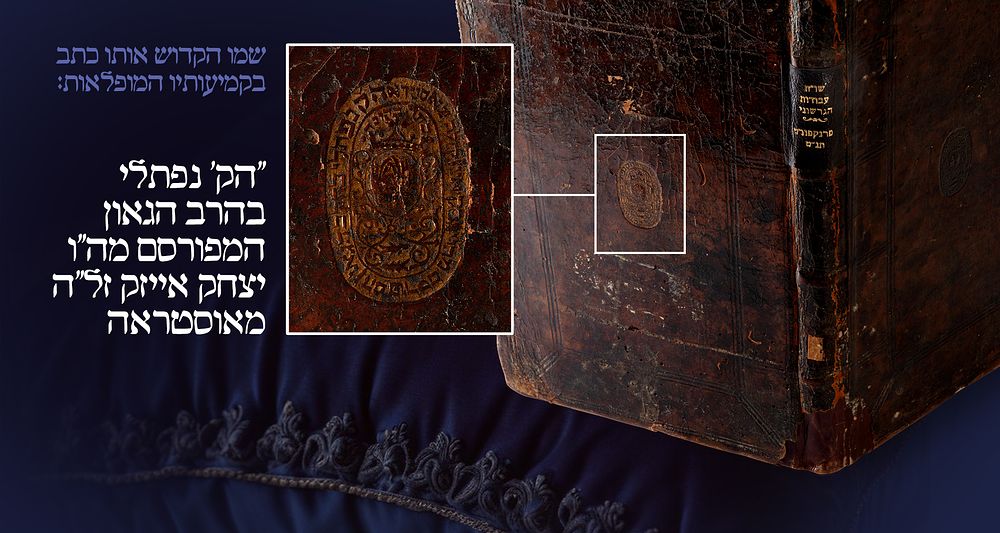
From the Treasured Seforim of the Holy Kabbalistic Gaon Rabbi Naftali Katz Av Beis Din of Ostroh, Poznań, and Frankfurt – the ‘Smichas Chachomim’ - Responsa ‘Avodas Hagershoni’ – Frankfurt am Main, 1699 – first edition – Emossed on front and back cover with a stamp of “Kesser Kehuna” – Crown of the Kohen – in which is written his holy name as he wrote it in his wonderous amulets: ”הק' נפתלי בהרב הגאון המפורסם מה”ו יצחק אייזק זל”ה מא[ו]סטרא[ה]” (“Naftali son of the famous Gaon Rabbi Yitzchak Eizik OBM of Ostroh”). The Sefer is bound in elegant, ancient leather. On both the front and back are embossed the famous seals of the “Smichas Chachomim”. Oval with a double frame, with his name embossed between the frames. Inside the seal, at the top are the words “כתר כהונה” (Crown of Priesthood) above a crown. Below that, a depiction of the Kohen’s hands extended in blessing, and below those are two horizontal fish, with the upper one facing right and the lower one facing left. [Another known seal of the “Smichas Chachomim, from his time as Av Beis Din of Poznań, was printed and copied in the Sefer “Shalsheles Zahav” (Jerusalem, ’01, ‘Ahavas Shalom’ publishing, p. 18 of the preface). There, on p. 137, are some details regarding the famous seal, which he had embossed on all his Seforim. The fish symbol is explained there, as it is a reference to his birth month of Adar, whose Mazel is fish, as well as a reference to the tribe of Naftali, who is also governed by that Mazel as is explained in the Sefer “Beis Rachel” written by the “Smichas Chachomim”.] The holy, saintly, kabbalistic Gaon, Rabbi Naftali Hakohen Katz (1649-1719), known as a holy man of G-D, concealed and obscure, famed worker of salvations, who, while being one of the leading Rabbis of his generation, also delved into the study of Kabbalah, and even practiced Practical Kabbalah in writing amulets and Segulos. Already during his lifetime, wonderous tales and legends were told of him, and he was hallowed and revered by the giants of Chassidus throughout the generations. Beyond this, he was known for his mastery of language, and his great works and scores of letters and approbations are known for their clear and eloquent speech. In 1680 he was appointed to the Rabbinate of Ostroh, succeeding his father-in-law Rabbi Shmuel Shmelke Za”K (a descendant of the Maharal). In mid 1688 was appointed Av Beis Din of Poznań, and in 1704was appointed Av Beis Din of Frankfurt am Main. (These dates are based on information gleaned from his approbations – see ‘Shalsheles Zahav’ pp. 211-212). Was one of the leaders of the fight against the Sabbatean Nechemia Hayun. On Jan. 15, 1711 a large fire broke out in his home, burning it and hundreds of other homes around it to the ground. The gentiles in his neighborhood accused him of being the cause of the fire, due to his dealing in Practical Kabbalah. Although acquitted in the trial, he was forced to leave Frankfurt, and spent the rest of his years wandering from place to place. We know that he spent time again in Ostroh during Nissan of 1718. From there he travelled to Constantinople, with the intent of continuing to Eretz Yisrael. He passed away in Istanbul, on the 24th of Tevet 5479 (Jan. 15, 1719), while on his way to Eretz Yisrael, and was buried there. The fashion of his passing was comparable to that of one of the Tanaim, with awesome revelations of Ruach Hakodesh and surrounded by flames. Authored several wonderous works, the greatest and most important of which is his Sefer “Bircas Hashem”, which includes “Kedusha Uvracha” and “Smichas Chachomim”. [The seals on this exemplar are either from his time in the Rabbinate of Ostroh during 1680-1688 or from his final years ca. 1718.] The Chida, in his work “Shem Hagedolim” writes of him that he was “a wonderous Mekubal of G-Dly and Practical Kabbalah” , and in another location he writes that he saw in Constantinople “a wonderous amulet which he wrote, and a sword on which he etched sacred names for protection, wonderous things” . In the Sefer “Shivchei HaBa’al Shem Tov” is told regarding the “Smichas Chachomim” that he would sometimes write his amulets while being immersed in the Mikveh while fasting. One of the wonderous things about the holy amulets of the “Smichas Chachomim” was the fact that sometimes he wouldn’t write any sacred names in them, just his own holy name. In Sefer “Divrei David” (Husiatyn, 1904) quotes a wonderous story told by the holy Rebbe Rabbi David Moshe of Tchortkov: “One time, Admor ZTZL (the holy Rabbi David Moshe) told that when the Ba’al Shem Tov was in Istanbul during his journey to the Holy Land, he heard that there was controversy regarding the Rebbe Rabbi Naftali Hakohen ZTZL that he gave amulets and was making use of sacred names. And the Ba’al Shem Tov asked someone to bring him one of those amulets and he opened it, and saw that there was nothing written there but his own name ‘the young, Naftali Hakohen’,