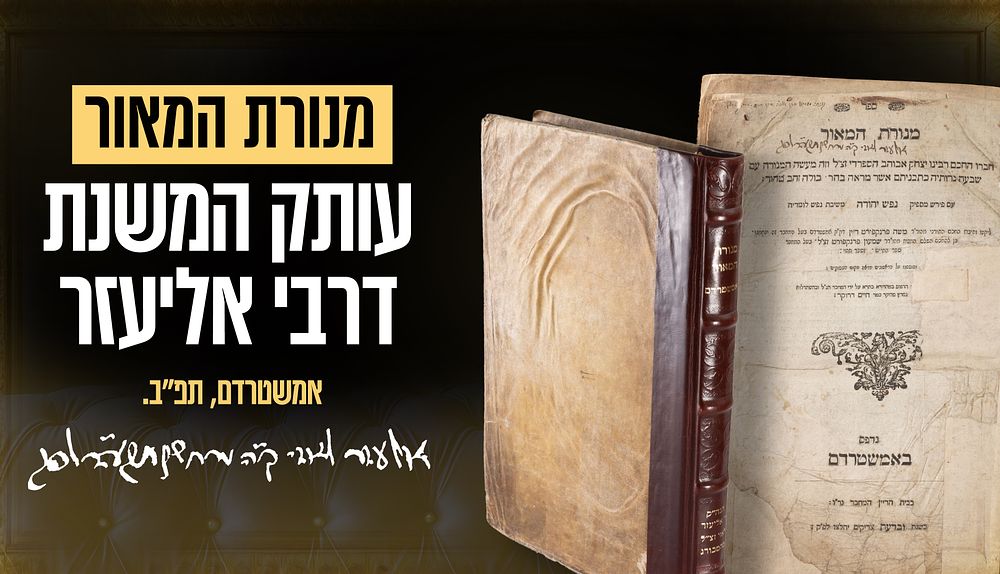
Bidspirit auction | Menorat Hama’or, Amsterdam, 1722. Exemplar
Menorat Hama’or, Amsterdam, 1722. Exemplar of the “Mishnas D' rabi Eliezer” - Noble exemplar! Sefer Menorat Hama’or by Rabbi Yitzchak Abuhav, with commentary Nefesh Yehuda by Rabbi Moshe Frankfurt (author of “Zeh Yenachameinu” on the Mechilta) – Amsterdam, 1722 – with the signature of the great Gaon Rabbi Elazar Lazi Heilbut, Av Beis Din of the AHU communities (author of “Mishnas D’rabi Eliezer”), who signed the Sefer during the last months of his life – and with the signature and glosses of his son, Rabbi Eizik Berlin. Signature on the title page: “Elazar Lazi – 25 Marcheshvan, 574 s.c.” [Nov. 18, 1813] (Rabbi Elazar Lazi passed away on Jan. 22, 1814). At the top of the title page is a signature of his son: “I took possession from my father’s estate OBM, Sivan 580 (May 1820), Eizik Berlin”. On the flyleaves are many references to various sayings of Chazal on different topicsm as well as direct quotes. Based on the style of the handwriting, iot appears that they were written by the son, Rabbi Eizik Berlin, who is also signed on the title page. Several glosses appear additionally within the Sefer. It appears that they, too, were written by Rabbi Eizik Berlin. The great Gaon Rabbi Elazar Lazi Heilbut (1744-1814), one of the great Gedolim of his generation. Born in Berlin, he was a distinct disciple of Rabbi Refael Hakohen, author of “Torat Yekutiel”, and later on served as a Dayan in his Beis Din. Served for about fifteen years as the Rabbi of the illustrious AHU communities (Altona-Hamburg-Wandsbek). The epithet on his tomb says: “The immensity of his diligence in the study of the holy Torah cannot be expressed. The night was as the day for him, and because he studied Torah for its own sake, he merited that his proficiency in the Talmud and the Poskim, in common and uncommon laws was astounding.; beyond this he was a great grammarian and literally knew the Tanach by heart and was versed in the short language of Rashi in his commentary on the Torah and the Talmud. His exalted mannerisms are untold, he was a true Chassid who placed his trust in Hashem and did not seek the philanthropists to take from them silver and gold, for he hated gifts and hated corruption, and therefore was a just judge who did not show favor in ruling; came and went in silence and did not seek greatness, and all the values which David Hamelech counts in the Psalm “Hashem who shall live…” were seen by him”. [4], 129 pp. 30cm. Moisture stains. Wear on some pages. Tears in the title page and several following pages. Old parchment covers with new leather spine. The original cover, with the flyleaves containing Rabbi Eizik Berlin’s many notations is pasted into the newer cover. God-fair condition.