Bidspirit auction | Yafeh Toar, on Vayikra Rabbah
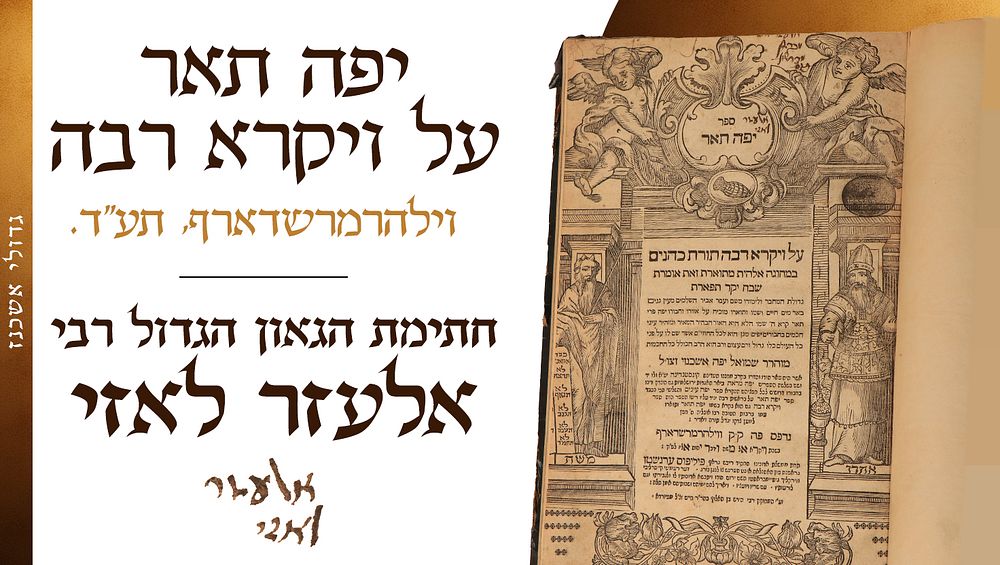
Yafeh Toar, on Vayikra Rabbah – Wilhermsdorf, 1714 – signed by the great Gaon Rabbi Elazar Loazi. - Yafeh Toar, on Vayikra Rabbah [with the text], by Rabbi Shmuel Yafeh Ashkenazi. Wilhermsdorf, 1714. Signature of the great Gaon Rabbi Elazar Lazi Heilbut (author of Mishnat DeRabbi Eliezer) Sefer Yafeh Toar on Vayikra Rabbah, Torat Kohanim, by Rabbi Shmuel Yafeh Ashkenazi of Kushtandina. Printed by Hirsch ben Chaim of Fuerth, Wilhermsdorf, 1714. At the top of the title page is a (trimmed) signature: ”Elazar Lazi from Berlin, Marcheshvan 1800.” In the middle of the title page is his full signature: ”Elazar Lazi.” Another signature (styled like a stamp): ”Beit Midrash of R' Leib son of R' Shaul.” On the protective leaf is written: ”Belongs to the Beit Midrash founded and established by the righteous Rabbi Leib son of Rabbi Shaul, of the holy congregation of Hamburg, and was rebound in the fifth month, year 1893.” [2], 132 leaves. Very good condition. In some pages the margins are trimmed, with loss only in the page headers, not in the text itself. Old binding in proper condition. The great Gaon Rabbi Elazar Lazi Heilbut (1744–1814), among the greatest of his generation. Born in Berlin. He was the prominent disciple of Rabbi Raphael HaKohen, author of Torat Yekutiel. Later, he also served as a Dayan in his Bet Din. For about fifteen years he served in the rabbinate of the renowned AHU communities (=Altona, Hamburg, Wandsbek). His tombstone is inscribed: ”His diligence in the holy Torah cannot be described. Night was illuminated like day for him, and because he studied Torah for its own sake, he merited that it was fulfilled in him, and in his Torah he would meditate. His proficiency in Talmud and Poskim, in both common and uncommon laws, was wondrous. In addition, he was a great grammarian and knew Tanach almost entirely by heart and was extremely knowledgeable in the concise language of Rashi in his commentary on the Torah and the Talmud. His lofty character traits cannot be described. He was a true Chassid who placed his trust in God and did not seek the favor of nobles to receive from them silver and gold, for he hated gifts and was averse to bribes. Therefore, he was a just judge who showed no favoritism in judgment, and he came and went in modesty and did not seek greatness. All the traits listed by King David A”H, in the psalm 'Lord, who may dwell [in Your tent]' were fulfilled in him.”