Bidspirit auction | Letter from Rabbi Moshe Mordechai
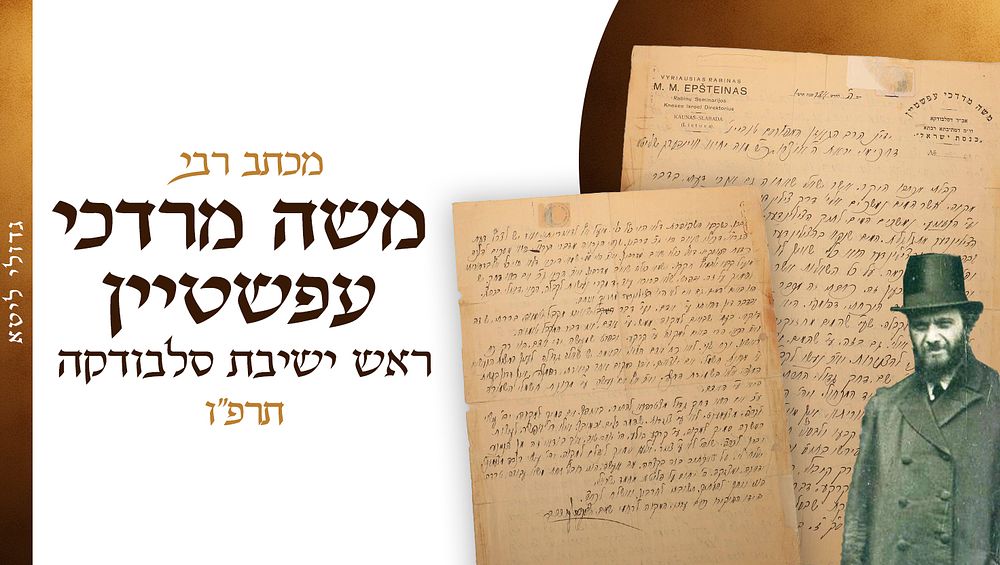
Letter from Rabbi Moshe Mordechai Epstein, Rosh Yeshiva of Slabodka – 1926 - Letter from the Gaon Rabbi Moshe Mordechai Epstein, Rosh Yeshiva of Knesses Yisroel Slabodka. Slabodka, 1926 “Therefore, if it is a case of great necessity, I join in permitting it, provided that near the mikveh there will be at least cement flooring” - A halachic responsum on matters of mikva'ot by the Gaon Rabbi Moshe Mordechai Epstein, Av Beit Din and Rosh Yeshiva of Slabodka, addressed to the Gaon Rabbi Yaakov Yechiel Weinberg, author of Seridei Eish. [1] Leaf, written on both sides, on official stationery of Rabbi Moshe Mordechai Epstein, in his handwriting and with his signature. Background: The Seridei Eish was asked about the halachic status of a mikveh filled through pipes via an electric pump, built from a metal cylinder open on both ends, containing a metal component that moves when the pump is activated. Rabbi Weinberg permitted the mikveh and recommended technical adjustments to satisfy all opinions. His leniency was supported by Rabbi Chaim Ozer and Rabbi Baruch Ber Leibowitz. Rabbi Moshe Mordechai Epstein, in the letter before us, permitted it in a case of necessity under specific conditions. He did not express concern regarding water being brought by human force (Havayah Al Yedei Adam) or impure origins (Havayah B’tumah), but he was concerned Lechatchilah about the issue of drawn water (Mayim She’uvim) through a vessel. Since water remains in the cylinder’s hollow and flows from there to the pipes, it may be considered a receptacle. He therefore advised that the water exiting the pipes should be transferred to the Mikveh via Hamshachah — flowing over absorbent ground or at least over a cement floor. This responsum was later printed in Shu”t Seridei Eish, vol. II, siman 46. Fold marks, filing holes, light stains, small tears and repairs. Good condition.