Bidspirit auction | Siddur HaShelah “Shaar HaShamayim” –
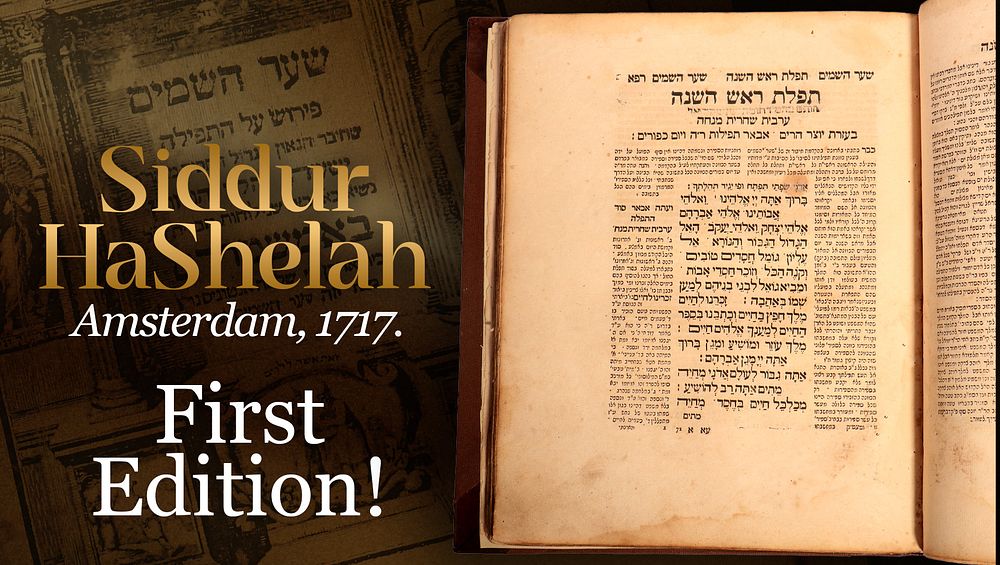
Siddur HaShelah “Shaar HaShamayim” – Amsterdam, 1717 – First Edition – Large Copy with Exceptionally Wide Margins – With Stamps of “Seal of the Beis Medrash Choma Yashan Shklov, ” the Synagogue of Chabad Chassidim That Was in the Home of the Philanthropist Rabbi Pinchas Reizes, One of the Greatest Disciples of the Baal HaTanya – A Rare Stamp Unknown from Any Other Source! Incomplete Copy Siddur Shaar HaShamayim – prayers for weekdays, Shabbos, and Moadim, with a commentary on the prayers based on Kabbalah titled Shaar HaShamayim – by Rabbeinu Yeshaya HaLevi Segal Horowitz – the Shelah HaKadosh. With a collection of laws and customs, by the editor and publisher Rabbi Avraham Segal Horowitz of Posen, the great-grandson of the author. Amsterdam, [1717]. First edition. Rabbeinu the Shelah HaKadosh writes in the introduction to the Siddur: “Blessed is Hashem… who has guided me in the path of truth… and brought me to Jerusalem, the Holy City, in the year 1622, on Friday of Parashas V’zeh Shaar HaShamayim… the gate through which the prayers ascend… through the gate of heaven.” In his will, printed at the beginning of the Siddur, he added: “…And then the thought arose in me to compose this sacred composition, in order that it be printed and distributed throughout the Jewish communities, so that I might merit a share in all the prayers of Israel.” The prayers in the Siddur were printed mostly in Nusach Ashkenaz, aside from some prayers printed side by side in both Nusach Ashkenaz and Nusach Sefard. This was done according to the author’s will printed at the beginning of the Siddur (though in practice the editor and publisher did not follow all the author’s instructions regarding changes in the texts). Prayer in this Siddur is known to carry a special Segulah for acceptance, as Rabbi Yoel Sirkes, author of the Bach, wrote in his approbation: “There is no doubt among us, when this Siddur spreads among Israel, that whoever prays from within it – his prayer will not return empty.” The Rebbe Rabbi Avraham Yaakov of Sadigura referenced this Segulah in his approbation to the third edition (Warsaw, 1882): “The Siddur Shaar HaShamayim of the holy Gaon the Shelah, and as testified by the renowned holy Gaon the Bach, OBM, in his golden words – we have no doubt that whoever prays with it, his prayer will not return empty.” The holy Gaon and Kabbalist Rabbi Naftali Katz, author of Semichas Chachamim, attributes this Segulah to the author himself, the Shelah HaKadosh, and writes in his letter: “…The order of prayers..., from the beginning of the year to its end, arranged and compiled by the Gaon Rabbi Yeshaya Segal, author of Shnei Luchos HaBris, who greatly yearned for this Siddur, and decreed upon his descendants to bring it to print, to merit the multitudes who would pray in this order with these intentions. And he made a covenant, that if they would do so with all their strength and intent – their prayers would not return empty before the Hearer of prayer. And go see what the nation does, and the approbations of the renowned great Geonim of that generation… the author of the Bach, and the great renowned Gaon Rabbi Yaakov, Av Beis Din of Lublin… and the great Gaon Rabbi Yom Tov Lipman Heller, author of Tosfos Yom Tov… and all the prophets speak in the same style, as these Geonim, that if one prays with these intentions – his prayer will not return empty.” In several leaves of the Siddur appears a stamp reading: “Seal of the Beis Medrash Choma Yashan Shklov.” The homes in the town of Shklov in the region of Reisin were built of wood, except for one stone house, which was built by the famed Chabad philanthropist the G-d-fearing Rabbi Pinchas Reizes, one of the “scribes” of his Rebbe the Baal HaTanya, in whose home Torah and greatness were uniquely united. When he built the “Beis Medrash Choma Yashan” in his home in Shklov, on the 20th of Teves 1807, his Rebbe the Baal HaTanya came for the dedication and delivered several Chassidic discourses there, which were recorded by Rabbi Pinchas and published. From letters of the writer Zalman Shneor, a native of Shklov who described the town in detail in his memoirs, it appears that until at least the mid-19th century, there was only one stone house in all of Shklov. The town of Shklov was known as a stronghold of the fiercest Misnagdim, who authored polemics and decrees against the Chassidim. Nevertheless, it had a prominent Chabad community, and several of the greatest disciples of the Alter Rebbe lived there, led by Rabbi Pinchas Reizes. Their stronghold was the Beis Medrash Choma Yashan in the stone house of Rabbi Pinchas. The Baal HaTanya visited Shklov frequently, staying there for weeks at a time. It is told about the Baal HaTanya, that in his youth, before traveling to his Rebbe the Maggid of Mezeritch, “His method of service was according to the order of the Shelah HaKadosh and his intentions in his work Shelah and his Siddur Shaar HaShamayim.” (Beis Rebbe,