Bidspirit auction | Rare Discovery! From the Treasury
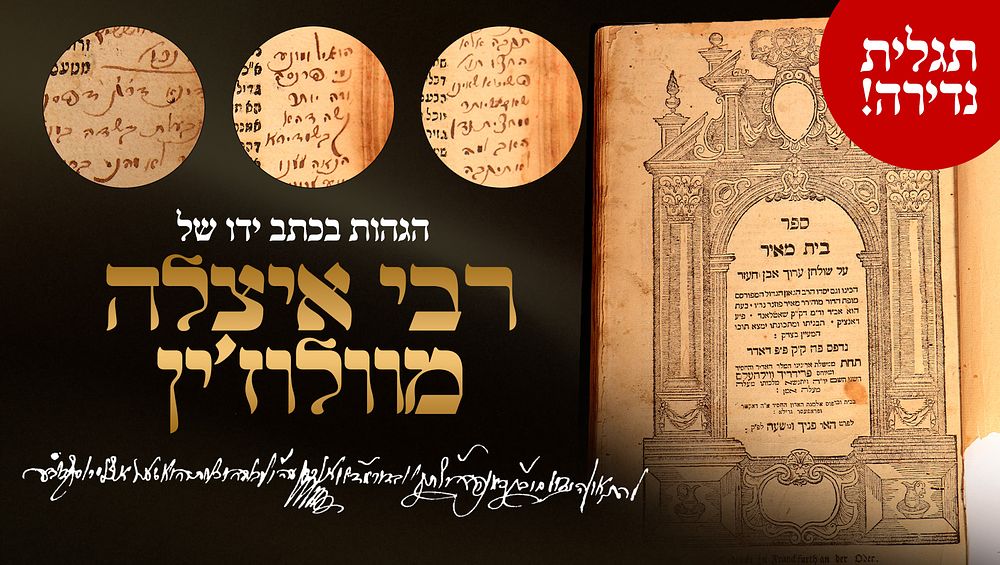
Rare Discovery! From the Treasury of the Sefarim of Rabbi Itzele of Volozhin! Sefer Beit Meir on Shulchan Aruch Even HaEzer, by Rabbi Meir Posner – Frankfurt an der Oder, 1787 – First Edition – With Glosses in the Handwriting of Rabbi Itzele, Av Beit Din and Rosh Yeshiva of Volozhin Manuscripts in the handwriting of Rabbi Itzele of Volozhin are exceedingly rare! On the front guard leaf appear several ownership inscriptions of “The great Gaon Rabbi Yitzchak, Av Beit Din of the holy community of Volozhin.” On the guard leaf, there also appear imitations of his known signature formula: נפש נענה יצחק אב”ד דק”ק וולאזין On the leaves of the Sefer are written over ten glosses, with profound depth of analysis, apparently in the handwriting of Rabbi Itzele of Volozhin. Manuscripts of Rabbi Itzele are exceedingly rare, especially in the revealed Torah. What has been printed from him are primarily glosses on the Sefer Nefesh HaChaim concerning Kabbalah, and a few letters of emissary missions concerning the Volozhin Yeshiva. No Chiddushim are known from him on sugyot of the Shas. Therefore, the significance of the glosses in the Sefer before us is clearly understood. At the margin of the title page appears a note from the author, the Gaon Rabbi Meir Posner, author of Beit Meir: ”טעות המצוי פעם מם סתומה במקום זיין ופעם להיפך” The renowned Gaon Rabbi Yitzchak (R. Itzele), Av Beit Din of Volozhin (1780–1849), was the son, disciple, and successor of his great father Rabbi Chaim of Volozhin, author of Nefesh HaChaim. After his father’s passing in 1821, he succeeded him as head of the famed Volozhin Yeshiva and assumed the position with all his might, both in delivering shiurim and in managing the finances. The financial burden and debts of the Yeshiva weighed heavily on him, and throughout his life, he was engaged in emissary missions and debt repayment from the Yeshiva’s early years. Rabbi Itzele was the leading spokesman of Lithuanian and Belarusian Jewry, the representative of the “Mitnagdim” in all crucial public matters in the first half of the 19th century. His contemporaries called him: 'נשיא ישראל' and 'ריש גלותא' 'חכימא דיהודאי' He was highly regarded by the Czarist government and was considered as the de facto “General Rabbi” of his generation. His opposition to Chassidut was moderate; even Chassidim studied in his Yeshiva, and he maintained friendly relations with the “Tzemach Tzedek” of Lubavitch. Chassidic writings and Sefarim could be seen on his table. He was deeply involved in the secrets of Kabbalah and also wrote amulets which contained only his name. Of all his shiurim and writings, only two Sefarim survived, compiled from his discourses by his disciples: Peh Kadosh on the Torah and Mili D’Avot on Tractate Avot. [1], 150, [1], 20 leaves. 32 cm. Good–Fair condition. Damp stains. Worming on some leaves. Fine new leather binding.