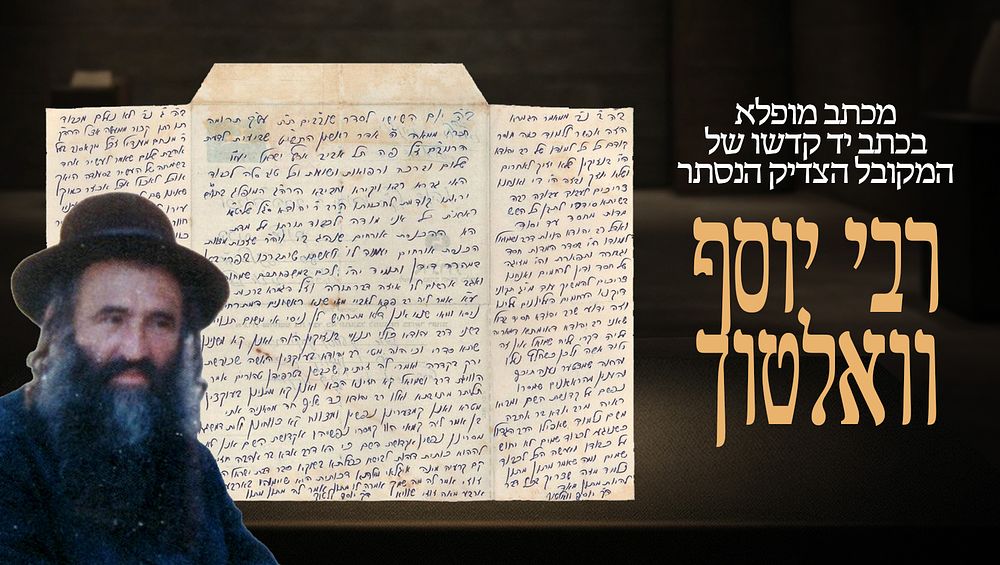
Bidspirit auction | Wonderful letter in the holy
Wonderful letter in the holy handwriting of the hidden righteous Kabbalist Rabbi Yosef Waltuch – written to his dear friend, the wondrous righteous Gaon Rabbi Yehuda Zarachia Segal, Rabbi of Kiryat Shalom in Tel Aviv – Adar I 5719 [1959] – on the virtue of hospitality, with an interesting story about the “Ahavas Shalom” of Kosov. With agadic novelty, Tractate Berachot 20a. A three-page letter, with his handwritten signature “The s. Yosef Waltuch” at the end of each page. The hidden tzaddik, Rabbi Yosef Waltuch (1922–1983), was a descendant of the Maggid Rabbi Yechiel Michel of Zlotchov. He was among the heads of the group of hidden righteous men of Tel Aviv, including “the Sandler” (Rabbi Moshe Yaakov Ravikov), “the Roofer” (Rabbi Avraham Fish), “the Painter” (Rabbi Yehuda Patilon), and others. Rabbi Yosef Waltuch would often prostrate himself at the graves of tzaddikim and in holy places and was known to bring salvations through his prayers. He endured great suffering all his life and, like most of the “hidden tzaddikim, ” had no children. Nevertheless, he served Hashem all his days with supreme joy. Heavenly and wondrous stories of revealed Divine inspiration about him circulated from mouth to mouth even during his lifetime. He passed away suddenly after collapsing inside the “Idra” cave. Rabbi Moshe Tzadka writes about him: “…He was a great Torah scholar, pious, humble, and modest, a man of much suffering who hid himself away… I merited to learn with him, perhaps even much. A vessel filled with all the delicacies of Torah — Talmud and Midrashim, Zohar and Kabbalah, commentaries and works of ethics, halachic authorities and codes — all were laid in his mind. He was also deeply knowledgeable in the chronicles and history of our nation. There was no sage from any generation, or author of any book, whom Rabbi Yosef Waltuch did not know by name and era. He showed great honor to all Torah scholars, both of past generations and, to distinguish, those living among us. He knew pain, illness, and accepted it all in silence. He wandered from place to place with his books, tallit, and tefillin. He was acquainted with many of the great sages of the generation, especially those who, like him, were hidden from view. He lived in a very modest room, most of his life in solitude, for his wife, sadly, was ill and hospitalized. Chagim and Moadim, Shabbasim, and weekdays he spent alone, between himself and his Creator, with nothing of this world — not even someone to wash his handkerchief or socks. Holy he was, a giant he was, and he never agreed that his praises or hidden deeds be publicized.” [1] leaf. 27 cm. Stains. Good condition