Bidspirit auction | A precious pearl without blemish!
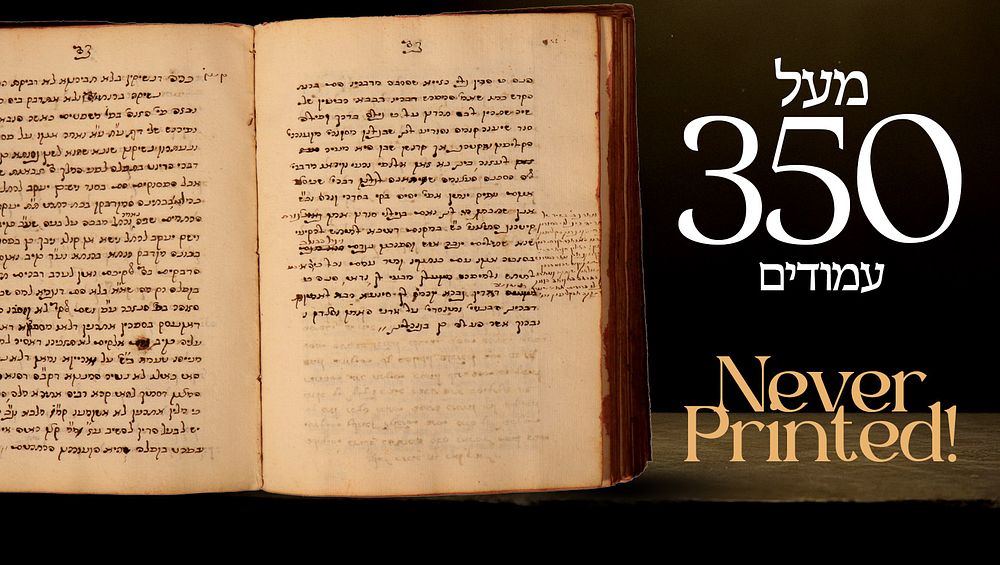
A precious pearl without blemish! Hidden treasures from the treasuries of kings! Discovery! A complete manuscript, 'Magen Aharon', by the holy Kabbalist Rabbi Aharon Berachiah of Modena, author of Ma’avar Yabbok — with additions, glosses, and numerous notes in the Holy Handwriting of the author throughout the Sefer — a large Kabbalistic–polemical work, over three hundred and fifty pages, Never Printed! — Italian script — Modena, 1628–1630. The work Magen Aharon is a polemical composition against a Sefer of Piyyutim written by his brother-in-law, Rabbi Yosef Yedidya Carmi, titled 'Knaf Renanim' (Venice 1627). Background of the polemic: the Kabbalah of the Ramak versus the Kabbalah of the Ari. The Holy Handwriting of the divine Kabbalist, of whom the Chida writes: “And I heard that he had a maggid, and I heard many matters of his might and wonders — may his merit protect us.” The manuscript contains much unique and precious information regarding the beginning of the spread of the writings of the Ari in Europe in general and in Italy in particular. The work before us was copied by Rabbi Yitzchak Shoshan Ben Reb Chat, a disciple of the author. In the margins and between the lines were added numerous valuable additions and glosses in the Holy Handwriting of the author. On leaf 3/a the copyist writes the date he began the copying: התחלתי להעתיק אמרים נעימים, מיוסדים נגד ספר 'כנף רננים', אני יצחק שושן יצ”ו ביום כ”ח תמוז שפ”ח... However, the author added his notes in the margins also in later years. This is evident from the author’s gloss on leaf 99/a, where he writes: ”ועיין בספר שתיל פורח... ”, Elsewhere in his writings, the author states that his Sefer Shatil Poreach was written between 1629–1630. From here, it is clear that the glosses before us were added by the author in the 1630s. Background of this polemical work: In 1627, in Venice, the author’s brother-in-law, Rabbi Yosef Yedidya Carmi, printed his work 'Knaf Renanim', containing new Piyyutim and prayers he composed to be said at dawn gatherings in synagogues in Italy. The Piyyutim are based on concepts from the Kabbalah of the Ramak as explained in Pardes Rimonim, and on Midrashim and teachings of Chazal. In the work before us, the author argues lengthily against 'Knaf Renanim' on several grounds. First, he claims based on the words of the Ari, who opposed all Piyyutim of later authors, and even earlier Piyyutim not founded on Kabbalah. Likewise, he argues at length regarding a large Viduy for Yom Kippur printed in 'Knaf Renanim', based on the upper Heichalot (which the Zohar expands on at length in Parashat Bereshit and Parashat Pekudei), which, according to the Ramak, are “located” in the world of Yetzirah, whereas according to the Ari, they are in the world of Beriah. From these topics, the author continues and branches out into entire subjects and sub-subjects. A historical detail in the manuscript, concerning the relationship between the Ramak and the Ari, and likely not recorded elsewhere, states: ושמעתי אומרי' כי בסוף ימי הקורדווי' [=רבי משה קורדובירו] עמדו שניהם [הרמ”ק והאר”י] לבד ארבעי' יום וארבעים לילה, ובחולי אשר מת החכם בעל הספ”ר [הרמ”ק, בעל ה”פרדס”] היה האר”י עומד עליו... ומי הוא היודע אם קודם פטירתו מן העולם הודה לדברי האר”י... החכם האר”י בירר לו מקומו להקבר אצל החכם קורדוויר”ו, ונכרי' קברותיהם בעה”ז בציון לבן וזה בציון שחור סמוכים זה לזה. כן למעלה בג”ע דורשים יחד אמתה של תורה והקבלה... (46/א) And these are the words of the Chida in Shem HaGedolim about the author: “The holy Kabbalist, the pious Rabbi Aharon Berachiah of Modena, author of the Sefer Ma’avar Yabbok . He composed a commentary on Tikkunei HaZohar, and a great work according to the disciples of the Ari, four parts: Part I — Shemen Mishchat Kodesh. Part II — Shemen Zayit Zach. Part III — Shatil Porach. Part IV — Imrei Shafer. I saw them in manuscript — his Holy Handwriting — in the city of Modena… And the aforementioned rabbi was a disciple of the Ram”a of Pano, and ascended to Heaven in 1639 . And I heard that he had a maggid, and I heard many matters of his might and wonders — may his merit protect us.” [186] leaves. All leaves (except the final leaf) written on both sides. Leaves 173–179 blank. 18 cm. Most leaves in good condition, aside from several leaves where the ink slightly scorches the paper. Stains. Worming in several leaves. Original thin-cardboard binding.