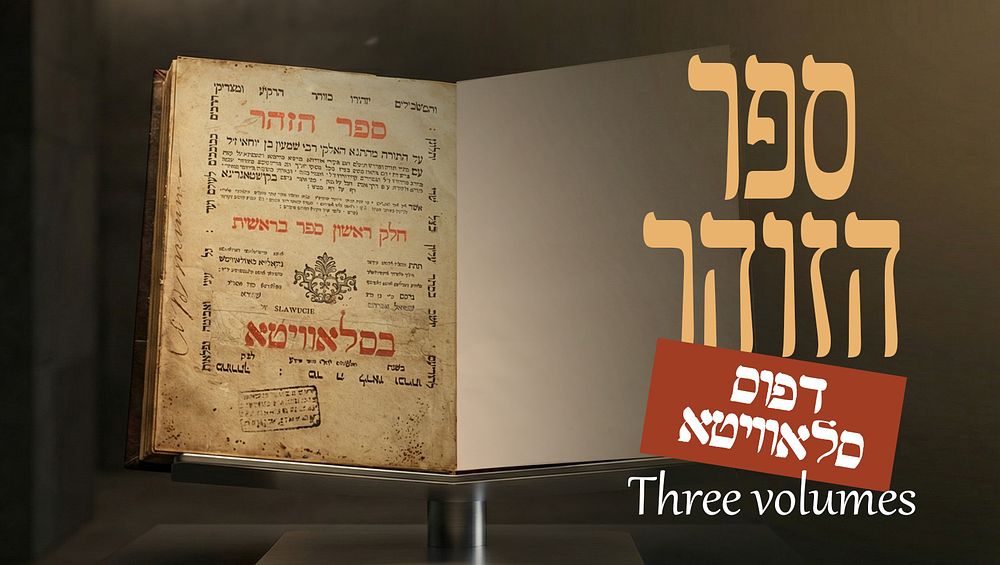
Bidspirit auction | Three volumes of Sefer HaZohar,
Three volumes of Sefer HaZohar, Slavuta Press, 1824–1827 The first volume is from the Slavuta 1827 edition, and the other two volumes are from the Slavuta 1824 edition. Both editions were printed by Rabbi Shmuel Avraham Shapira, son of the Rabbi of Slavuta, as stated on the title pages. Volume I, Bereshit: [4], 157; 17 leaves. The first two leaves restored and supplied from another copy. Tear on the title page. The missing section of the title page was restored using a replacement from the title page of the Slavuta 1824 edition. 21 cm. Fair–good condition. Worming and damp stains on some leaves. Tears on the final leaf. Volume II, Shemot: [1], 278 leaves. 21 cm. Fair–good condition. The first two leaves restored and supplied from another copy. Worming and wear on some leaves. All leaves of the Sefer restored. Volume III, Vayikra–Devarim: 115, [1], 117–300 leaves. 21 cm. Fair condition. The first six leaves restored and supplied from another copy. Worming. Damp stains. Wear. All leaves of the Sefer restored. New leather bindings. On the Slavuta Press and its founder, Rabbi Moshe Shapira, Av Beis Din of Slavuta: The Jewish printing house in Slavuta (in Khmelnytskyi district, western Ukraine) operated from 1790–1837. The founder of the Slavuta Press was Rabbi Moshe Shapira (1762–1840), son of the Holy Rabbi, Rabbi Pinchas of Koretz. From childhood, he demonstrated exceptional talent in writing Sifrei Torah, in drafting, engraving, and carving. His holy father encouraged him to develop these skills and acquire these crafts. In the early 1790s, Rabbi Moshe was appointed Rabbi of Slavuta, but since he did not wish to benefit from the crown of Torah, he established his renowned printing press. The letters used in the printing house was crafted by Rabbi Moshe himself. In addition to the printing press, he founded workshops for paper-making and for casting and melting letters. A significant portion of Slavuta’s Jewish community was employed honorably in one of the divisions of the printing works. Slavuta Sefarim became famous throughout the Jewish world for its beauty and fineness, for its accuracy and quality of proofreading, and because of the owner of the press — Rabbi Moshe — who was sanctified and revered among the great figures of Chassidut. Rabbi Moshe of Slavuta was close to the Baal HaTanya. The Baal HaTanya wrote of him: ” המופלג בתורה, ויראת ה' אוצרו, בנן של קדושים” ”הצדיק האמיתי אשר האיר עיני ישראל בכל מקומות מושבותיהם זה יותר מארבעים שנה החל עשות אך טוב לישראל במכבש הדפוס המהודר שלו בכל ספרי קודש גדולים וקטנים, חדשים גם ישנים, בניירות יפים ואותיות מזהירים ככוכבים” An exalted distinction of this press was that no secular books were ever printed there, and its letters were never profaned in books of mundane content. Most of the printing workers were God-fearing and upright Jews. According to a famous Chassidic tradition, the printing machines, etc, were immersed in a Mikveh before any printing began.