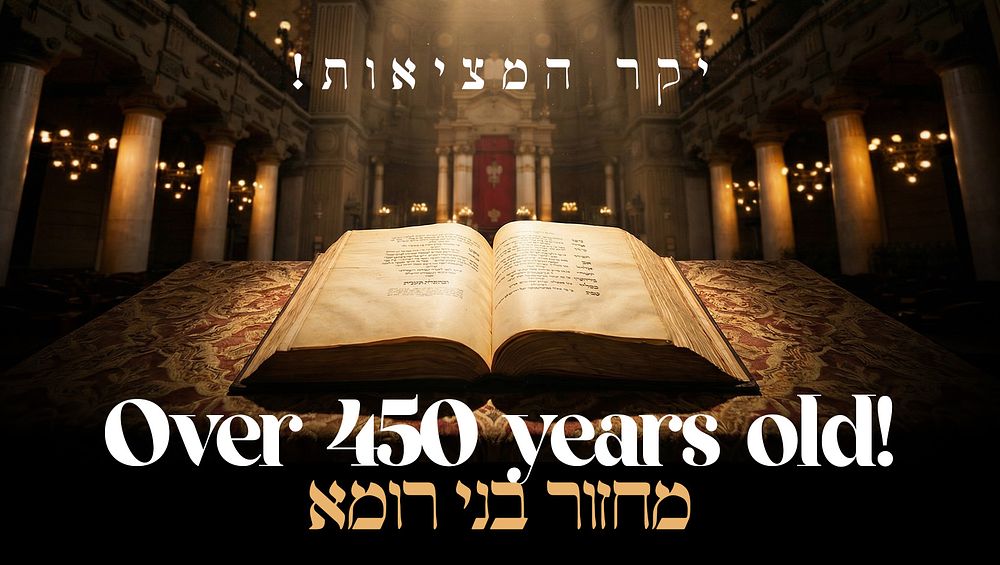
Bidspirit auction | Machzor Bnei Roma, Central Italy.
Machzor Bnei Roma, Central Italy. Manuscript from the mid-15th century. A monumental and unique treasure! Manuscript on parchment, a Machzor according to the Italian rite, for weekdays, Shabbat Rosh Chodesh, Chanukah, fast days, the Four Parshiyot, Purim and Pesach; Yotzerot and Kerovot; the Pesach Haggadah; and more. Central Italy [Florence?], mid-15th century [apparently between 1450–1458]. 311 leaves, foliated in an Italian cursive hand 3–313. Italian square script with vocalization, and semi-cursive Italian script for laws, customs, and instructions. Written in great splendor, in beautiful calligraphy, by the scribe Moshe Ha'Sofer Ben Reb Avraham. The script of the present Machzor is identical to that of a manuscript, Schocken Institute for Jewish Research MS 13873, a Machzor copied by the same scribe and completed on 2 Sivan 1441. The manuscript contains opening words customarily illustrated in color and gold, executed as hollow framed letters; see leaf 236a, in the Haggadah Shel Pesach: “Ha [Lachma Anya], ” and likewise in the Scrolls of Esther and Shir HaShirim, on leaves 210a and 308a. At the beginning of the manuscript is a large and unique quire [74 leaves] of personal prayers recited prior to prayer, supplications, and Piyyutim by early Sages of France, the Chasidei Ashkenaz, and Kabbalists of Spain, including rare prayers and supplications—some unknown from any other source —and many rare Piyyutim, among them a Piyyut extant in only one other manuscript besides this one, as well as rare Piyyutim and supplications by Rabbi Netanel Ben Yosef of Kinon. Contains blessings over Nevi’im and Ketuvim within Birkat HaTorah for the individual, as well as ancient Piyyutim that later fell out of use in the Italian rite, indicating that the Machzor was copied from a much earlier exemplar. A long and detailed list of all the special prayers and Piyyutim appears in a research document appended to this item. On leaf [65a] appears an extremely rare Kabbalah by Rabbi Avraham Ben Reb Yitzchak, Av Beis Din of Narbonne, concerning the recitation of verses efficacious for protecting travelers. His identity is known only from the present manuscript, and anonymously it appears in only one additional manuscript. Another Kabbalah is recorded there, in the name of Rabbi Yehuda HaChasid, for the recitation of verses efficacious for protection from all trouble. An ownership drawing, taken from a previous binding, impressed on the pastedown of the front cover: Jacob Rimini, who lived in Florence, 17th century. With various ownership inscriptions, including: *בהנו”א [בשם ה' נעשה ונצליח אמן] [...] פה אעלה לזכ[ירה] לפי דברי המופארה הורתי תחי' איך בליל שבת קדש בין ז וח שעות שהיה ד' נובימרו [4.11] רצ”ב לפ”ק פרשת [חיי שרה] שהיה שנת 1531 המליטה זכר וקראו בישראל שמו יעקב ה' יזכהו ויחייהו ויתקיים בו קרא דכתיב יגל וישמח ישראל אמן * עו[ד] לזכירה איך ביום ו' ב' מאייו שנת רצ”ט [2.5.1539] יד אייר הכבו[דה] הורתי תחי' המליטה זכר בין יד ויז שעות ה' יגיעהו ויזכהו [...] ויקיים בו קרא דכתיב ואברהם היו [!] יהיה לגוי גדול ועצום * [...] הזקן הנכבד דוד מרימיני [אביו של הבעלים הנ”ל, יעקב רימיני] שנפטר [...] טו לחדש חשון התל”ג [5.111.1672] [...] ויניח לנו חיים ארוכים טובים ונאמנים אמן כן יהי רצון, כל הנשמה תהלל י”ה • A list in Italian, difficult to read, headed with date and place: 16.03.1667, Florence. In many places in the manuscript there are censorship erasures by a censor from the mid-15th century, who signed alongside them: Marchion NP [= Nutius Papae]. The present manuscript was part of the collection of Shlomo Zalman Chaim Halberstam and was described by him in: Kohelet Shlomo, being a list of manuscripts in the possession of S. Z. C. H. in Biala, Vienna 1890, no. 224. At the beginning of another manuscript from the same collection, Halberstam no. 225, a Machzor for Rosh Hashanah, Yom Kippur, and Sukkot, which was certainly also copied in the hand of Rabbi Moshe HaSofer Ben Reb Avraham, appear the signatures of the same censor next to every erasure, as in the present volume. In that Machzor, there is recorded a deed of sale of the Machzor from Raphael Zagi Ben Reb Yitzchak of Florence, dated 7 Tammuz 1458 [19.7.1458]. In the Ne’ilah prayer of that Machzor is included the Akeidah Piyyut “El Chai Daltei Ratzon Hayah Poteach…, ” by Rabbi Raphael Zagi Ben Yitzchak of Florence [the above seller], which appears in the Parma manuscript Cod. Parm. 2735 De Rossi 802; there the Parma manuscript notes: “Tachanun for the Akeidah by Moreinu Rabbi Raphael Zagi Ben Yitzchak of Florence, composed on 6 Tishrei 1450 [12.9.1450].” From all of the above, it emerges that the Machzor for Rosh Hashanah, Yom Kippur, and Sukkot mentioned above was copied between the year of composition of the Piyyut and the year of sale of the Machzor, i.e., between 1450–1458. It may therefore be assumed that the present Machzor, copied by the same scribe and examined by the same censor, was produced in that same period.