Bidspirit auction | Sefer Shaarei Shevuos, attributed to
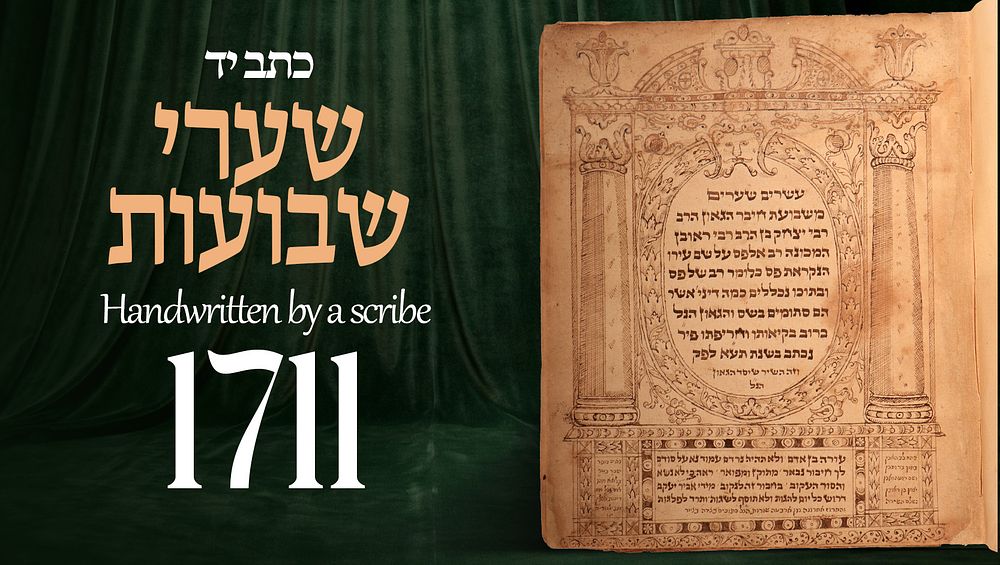
Sefer Shaarei Shevuos, attributed to Rabbi Yitzchak Ben Reuven, in a manuscript written by the scribe Yissachar Ber Ben Reb David of Bilgoraj, 1711. Manuscript composition, [Sefer Shaarei Shevuos], “Twenty Gates on the Laws of Oaths composed by the Gaon Rabbi Yitzchak Ben Harav Rabbi Reuven, called Rav Alfasi.” Written in the hand of the scribe Yissachar Ber Ben Reb David of Bilgoraj, 1711. [35] leaves. Fine and legible manuscript. The entire composition is in manuscript, including the illustrated title page. The final leaf, containing the concluding lines of the present composition, is lacking. A photocopy of the final leaf of this composition from the Krakow 1597 edition is attached, in which the missing text from the present exampler is printed in [6 lines] In 1522 Daniel Bomberg printed the Halachos of Rav Alfasi on Tractate Shevuos and appended to them the composition “Twenty Gates of Shevuos… founded by the Gaon Rabbi Yitzchak Ben Harav Reb Ravon, called Rav Alfasi[!]”, dealing with the laws of judicial oaths, opening with the rhymed lines: ”עורה בן אדם ולא תהיה נרדם” In later editions, it was noted that there are disagreements between the approach of the Rif and that of this composition, and it was suggested that the work was written by a grandson of the Rif, or that the Rif composed it in his youth and later retracted its views in the Halachic rulings he wrote in his old age. Some scholars have suggested that the author is Rabbi Yitzchak Ben Reb Reuven of Barcelona, who translated Sefer HaMekach V'HaMimkar of Rav Hai Gaon, while others have written that the work was originally composed in Arabic by Rabbi David Ben Reb Saadia and translated into Lashon HaKodesh by Rabbi Yitzchak Ben Reb Reuven. See: S”Y Friedman, Talmud Aruch: Perek HaSocher Es HaOmanin, section of commentaries, Jerusalem 1991, p. 325 note 183; Y. Ta-Shma, HaSifrut HaParshanit LaTalmud, I, Jerusalem 1999, pp. 170–173; S. Assaf, Sefer Mishpetei Shevuos by Rabbi David Ben Reb Saadia, Kiryat Sefer, III, 1926, pp. 295–297. The Sefer underwent professional restoration; the upper portion of the title page has been fully reconstructed. Damaged and detached half-leather binding; final leaf lacking; stains; moderate-good condition.