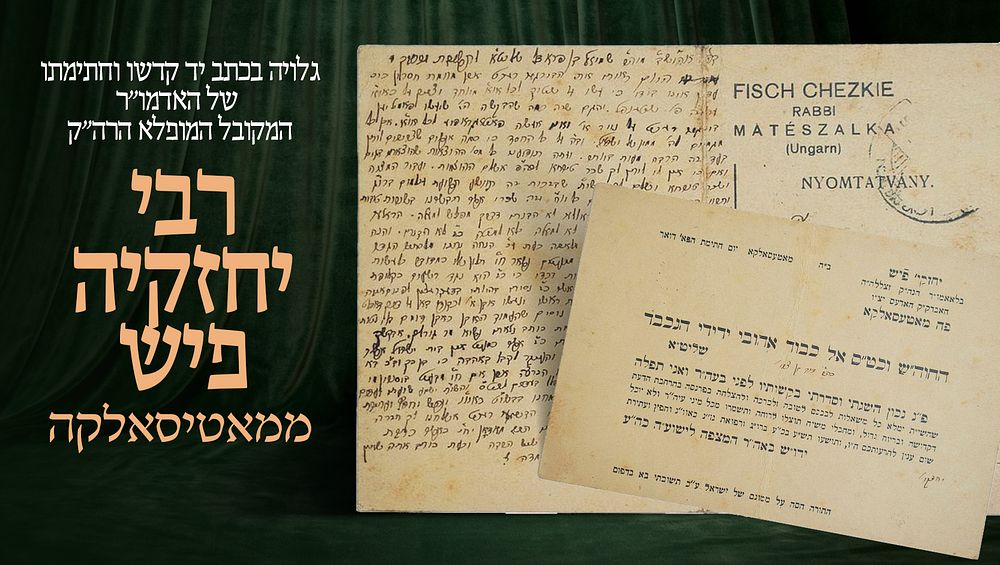
Bidspirit auction | Postcard in His Holy Handwriting
Postcard in His Holy Handwriting and with the Signature of the Admor, the Remarkable Mekubal Harav HaKadosh Rabbi Yechezkel Fisch of Mátészalka – Late 1930s Most of the postcard deals with mundane matters and business negotiations of a Chassid who consulted him regarding his commercial affairs, yet its content is filled with faith and encouragement during a time of Hester Panim, to accept the sufferings of the birth pangs of Mashiach with love. Toward the end of the postcard the Harav HaKadosh of Mátészalka writes: “Almost no house of Israel exists for whom they do not measure at all times with a full measure, and the main thing is to accept with love. For in any case it comes. At the very least let it be accepted with love, and then it comes to its desired purpose. But if, Heaven forbid, one rebels against the suffering, who knows.” The Admor, the remarkable Mekubal Harav HaKadosh Rabbi Yechezkel Fisch of Mátészalka (1885–1944; Encyclopedia of Chassidus, II, p. 189) was the son of Harav HaKadosh Rabbi Aharon Yeshayah Fisch, Av Beis Din of Hadas, and the son-in-law of Rabbi Yisrael Waldman of Borsa (a descendant of the Bnei Yissaschar and Harav HaKadosh of Ziditchov). After the passing of his father in 1928 he filled his father’s position and moved to reside in Mátészalka. He was known as an exceptional Oved Hashem in Chassidus and asceticism, with tremendous fervor and self-sacrifice, through mortifications and fasts. He devoted himself extensively to the study of Kabbalah in great depth according to the teachings of Kamarna and Ziditchov. During the final seven years of his life, “most of his Torah teachings and talks concerned the matter of Mesiras Nefesh, and he urged that every Jew must be prepared even to be burned in fire and to sacrifice his life for the sanctification of His blessed Name.” From the day after Pesach in 1944 he remained in the ghetto of Mátészalka for about a month. Throughout that entire time, he spoke about the coming of Mashiach and Mesiras Nefesh. On 28 Iyar, he was murdered Al Kiddush Hashem in Auschwitz. After his martyrdom, a note was found in one of the Sefarim he had left in the ghetto containing “a Name and Yichud to be contemplated at the time of giving one’s life for the sanctification of the Divine Name” (Eleh Ezkera, IV, pp. 70–75). From his writings was printed the Sefer Lev Yechezkel on the Torah. Good condition. Stains. Fold mark.