Bidspirit auction | Korban Nesanel, by HaGaon Rabbi
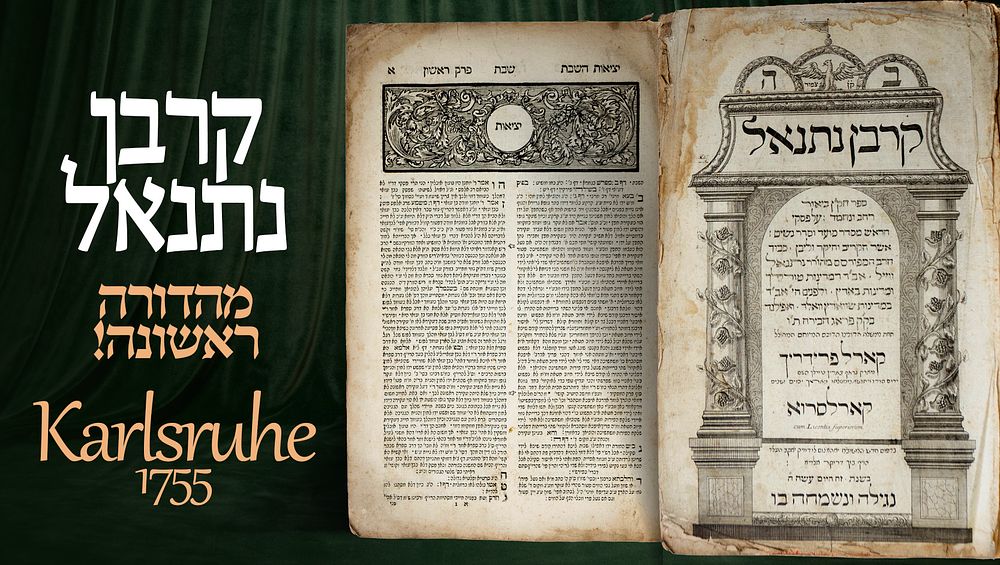
Korban Nesanel, by HaGaon Rabbi Netanel Weil. Karlsruhe, 1755. First Edition Sefer Korban Nesanel, a commentary on the doubts of the Rosh on the orders Moadim and Nashim, by Rabbeinu Nesanel Weil. Printed by Johann Ludwig Jakob Höller, Karlsruhe, 1755. First edition. [2], 148, [3] leaves. On leaf 148, the author recounts the kindnesses of Hashem bestowed upon him, from which details of his life may be learned. HaGaon HaKadosh Rabbeinu Nesanel Weil (1687–1769), author of Korban Nesanel, was the seventh-generation descendant of Mahar”i Weil (Mahari”v). He was the brother-in-law and foremost disciple of the great disseminator of Torah of his generation, Rabbi Avraham Broda, Av Beis Din of Frankfurt, and remained constantly at his side. After the passing of his Rebbe in 1717, he moved to Prague, where he served as Dayan and Halachic decisor and headed a Yeshiva, producing distinguished students. Regarding this period, his son relates: “His diligence in Torah study cannot be described: first, every day throughout his life until the day of his passing he reviewed eighteen chapters of Mishnah daily. Second, he taught publicly in the Yeshiva the entire Shas, even the orders Zeraim and Taharos… Every day, he would arise after midnight to recite Tikkun Chatzos and review his studies. He also studied Tanach every year.” During his years in Prague, he began composing his famous work Korban Nesanel on the Rosh (continuing the work begun a generation earlier by the author of Tosafos Yom Tov). In 1745, following the expulsion of the Jews of Bohemia, he moved to the Black Forest region of Germany, where he continued writing his great work. In 1750 he was appointed Rav of Karlsruhe, where he served until his passing in 1769. In addition to his renown as a towering scholar in the revealed Torah, the author of Korban Nesanel was also a hidden Mekubal, engaged deeply in the secrets of the Torah. He possessed vast mastery of the writings of the Ari z”l, the Ramaz, and the Rema of Pano. Writing Sifrei Torah was for him a complete Avodah, particularly the writing of the sacred Divine Names with profound Kavanot and Yichudim. Worn binding; front cover detached; stains; loose spine; gatherings of the first [2] and last [3] leaves detached; worming. Fair condition.