Bidspirit auction | Roman Life-Size Marble Statue of
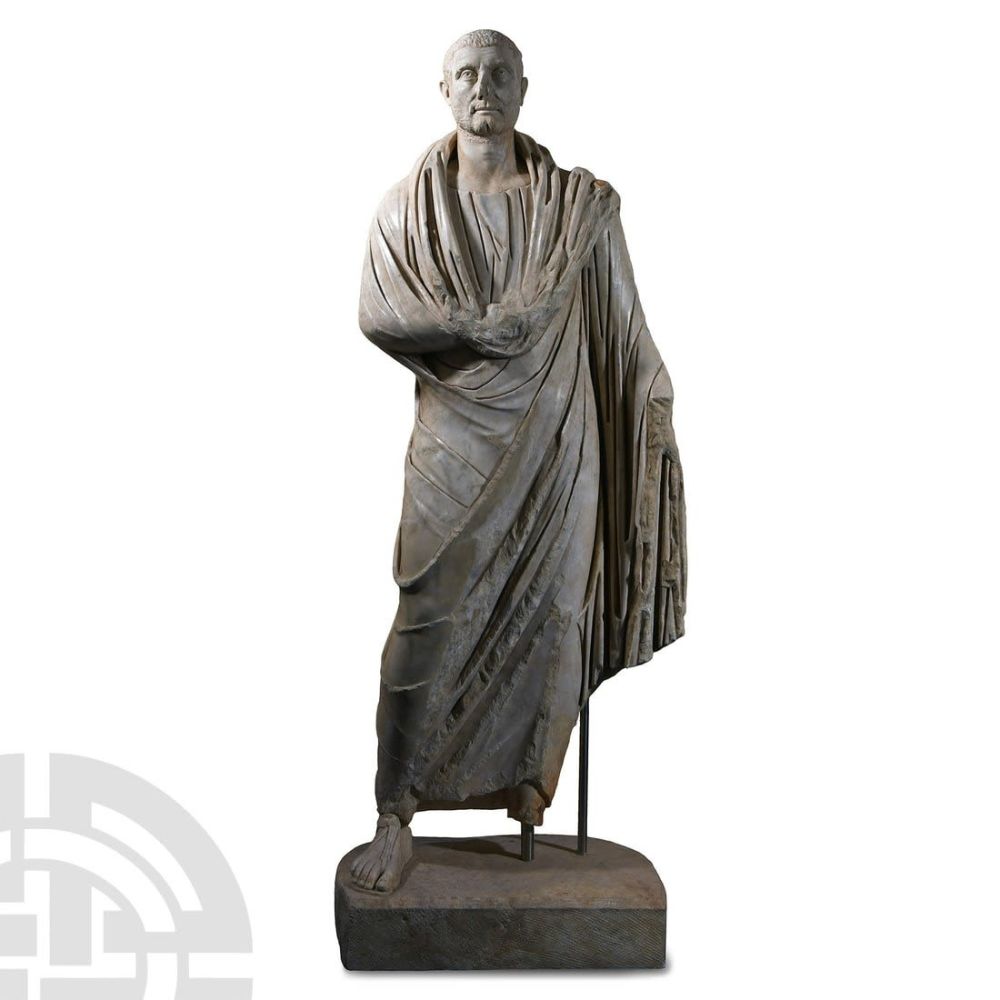
Roman Life-Size Marble Statue of an Important Magistrate - Late 3rd-early 4th century A.D.. Clad in a symmetrically incised late Roman toga, which was originally painted; the right hand covered by the robe and resting against his chest, the now lost left hand probably held a rank symbol or a scroll; short hair, cut according to the style of the Tetrarchy, wide eyes and pronounced lips; beard extended under the chin and on the throat; crepida sandal of Greek typology still visible on the right foot. See Calza, R., Iconografia Romana Imperiale. Da Carausio a Giuliano (287-363 d. C.), Rome, 1972; L?Orange, H.P., Das sp?tantike Herrscherbild von Diokletian bis zu den Konstantin-S?hnen, 284-361 n. Chr. Das R?mische Herrscherbild. III. Abteilung, Bd. 4, Berlin, 1984. 700+ kg, 206 cm including base (81 in.). From the C.M. collection, Switzerland.Formerly the property of his father, H.V.C., Munich, Germany; forming a central part of the H.V.C. family collection in the 1980s.Acquired from the private collection of L.H. of Munich, Germany, in 1982.Accompanied by a copy of an German cultural export licence.Accompanied by an academic report by Dr Raffaele D?Amato.Accompanied by a geological report No. TL3253 by geology consultant Dr R. L. Bonewitz.This lot has been checked against the Interpol Database of stolen works of art and is accompanied by search certificate no.12089-211955. This statue of a Roman magistrate represents a high-ranking citizen with political and ritual responsibilities. The stylised facial features date it to the period of the Tetrachy under the Emperor Diocletian (284-305 A.D.), when representation of the human form began to show a concern for geometry and symmetry. A similar style can be seen in official portraits of Diocletian, Galerius, Constantinus Chlorus, and Maximianus Herculius. Despite the stylisation typical of the era, however, the sculptor of this lot has taken pains to add personal details, such as the dimpled chin and creased forehead. Its powerful resemblance to Imperial portraiture stems from the desire of magistrates to emulate emperors in the way they represented themselves. This is a piece of outstanding quality, and unlike other Late Roman sculptures, in which a portrait head is often attached to an earlier body, it appears to have been created as a whole. It shows exceptional attention to detail, including in the magistrate?s beautifully carved footwear. It is likely to represent an official of an Eastern Empire city, either in Greece or Illyria. [A video of this lot is available to view on Timeline Auctions Website]