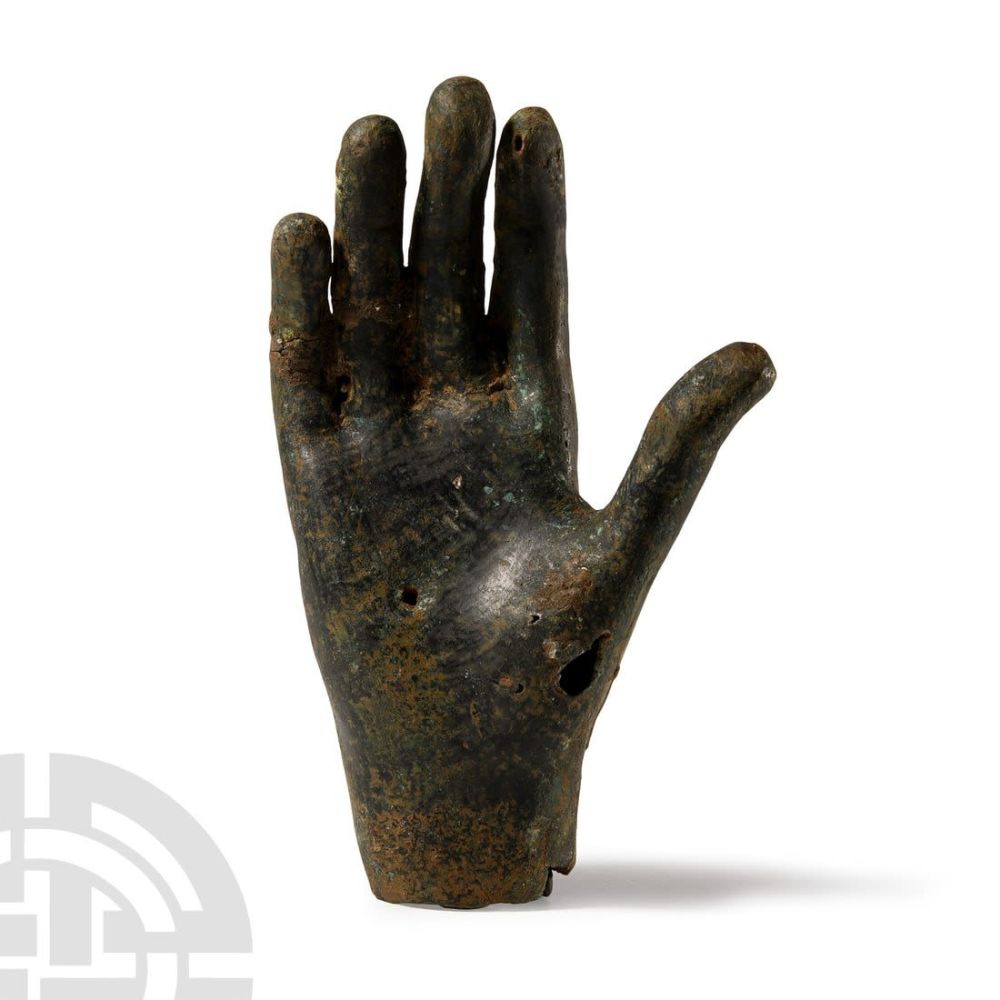
Bidspirit auction | Roman Bronze Hand-Shaped Military Standard
Roman Bronze Hand-Shaped Military Standard Finial - 1st-3rd century A.D.. Hollow-formed with fine detailing to the fingers and nails; with fixing points for a military standard (signum) used by each unit under a centurion, originally fixed with the palm facing forwards inside a wreath. Cf. a similar item from Martigny, in Z?rich, Schweizerisches Landesmuseum, inventory nr. 41434, see Von Gonzenbach, V., 'Fides Exercituum, eine Hand von Vindonissa', in Jahrbuch der Gesellschaft Pro Vindonissa, 1951-1952, pp.5ff.; D?Amato, R., Arms and armour of the Roman Imperial Soldier, 112 BC - AD 192, London, 2009, p. 170, fig.239; Toepfer K.M., Die r?mischen Feldzeichen in der Republik und im Prinzipat, Mainz, 2011, NZ52; D?Amato, R., Roman standards and standard-bearers, (1), 112 BC - AD 192, Oxford, 2018, p.31. 718 grams, 21 cm (8 1/8 in.). Acquired in Europe before 2000.European private collection.Accompanied by an academic report by Dr Raffaele D'Amato. This lot has been checked against the Interpol Database of stolen works of art and is accompanied by a search certificate number no.12003-211851. Roman military signa decorated by phalerae and surmounted by a right hand are visible since the Late Consular Age. The hand (manus) symbolised the fides, i.e. the allegiance between the soldiers and the Res Publica. It is also possible that the hand belonged to a statue in which it was extended as a sign of silence, to allow the speaker to speak. However, the iconography of military hands, and also the resemblance with a bronze hand (military signum) preserved in the Vindonissa museum (Windisch), support the possibility that the object was part of a military standard. (For this specific lot, 5% import VAT is applicable on the hammer price.) [A video of this lot is available to view on Timeline Auctions Website]