Bidspirit auction | Marcel Janco
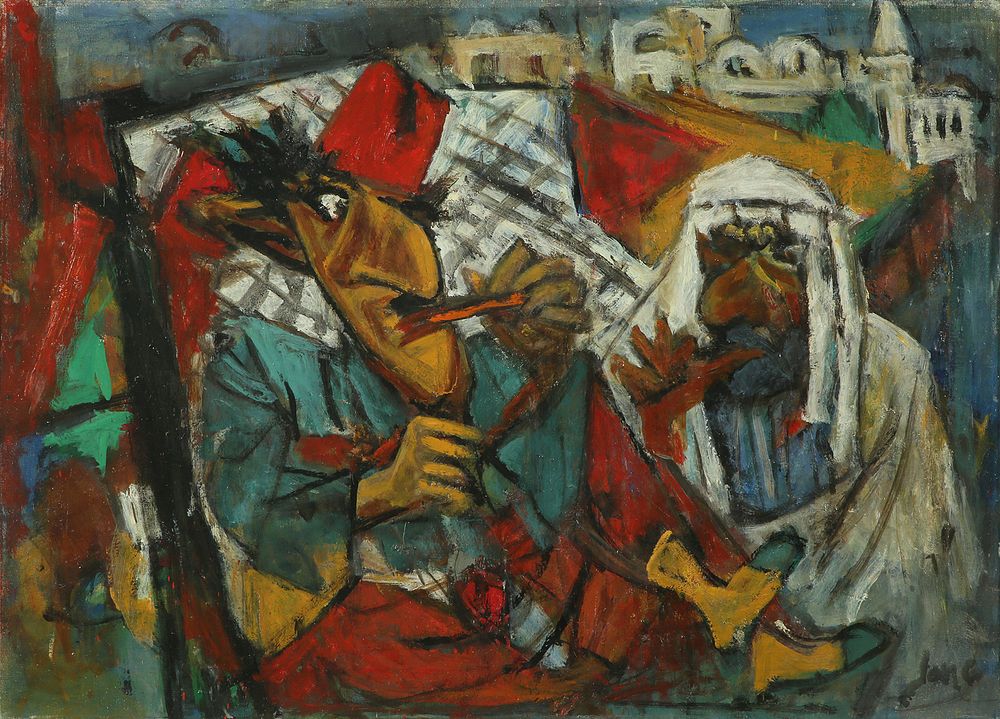
Marcel Janco - 1984 - 1895. Oriental Figures, Oil on canvas, 53x74 cm. Signed. Janco Atelier label on the reverse. Marcel Janco, a Jewish-Romanian artist, was one of the earliest artists in the Land of Israel to openly identify with Zionism. He left behind modernist Europe and took a clear stand: to build and to create. In his paintings from 1940 to 1944, we see decorative lines, flat figures, and vibrant colors — yet also an orientalist and patronizing gaze. He presents the local Arabs as “types, ” sometimes grotesque, and sometimes merely picturesque, and portrays them as inferior to the Jews. Janco, born in Bucharest in 1895, was one of the founders of the Dada movement in Zurich. After immigrating to the Land of Israel in 1941, his work continued to reflect his European past — yet it also marked a deliberate turn toward a new artistic and national path. He joins the national effort, contributes to the shaping of cultural life in the Yishuv, and participates in the formation of a Zionist visual language. Among his prominent works from this period is the painting Two Yemenites (1941), in which he depicts two Yemenite Jews — a man and a woman — standing stiffly in profile. Their clothing is folkloric; their faces, masklike. The figures are stylized to the point of abstraction. Although Janco honors their “authenticity, ” he also turns them into museum-like exhibits, reducing their individuality in favor of typology. In another painting, Coffeehouse in Jaffa (1942), Arab men sit at tables, smoking and talking. Their features are distorted, sometimes caricatured. The background is decorative and bright. Here too, Janco aestheticizes the East — both fascinated and detached. The painting captures the tension between attraction and alienation, between admiration and superiority. Janco’s contribution to the formation of local art is enormous. As an artist, teacher, and founder of the Ein Hod Artists’ Village, he helped shape the modernist language of Israeli painting. Yet his early works in the country reflect a colonial gaze: the East as a spectacle to be consumed, as color and costume, as the “other” to European modernism.