Bidspirit auction | Yochanan Simon
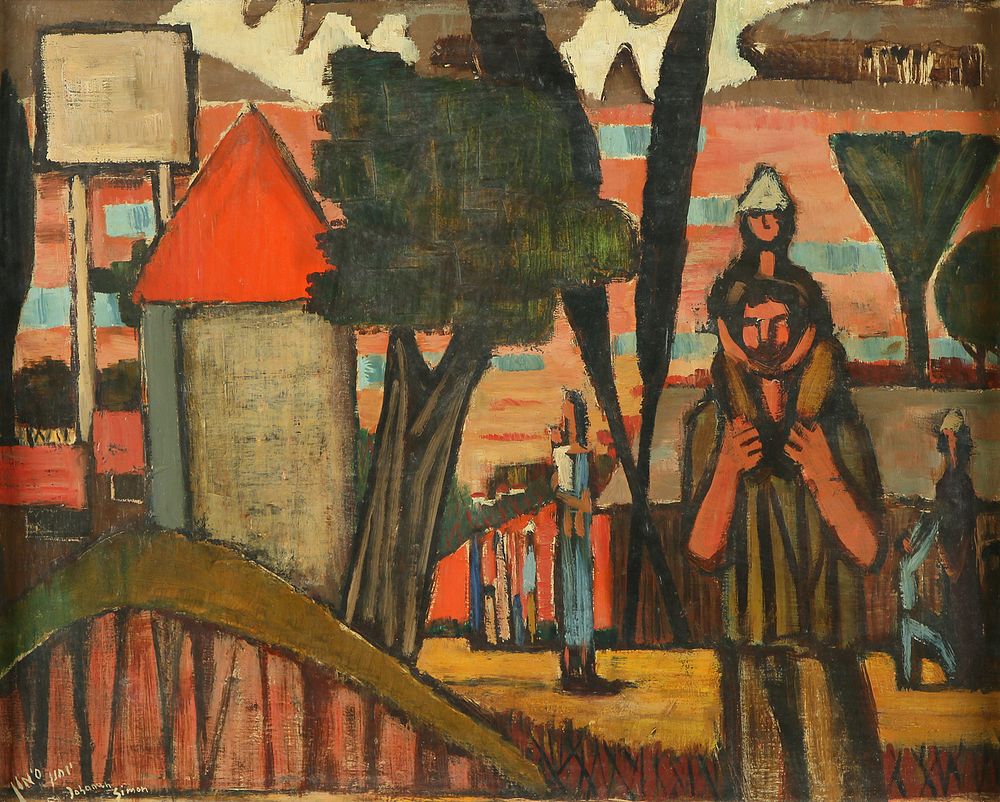
Yochanan Simon - 1905 – 1976. Parenting in a Kibbutz, 1954, oil on canvas, 48x60 cm. Signed and dated. Yohanan Simon, born in Berlin in 1905, studied at the Munich Academy of Art and later at the Bauhaus in Dessau. In 1936, he immigrated to Palestine and joined Kibbutz Gan Shmuel, where he lived until his death in 1976. Simon’s life in the kibbutz had a profound impact on his art and ideology. He created many murals in public spaces such as dining halls, auditoriums, and cultural buildings — works that were defined by scholars as “Red Wall Art.” This term refers to the idealistic, collectivist spirit of the kibbutz and the socialist vision of the workers’ movement. His murals depict joint labor, fieldwork, harvest, celebrations, and youth. The figures are often faceless or generalized, without individual traits. They work in coordinated groups, in harmony with one another and with the land. Simon used strong, contrasting colors, a flattened perspective, and compositional symmetry — all to underscore the idea of collective unity. One example is the painting Work Scene with a Father and Daughter, where a father carries his young daughter on his shoulders. The scene is both intimate and emblematic — the child as the future, supported by the laboring generation. The background is a vibrant landscape: fields, trees, and blue sky. Yet beneath the celebration lies a trace of fatigue, of ideological effort. The characters are not ecstatic; their expressions are serious, absorbed in purpose. Simon’s art was part of a broader visual project to shape the image of the “New Jew”: strong, healthy, rooted in land and labor. His murals were not just decorations but educational tools. They instructed the viewer on values — work, solidarity, renewal — and placed the collective above the individual. But Simon was also aware of tension. In some of his works, cracks appear in the utopian vision. A figure rests alone. A gesture betrays exhaustion. In this way, his work oscillates between propaganda and realism, between dream and doubt. It reflects both the myth and the burden of the Zionist enterprise.