Bidspirit auction | Israel Paldi
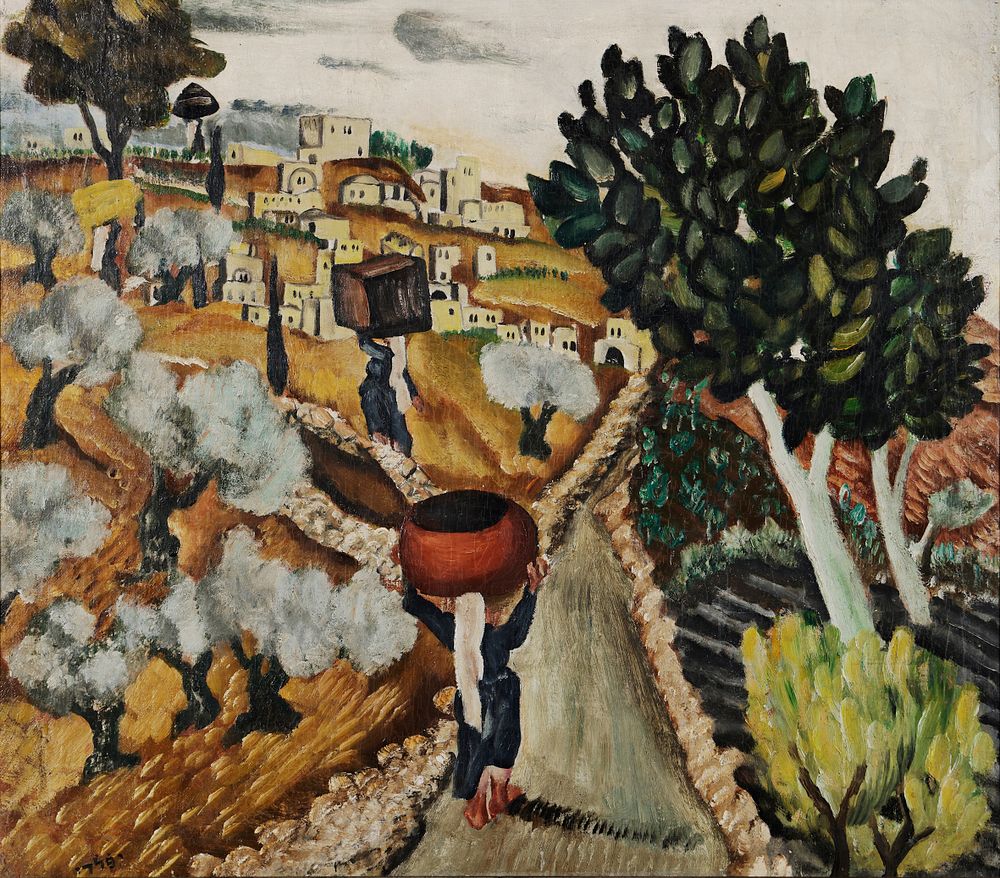
Israel Paldi - 1892 – 1979. Carrying a Pitcher along the Path, 1920s, oil on canvas, 54x61 cm., Signed. Collection Of Nathan Kaplan, Chicago, USA. Loaned to the Israel Museum until 2010. Israel Paldi's works from the 1920s are considered one of the most important and poetic expressions of the beginnings of modern painting in the Land of Israel. During this period, Paldi turned repeatedly to the landscapes of the land, the Arab villages, the local figures, and the Mediterranean nature, and built a distinctive pictorial language that combined European modernism with a deep attraction to Eastern culture and local light. Like the artists of his generation - Reuven Rubin, Nachum Gutman, and Tziona Tagger - he saw in the Land of Israel a new world, ancient and simple at the same time, a space in which man, earth, and nature coexist in an almost mythical harmony. In his paintings from the years 1920–1929, figures of local Arabs appear repeatedly- peasants, shepherds, water carriers, and laborers- as an inseparable part of the Land of Israel’s landscape. Paldi did not portray them in a political or dramatic manner, but rather as natural and authentic elements of the ancient land. The Arab villages, the terraced stone houses, the winding paths, and the agricultural terraces became for him symbols of simplicity, rootedness, and a life bonded to the earth. The figures are absorbed into the landscape, and at times it seems as if the mountains, the trees, and the people are made of the same pictorial matter. Local vegetation played a central role in his work. The olive trees, cypresses, cacti, and the brown-golden earth are not merely a botanical description; they are part of the symbolic atmosphere he sought to create. Specifically, the olive trees signify antiquity, continuity, and a deep bond with the land, while the radiant light and warm coloration lend the landscapes a dreamlike, idealized quality. Paldi was influenced by European Expressionism and French Modernism, but he translated them into a local language full of rhythm, color, and materiality. His broad brushstrokes and seemingly simple compositions create a sense of movement and vitality, even when the landscape itself appears quiet and eternal. These paintings have considerable historical and artistic importance, for they document the way in which the artists of the Third and Fourth Aliyot imagined the land and sought to shape a new visual identity for Hebrew art. They are not merely depictions of landscape, but a cultural vision of the Land of Israel as an ancient, Eastern, and spiritual space. Owing to their great importance and the high demand for early Paldi works, it is very rare to find pieces from this period outside of museum collections or the collection of the Phoenix Insurance Company- which holds one of the most important collections of early Israeli art. Nathan Kaplan was a Zionist activist from Chicago who worked to raise donations for the realization of the Zionist dream and the purchase of land in the Land of Israel, and was later appointed to fill the seat of Tel Aviv's first mayor, Meir Dizengoff, on the city council. In 1927 he received an appointment on behalf of the American Zion Commonwealth, a Zionist settlement company established in the United States to purchase land in the Land of Israel for Jewish settlement during the pre-state period. The company was involved in founding settlements and towns such as Afula, Herzliya, and Kiryat Ata. Kaplan succeeded in mobilizing American politicians on behalf of the Zionist enterprise, was active in fundraising, and successfully negotiated with the British authorities as the flow of immigrants from Europe surged at the end of the First World War. During the 1920s, Kaplan became acquainted with Joseph Zaritsky and Elias Newman and began acquiring works from them. He then acted not only on the political plane but also worked to organize exhibitions of Bezalel artists in Chicago and New York, and likewise managed to acquire early and rare works by the leading artists of the 1920s and 1930s. A significant portion of these works, including those by Israel Paldi, Menachem Shemi, and others, were placed on long-term loan at the Israel Museum and were displayed in exhibitions there. In 1936, as noted, Kaplan was selected to succeed Meir Dizengoff as mayor of Tel Aviv upon the latter's death, but he declined to accept the position, believing that the mayor should be someone who had been born and raised in the Land of Israel.