Bidspirit auction | Reuven Rubin
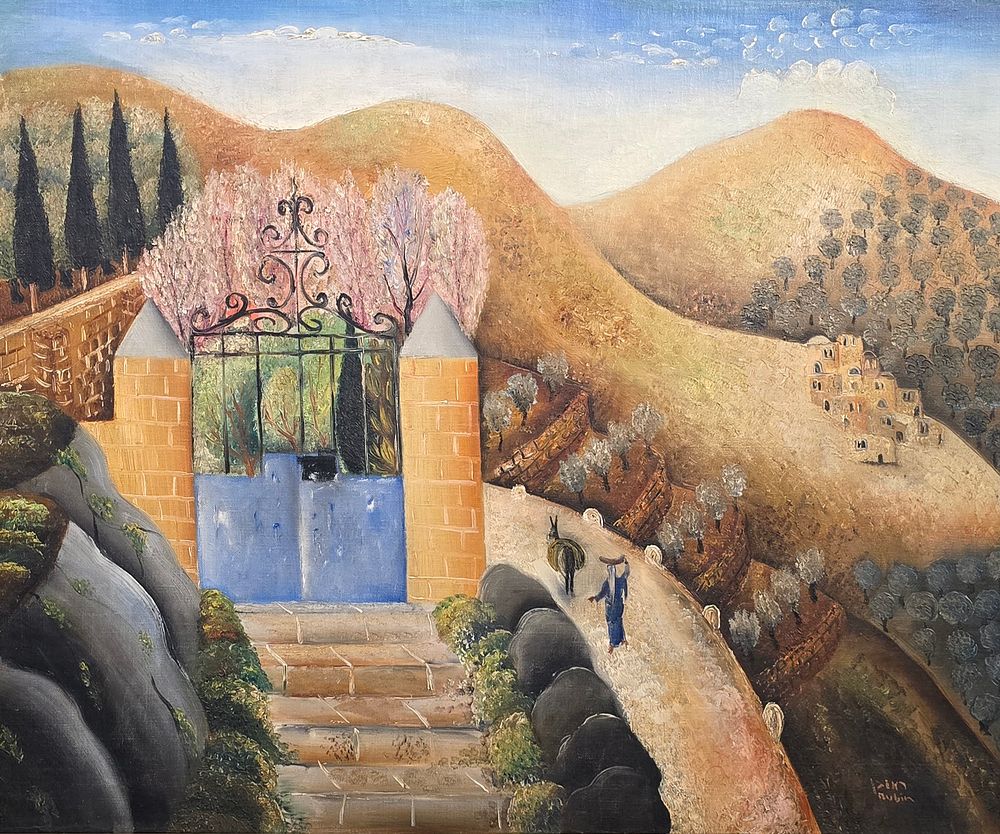
Reuven Rubin - 1893 – 1974. Gate at Ein Karem, Jerusalem, 1929, Oil on canvas, 60x73 cm., Signed. The authenticity of the painting was confirmed by Ms. Carmela Rubin, Reuven House, Tel Aviv. Collection of Gerda and Joseph Brender Exhibitions: • Views of Jerusalem, 40th anniversary to Israel, Beit Reuven, Tel Aviv, 1988. • Reuven Rubin, Dreamland, Tel Aviv Museum of Art, 2006. This precious painting- yet another of the beautiful “paintings of innocence” of the Land of Israel that Reuven Rubin painted during the sweet 1920s- is all blossom and light, soft and winding lines, and air clear as wine. It depicts the landscape of Ein Karem, at the center of which stands a blue, locked gate that conceals a flowering garden. Between 1925 and 1927, Rubin the Tel Avivian traveled throughout the country and painted Tiberias, Safed, and Jerusalem: “Jerusalem, Tiberias, Safed, and Jaffa appeared in my paintings in the colors of my imagination, ” he said. And indeed Jerusalem appears, ancient and dreamlike, from various viewpoints: Herod's Gate (the Flower Gate) and the walls of the Old City, a view of Mount Scopus, the road to Mount Zion, and the hilly Ein Karem neighborhood whose magical landscapes drew his heart in particular. Rubin's Land of Israel in the 1920s is a dreamlike, Orientalist space in which there are as yet no visible signs of the Zionist enterprise being woven within it. He focused his statement on the pioneers in the Land of Israel in his painting First Fruits (1923), while he left the landscapes primordial and visionary, wrapped in the threads of reverie. The painting before us is composed of various elements that Rubin combined together, not necessarily according to any precise geographical source. Rubin's paintings, Bialik wrote on February 18, 2026, in the newspaper Haaretz, depict a country that is entirely a midrashic legend, a land that “thus was revealed to us and sealed in our blood and minds from childhood through Rashi's commentary and the Midrashim, and through the folktales - written and oral - and so we carried it, bound up in the hidden bundles of our soul, until we arrived here.” This painting too, depicting the landscape of the land, “its mountains and its cities, its gardens and its valleys, its elders and its women, its Jews and its Arabs, its donkeys and its goats, its stones and its plants…” (Bialik), is a combination of various elements characteristic of the environment: soft curves of hills covered with downy vegetation, a brick wall crossing the landscape, agricultural terraces, olive groves, spear-like cypresses, and a cluster of Arab village houses huddled together at the foot of the hill. Along the white path that appears in many of Rubin's landscape paintings walks an Arab woman, a basket on her head, alongside her donkey carrying its load on its back, the two moving to the rhythm of the Orient. But the crowning glory of the painting is undoubtedly its mysterious and erotic heart: the pink blossom behind the blue gate… The painting begins at the staircase ascending to the gate, but the gate appears locked and we cannot penetrate the garden’s secret. A similar blue gate also appears in another painting from the same year, depicting a well-house on the Jaffa–Tel Aviv border; but it is planted in a flat lowland landscape. This time, set against a flowering, hilly landscape, Rubin painted the blue gate standing between two stone pillars and adorned with wrought-iron motifs (which are not crosses). The fine detail and color density echo the naïve painting of the French artist Henri Rousseau, whom Rubin embraced in the 1920s, learning from him to set apart each tree and each branch separately and to give every tiny figure a role within the small visual drama orchestrated inside the square of the painting. But in those distant days, “all these come jumbled together, joined in unexpected combinations, ” Bialik explained. And today, all that remains for us is to gaze at this enchanted painting with longing and to set sail in our imagination together with Rubin. Tali Tamir Gerda and Joseph Brender were among the leading figures in the world of art, philanthropy, and the Jewish community in Australia in the second half of the 20th century. The couple, based in Sydney, combined exceptional business success with a deep commitment to culture, education, and Jewish historical memory. Gerda Brender carried with her an extraordinary story of survival and renewal. In her childhood, her family fled from Vienna to Shanghai, one of the few places that took in Jewish refugees during the Second World War. Many years later, she received international attention when her wartime passport which had been lost in Shanghai, was recovered and returned to her in a moving ceremony in the city. The story became a symbol of memory, identity, and Jewish continuity. Joseph Brender arrived in Australia in the 1950s after his military service in Israel,