Bidspirit auction | Reuven Rubin
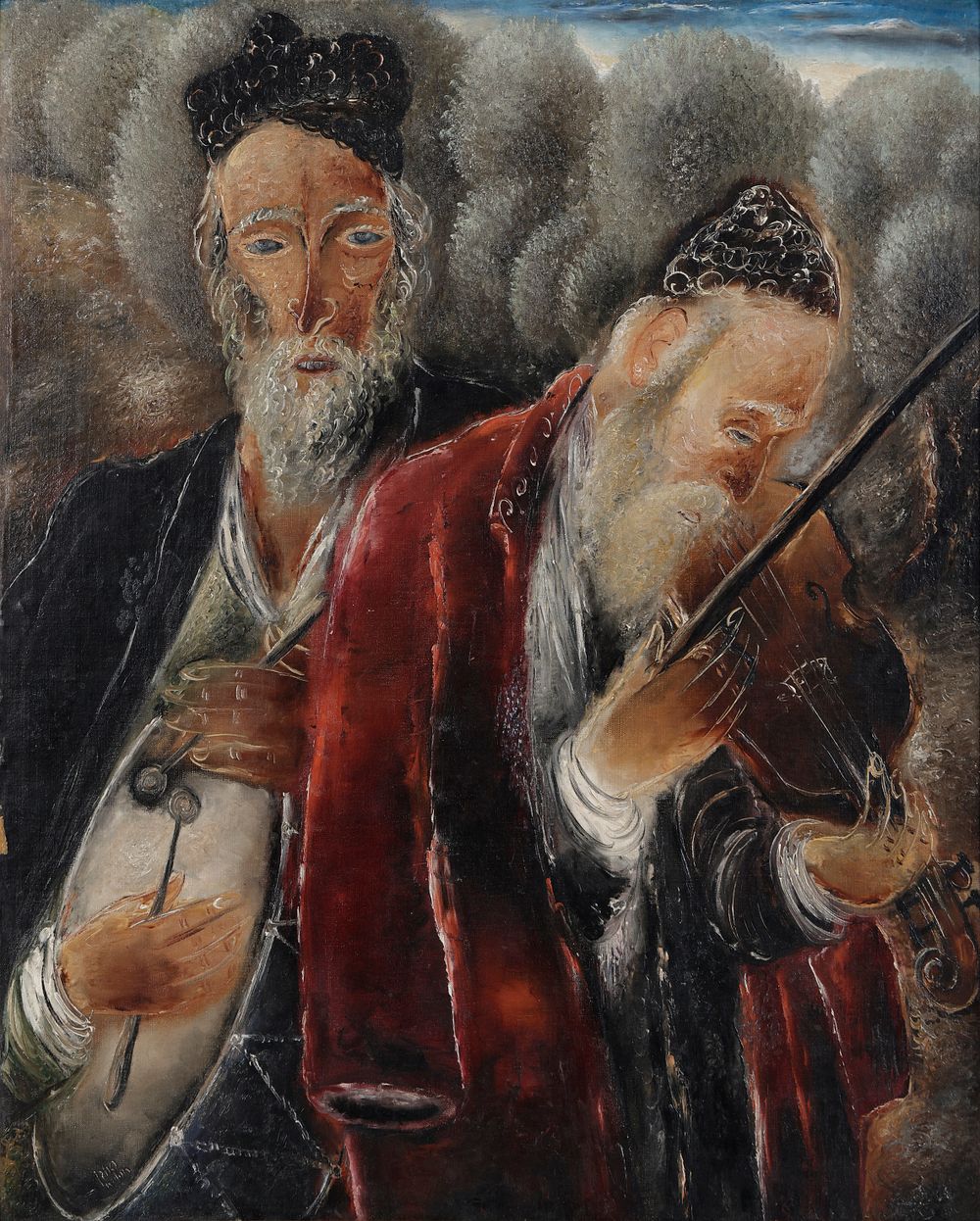
Reuven Rubin - 1893 – 1974. Two Musicians, 1930, Oil on canvas, 92x73 cm, Signed. The authenticity of the painting was confirmed by Ms. Carmela Rubin, Reuven House, Tel Aviv. Collection of Greda and Jodeph Brender, Sydney, Australia. Exhibitions: Solo exhibition, Guarino Gallery, New York, 1928. Group exhibition of the ”Israeli Artists Association”, ”The Artists' Pavilion”, Rothschild Boul., Tel Aviv, 1932. This painting has two brothers, a trio born at short intervals during the same year, 1938. The same musicians return in each of the three paintings; what distinguishes each picture from its “brothers” is the number of musicians: in one, only the drummer appears; in the second, only the drummer and the violinist; and in the third - the present painting - the clarinetist joins them. The Safed klezmer trio is made up of aged Hasidim, white-bearded, with wool skullcaps on their heads, kapotas on their bodies; presumably they have been returning for decades to gladden the Jews of the Galilee at wedding celebrations, bar mitzvahs, Purim, and so on. But their pinnacle is on Lag BaOmer, when they play at the hillula of Rabbi Shimon bar Yochai and rouse the crowd by the light of the bonfire with the beloved song Bar Yochai. To put it differently: this is not exactly “Musicians in Safed”, but rather musicians on the road from Safed to the Rabbi's tomb in Meron. Thus, while in the present painting only a handful of olive trees appear in the background, in the second painting (with two musicians) we already see the olive grove almost in its entirety; and in the third painting (with only the drummer, who this time also holds cymbals) a deep panoramic background is revealed, with a path that winds and rises from the grove to the tomb-marker near the summit of Mount Meron. In other words, the trio of paintings clarifies for us, step by step, the location of the “trio” in the painting before us. Reuven Rubin of 1938 had brought to full maturity the soft, poetic Expressionism, bathed in cotton-like whiteness, that he had adopted nearly a decade earlier. By now he was a familiar and esteemed painter in Israel and abroad, also commercially very successful, who had exhibited widely in Europe and the United States; and a major exhibition of his work had recently traveled from the Tel Aviv Museum to the Bezalel Museum in Jerusalem. The “Arab Revolt” and the bloody disturbances in the land of Israel between 1936 and 1939, to say nothing of rising fascism in Europe- left no trace in his work, just as they did not prevent the establishment of the Philharmonic Orchestra in 1936, the continuation of construction on the Habima building, or the opening of Tel Aviv Port to passenger traffic in the same year in which this painting was made. Soon afterward World War II would break out, and Reuven and Esther Rubin would spend it in the United States. Another version of the present painting would be painted in 1965, in which the musicians' eyes are closed and only the sky appears in the background, testifying to the fact that Rubin held this painting in high regard and granted it four different versions. Gideon Ofrat Gerda and Joseph Brender were among the leading figures in the world of art, philanthropy, and the Jewish community in Australia in the second half of the 20th century. The couple, based in Sydney, combined exceptional business success with a deep commitment to culture, education, and Jewish historical memory. Gerda Brender carried with her an extraordinary story of survival and renewal. In her childhood, her family fled from Vienna to Shanghai, one of the few places that took in Jewish refugees during the Second World War. Many years later, she received international attention when her wartime passport which had been lost in Shanghai, was recovered and returned to her in a moving ceremony in the city. The story became a symbol of memory, identity, and Jewish continuity. Joseph Brender arrived in Australia in the 1950s after his military service in Israel, and together with Gerda he built one of the largest textile and fashion empires in Australia, establishing their position as central supporters of the country's leading cultural institutions and of the Jewish community in particular. In the 1980s, the couple were among the figures who helped make Australian art more accessible and more highly valued by the general public. Through their fashion company, Katies, they initiated significant sponsorships of Australia's most important art prizes and donated substantial sums to Jewish institutions in Australia as well as to academic and cultural institutions in Israel. Alongside their public activity, the Brenders built over decades an exceptional art collection of unusual quality and scope, reflecting refined taste and deep connoisseurship. Alongside masterworks of modern Australian art by Arthur Boyd, Sidney Nolan, and Russell Drysdale,