Bidspirit auction | Nachum Gutman
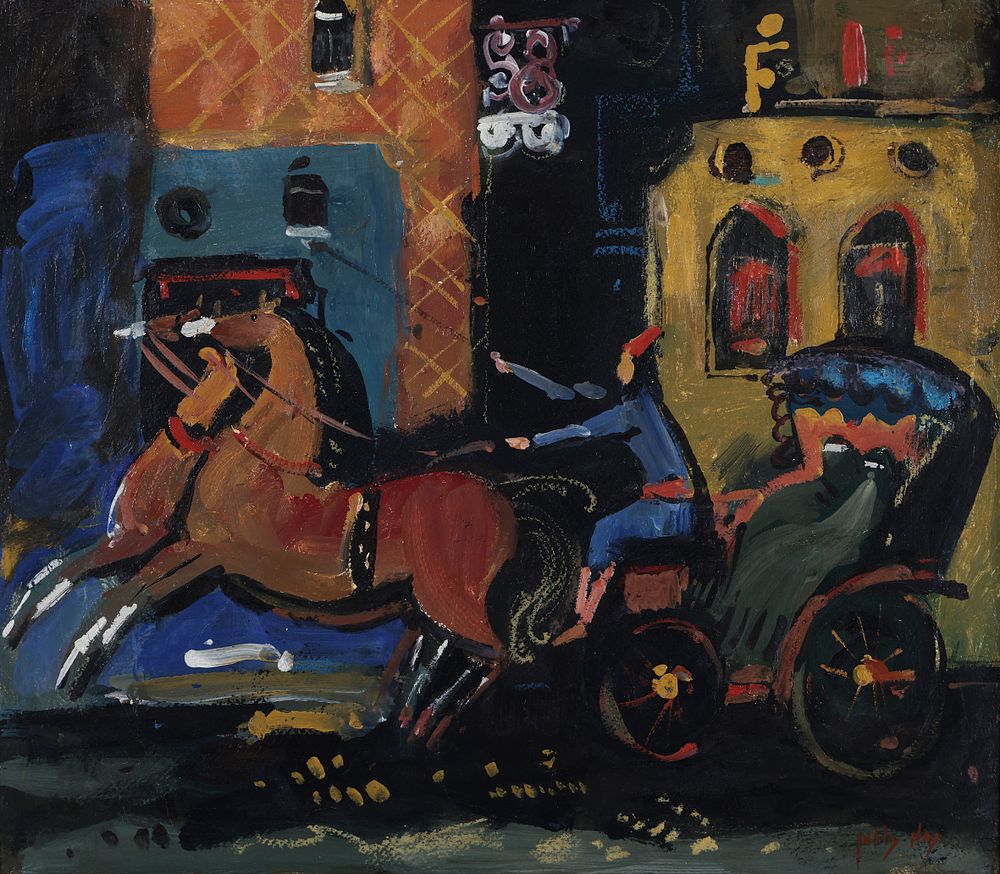
Nachum Gutman - 1898 – 1980. Carriage, Oil and gouache on paper laid down on canvas, 38x43 cm. Signed. The authenticity of the painting has been confirmed by Prof. Hemi Gutman, the artist’s son. The atmosphere that Nachum Gutman found in Jaffa left an imprint on him that lasted throughout his life and work. He was drawn to its manners, to the slow rhythm of life, to the figures who moved through its streets, to the smell of the port, and to the glaring light that colored every corner with a chromatic richness he had not known in his cold early days in Eastern Europe. “In the Oriental atmosphere that surrounded us, I sensed a strong ferment of the will to live, of healthy instincts and a natural bond with the landscape, ” Gutman attested. “I later tried to give expression to these in my paintings.” It was a love rooted in a local and intimate childhood experience. “A particular kind of art that grows out of a place, providing a full and unaffected translation of landscape, ” wrote Adam Baruch. The Land-of-Israel current to which Gutman belonged sought to detach Jewish art from the diaspora and to find a new visual language of a new Jew, native to the country and connected to its soil. The figure of the Oriental Arab was a symbol of that instinctive directness to which the Sabra aspired. The sense of belonging to the land and the landscape was a living reality for Gutman; he did not adopt this view out of ideology. It was, simply, the backdrop of his homeland. He absorbed it through his body, in Neve Tzedek on the border of Arab Jaffa, where he grew up and learned to see while honing his tools as an artist. The carriage in the painting moves slowly through the streets of Jaffa. Under the influence of the German Expressionism that Gutman had encountered in real time, the horse blazes in intense oranges and reds, the street dissolves into patches of deep blue and warm yellow, and the buildings in the background flatten into sharp shapes that no longer obey the traditional perception of deep space. Gutman sees the carriage with his mind's eye. This is the Gutmanian vision present throughout virtually all of his work. It expresses the magic, warmth, and simplicity he experienced in his childhood in Jaffa. The motif of the carriage is, for Gutman, what the sunflowers were for Van Gogh, and not by chance. The carriage was an inseparable part of the atmosphere of early Jaffa, the means of transport of the city's dignitaries, a symbol of that very rhythm that enchanted him. A carriage that gradually disappeared from the streets with the city's expansion and the modernization of life. The colors in his paintings grew more intense the further he was removed in time from his childhood memories. They became more vivid, more emotional, as if Gutman were trying to grasp what was being blurred and lost at the hands of time. “His brush still paints the legend of childhood, which is preferable to any reality, ” wrote the scholar Ehud Ben-Ezer of him. This painting bears witness to that: A Land of Israel painted as a lost Eden, in the very days when Jaffa was being swallowed up in the landscape, within the metropolitan skyline of Tel Aviv.