Bidspirit auction | Nachum Gutman
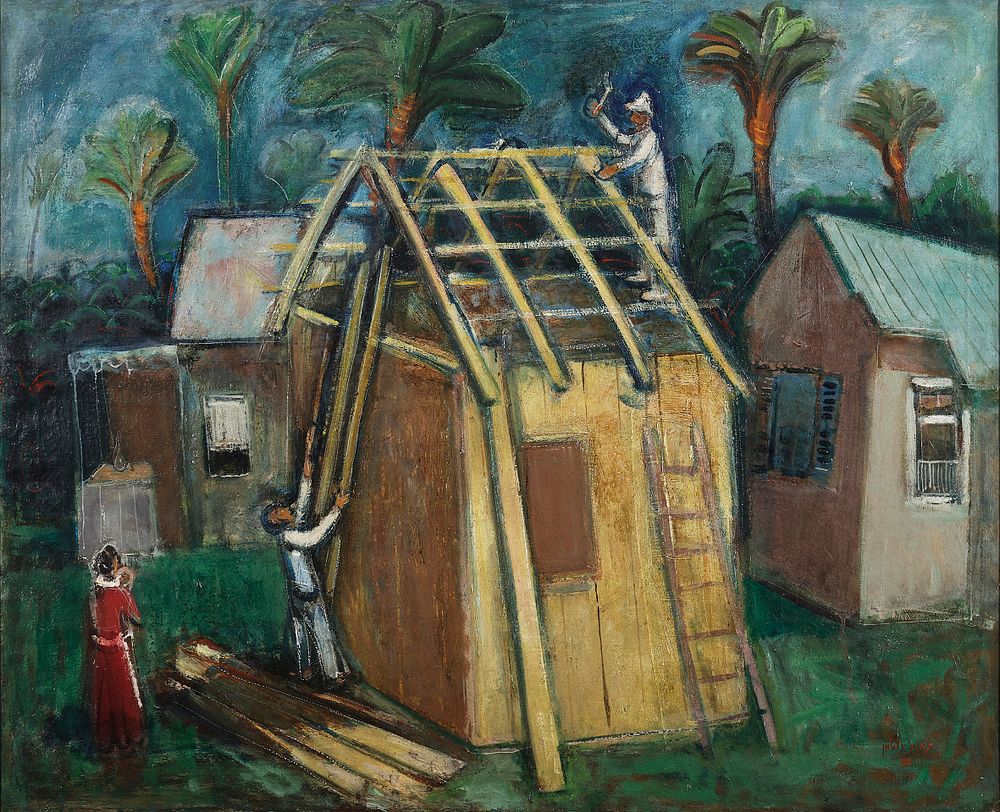
Nachum Gutman - 1898 – 1980. Construction in Neve Shaanan, 1930, oil on canvas, 72x93 cm, Signed and dated. The authenticity of the painting has been confirmed by Prof. Hemi Gutman, the artist’s son. Collection of Rubin and Faigie Zimmerman, Israel. In Ehud Ben-Ezer's book on Nachum Gutman (Masada, 1984) the painting is titled Huts in Neve Shaanan. It is a sister-painting to The Kiosk in Neve Shaanan, also an oil from 1930. Nachum Gutman became acquainted with Neve Shaanan as a Tel Avivian “tourist”, having grown up in the Neve Shalom neighborhood, then in Neve Tzedek, and finally in Tel Aviv. In countless drawings, paintings, and stories, Gutman depicted the dawn of “Ahuzat Bayit” and “Little Tel Aviv, ” just as he devoted many paintings to the alleyways, shops, and houses of Neve Tzedek. About Neve Shaanan he did not write, and he painted it only rarely. But in 1930 Gutman painted two oils of Neve Shaanan, a neighborhood of artisans established in southern Tel Aviv in 1921, close to what would later be known as the old central bus station. Some 400 Jews (foremost among them Yaakov Perremen- remembered as a collector and prolific public figure in Israeli art of the early 1920s) had decided to leave Jaffa in the wake of the 1921 riots, (during which Y.H. Brenner and his friends were murdered in the Jaffa orchards). Moving there, they began to build for themselves wooden huts and auxiliary farmsteads on 214 dunams encircled by Sheikh Ali's vast orchard (note in the painting the orchard in the background of the cluster of huts, including the palm trees rising up from within it). In 1930, the year in which Gutman painted the present work, the “Neve Shaanan” neighborhood was undergoing a wave of development whose centerpieces were the dedication of the Bialik School and the beginning of massive construction of International Style (“Bauhaus”) buildings, days in which the neighborhood also began to disconnect from the existing Tel Aviv core and develop as an independent entity. Nachum Gutman found it difficult to accept the modernization of the neighborhood as it was remembered from its earliest days, and accordingly preferred to represent it as a rural, innocent neighborhood of small wooden huts. In spring 1930, Gutman returned to the country (after roughly half a year in Paris, G.O.) and began working as a painter and editorial team member of Davar LeYeladim. Gutman, upon returning home, took leave of his paintings of Arab shepherds, fellahin, and the Arab woman with the pitcher (the monumental, sublime Easterners who had starred in his works of 1926-1928) and adopted an intense colorist language, leaning toward Fauvism, lighter in brushwork and speaking with a joyful spirit. Gutman's gaze was now directed mainly at the Jewish culture taking shape in the neighborhoods of Tel Aviv, but with an emphasis on an innocence that resists the encroaching urbanism. Comparing his two Neve Shaanan paintings of 1930, Huts and The Kiosk, brings out analogies in spirit, form, and color: the sharp, multi-colored radiance; the focus on a handful of simple forms (the geometry and centering of the huts); the free, personal coloration (such as the roofs in light blue and yellow); the innocent atmosphere; and the social harmony (the easy pleasantness of those seated at the “kiosk, ” which is, in essence, a café). Now, in the Neve Shaanan paintings and in the drawings for Davar LeYeladim, the familiar and beloved Nachum Gutman “ripens” as the friendly painter of Little Tel Aviv as a childlike, enchanted Garden of Eden. Gideon Ofrat Rubin and Faigie Zimmerman are among the most prominent and inspiring figures in the Israeli collecting and philanthropic community. Over many decades, the couple demonstrated a profound commitment to culture, education, healthcare, and social welfare in Israel, combining a genuine passion for art with a broad public vision and a lasting impact on society. Living and working between Canada and Israel, the Zimmermans succeeded in building cultural and human bridges between communities, making support for major Israeli institutions an integral part of their public activity. They were among the significant benefactors of some of Israel’s leading cultural and academic institutions, including the Israeli Opera, the Israel Philharmonic Orchestra, Tel Aviv University, and the Tel Aviv Museum of Art. At the same time, they devoted considerable effort and resources to humanitarian and social causes, supporting a wide range of organizations and initiatives in healthcare and welfare. Faigie Zimmerman was particularly distinguished for her philanthropic and community work. Among her many initiatives, she founded the Aryeh Yehuda Israel Foundation, established to advance educational, cultural, and community-oriented goals while continuing a tradition of philanthropy and civic engagement. The foundation became a further expression of the couple’s worldview — one that regarded culture, education,