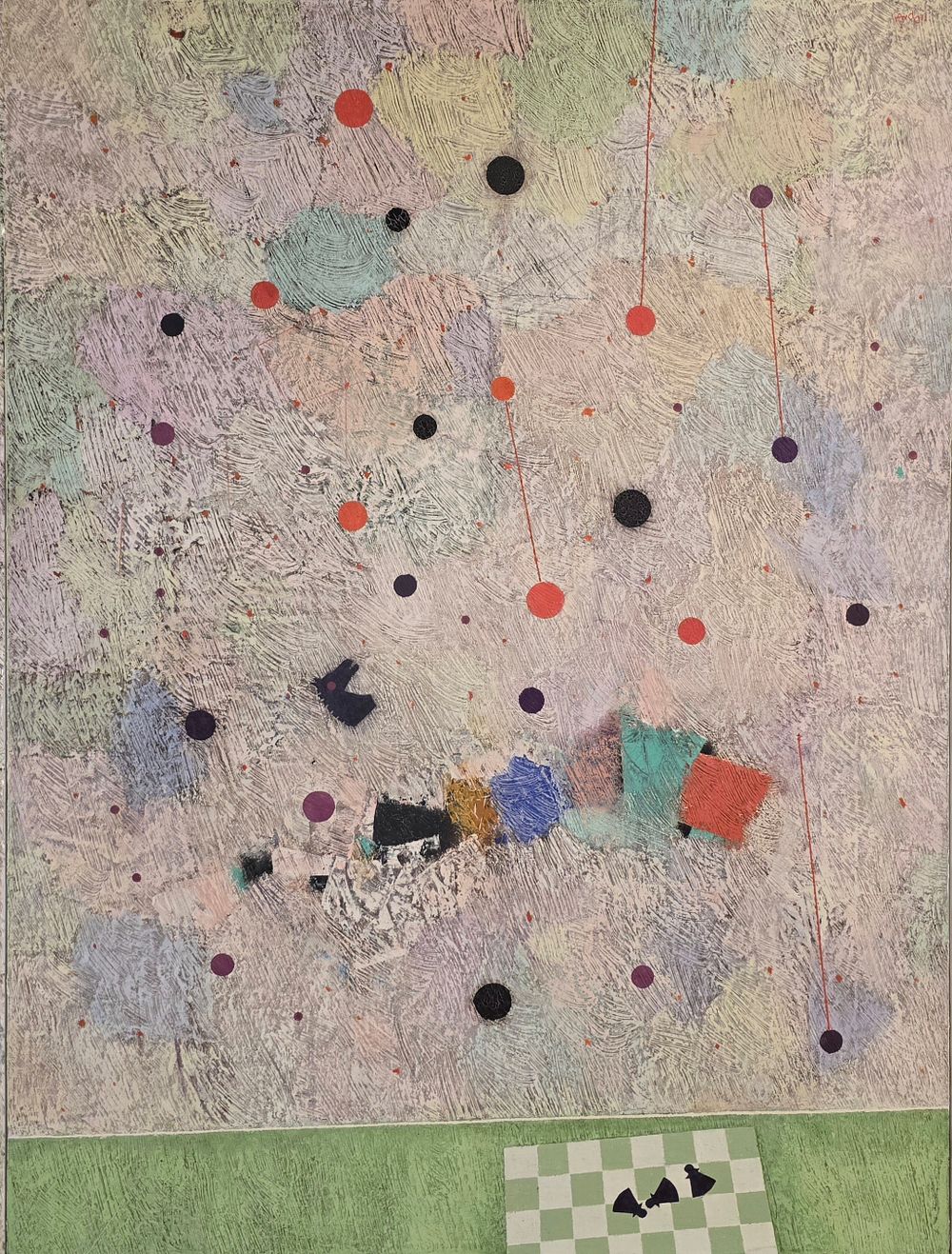
Bidspirit auction | Mordecai Ardon
Mordecai Ardon - 1896 – 1992. Frenzy of the Black Horse, 1972, Oil on canvas, 130x97 cm, Signed, dated on the reverse. Collection of Rubin and Faigie Zimmerman, Israel. Literature: • Mordecai Ardon, Michele Vishny, New York, 1973, p. 234, no. 285 (illustrated). • Mordecai Ardon, Ardon: A Comprehensive Catalog, Dalia Ardon Ish Shalom, Jerusalem, 2019, p. 197, no. 360 (illustrated). Literature and Exhibitions: • Mordecai Ardon, Marlborough Fine Art, London, 1973, no.29, p. 47 (illustrated). • Mordecai Ardon, Retrospective, Tel Aviv Museum of Art, 1985, No. 19 (illustrated). • Mordecai Ardon, Space-Time and Metaphysics, Tel Aviv Museum of Art, 2003, No. 16 (illustrated). • National Library, The Hidden Light of Mordecai Ardon, Selected works, 2003-2004. Ardon was 76 when he painted this work, an artist sated with years and international honors, one who had long since consolidated a language of symbols and abstraction, and who was among the elite roster of the prestigious Marlborough Gallery. The gallery exhibited the painting for the first time in 1973, shortly before it was published in New York in Michele Vishny's celebrated book on the artist. In 1985 the painting was shown in Ardon's retrospective at the Tel Aviv Museum of Art, and since then in further exhibitions. Classic Ardon at his best. Once again, Ardon spreads before us a fateful sky, raked by unrest with an iron comb, in which cosmic spheres in black, red, and brown hover, at times like the pendulum of a clock (in that same year, 1972, Ardon would also paint Giant Clock, some of whose numerals fall from it into the enveloping sky). At the foot of the celestial vision, however, lies a chessboard with only three pawns (“foot soldiers”) on it, black and toppled, a familiar sign of conceding defeat in a game of chess. Now two black “knights” join them, themselves also toppled and lost in space. Since the 1950s, Ardon has often dealt in his paintings with the enigma of human fate in general and with the question of war in particular. Now, the “fall” of the common soldiers (the pawns) is joined by the knights, which combine with the black and red spheres, whose tidings are bitter. By 1972 Ardon had more than once represented in his historiosophical paintings symbols of existential defeat, but he had primarily used images of cards and gaming-dice (as in another 1972 painting of his, The Adventures of the Ace of Hearts). In a 1955 triptych, In Memory of the Fallen, he painted the rickety “House of Cards”, including the cards of the King and Queen, destined to collapse. In The Jester (1958), he painted hosts of cards dripping blood, at whose center are two hands of a clock. The time of life is the time of bitter fate, the time of the tragic game of the defeated. Now, in the present painting, we see only one side of the chess game: the black side. The white player, the winner, remains a mystical riddle. The painter's bitter gaze leaves the human being with the black pieces and with defeat in the battle of life. The absence from the chessboard of the “King, ” the “Queen, ” and the “officers” underscores the abandonment of the common person to a hopeless fate. And all this is painted in a “spring-like, ” light, ostensibly playful -should we say- sarcastic? atmosphere. Those who seek the further reincarnations of the black chess knight in Israeli art will find them in the paintings of Samuel Bak. Gideon Ofrat Rubin and Faigie Zimmerman are among the most prominent and inspiring figures in the Israeli collecting and philanthropic community. Over many decades, the couple demonstrated a profound commitment to culture, education, healthcare, and social welfare in Israel, combining a genuine passion for art with a broad public vision and a lasting impact on society. Living and working between Canada and Israel, the Zimmermans succeeded in building cultural and human bridges between communities, making support for major Israeli institutions an integral part of their public activity. They were among the significant benefactors of some of Israel’s leading cultural and academic institutions, including the Israeli Opera, the Israel Philharmonic Orchestra, Tel Aviv University, and the Tel Aviv Museum of Art. At the same time, they devoted considerable effort and resources to humanitarian and social causes, supporting a wide range of organizations and initiatives in healthcare and welfare. Faigie Zimmerman was particularly distinguished for her philanthropic and community work. Among her many initiatives, she founded the Aryeh Yehuda Israel Foundation, established to advance educational, cultural, and community-oriented goals while continuing a tradition of philanthropy and civic engagement. The foundation became a further expression of the couple’s worldview — one that regarded culture, education, and community support as essential to creating a strong and thriving society. Alongside their public activities,