Bidspirit auction | Reuven Rubin
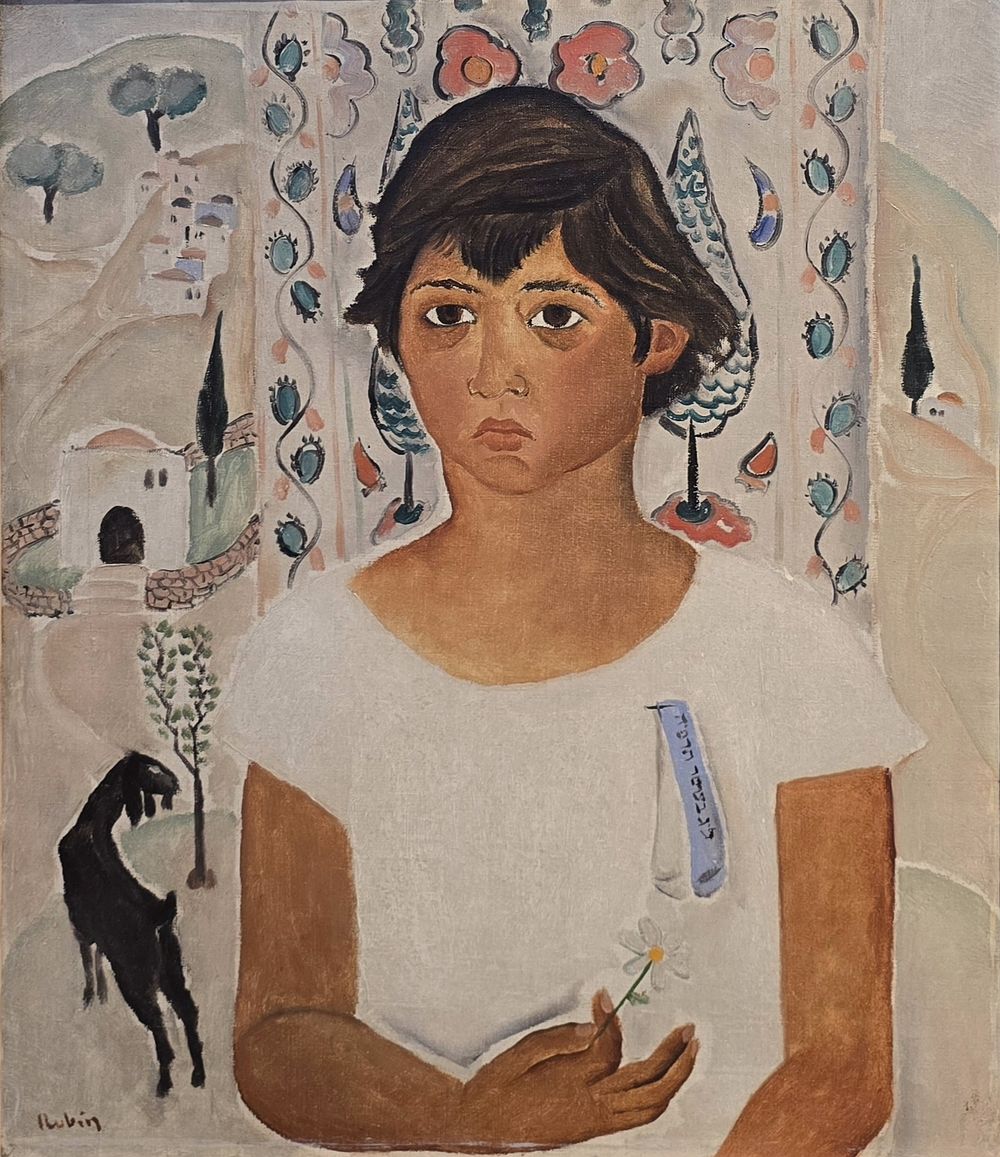
Reuven Rubin - 1893 – 1974. A Jerusalem Girl (Lag BaOmer), 1925, Oil on canvas, 60x50 cm, Signed. Literature: Reuven Rubin, Dreamland, Tel Aviv Museum of Art, 2006, p. 160 (illustrated). Exhibition: Reuven Rubin, painting from Palestine, 1924 - 1926, Galerie Marcel Bernheim, Paris, March 1926 - April 1926. The authenticity of the painting was confirmed by Ms. Carmela Rubin, Reuven House, Tel Aviv. Collection of Rubin and Faigie Zimmerman, Israel. This was the title of the painting, one of Reuven Rubin's rare, eye- and heart-delighting works, when it was shown in 2007 at the Tel Aviv Museum of Art in the exhibition Reuven Rubin: Dreamland. And indeed, the painting unites by allusion two “dream places”: Jerusalem and Safed (or more precisely, the road to Safed; and more precisely still, the road to Meron). The work is unusual in its structure: while the panoramic landscape of the mountain road to Meron is glimpsed in the background, Rubin presents the girl within the interior of a domestic space, against the backdrop of a wall-rug. The girl's white dress, the flower in her right hand, and the ribbon pinned to her blouse (her dress?) explicitly mark a festival: Lag BaOmer 5685. The Galilean landscape in the background alludes to the hillula of Rabbi Shimon bar Yochai at Meron, which takes place on the eve of the festival (and to which Rubin turned in 1924 in several paintings, such as D Dancing in Meron, Playing Music in Meron, and others). Let us begin with the landscape: we recognize the black goat licking the young tree from Rubin's painting The Way to Meron (1923–1924). This is the same goat that reminded several Rubin scholars of Agnon's Tale of the Goat (the story of a goat who discovered a cave that transported her directly from Poland to Safed, where the goat licks a carob tree), a folktale that Agnon first published in 1925. Above the goat we see a fenced structure of a “holy place” and beside it a cypress, as is customary. A parallel structure and cypress appear on the right-hand side of the painting. Far in the distance can be seen a cluster of houses, among which the tomb of Rabbi Shimon bar Yochai is presumably located. Is the girl a pilgrim to the hillula? Apparently not, given the symbolic, substitute ribbon worn on her dress (as part, perhaps, of a celebration held at her school?). Moreover, the rug behind her tells us that she is at home and not “on the road”: the pair of cypresses woven into the rug echo the pair of cypresses in the landscape, and the spiraling ornament surrounding them, with its image of cactus leaves, is itself a substitute for the cactus bushes growing along the road to Meron, even though they are not visible in the painting. Thus, Rubin connects, by allusion, the holy city Jerusalem and the holy city Safed; the outside and the inside; the individual woman and the multitudes who go up to the Rabbi's tomb. In the evening, the girl will light a bonfire in Jerusalem, while the multitudes will exult in Meron around the bonfire at the tomb of Rabbi Shimon bar Yochai. The painting is, throughout, a celebration. And as if to strengthen the link to Agnon's tale, Bialik wrote in 1927: “Eretz Yisrael [as given to us in Rubin's paintings] - this Eretz Yisrael appears to us as a kind of single midrashic legend, the legend of Eretz Yisrael. (...) Such an Eretz Yisrael is conjured up for us, with his magic, by yet another artist - a writer who, in this respect, resembles Rubin in several details - the writer S.Y. Agnon.” -Gideon Ofrat Rubin and Faigie Zimmerman are among the most prominent and inspiring figures in the Israeli collecting and philanthropic community. Over many decades, the couple demonstrated a profound commitment to culture, education, healthcare, and social welfare in Israel, combining a genuine passion for art with a broad public vision and a lasting impact on society. Living and working between Canada and Israel, the Zimmermans succeeded in building cultural and human bridges between communities, making support for major Israeli institutions an integral part of their public activity. They were among the significant benefactors of some of Israel’s leading cultural and academic institutions, including the Israeli Opera, the Israel Philharmonic Orchestra, Tel Aviv University, and the Tel Aviv Museum of Art. At the same time, they devoted considerable effort and resources to humanitarian and social causes, supporting a wide range of organizations and initiatives in healthcare and welfare. Faigie Zimmerman was particularly distinguished for her philanthropic and community work. Among her many initiatives, she founded the Aryeh Yehuda Israel Foundation, established to advance educational, cultural, and community-oriented goals while continuing a tradition of philanthropy and civic engagement. The foundation became a further expression of the couple’s worldview — one that regarded culture, education,