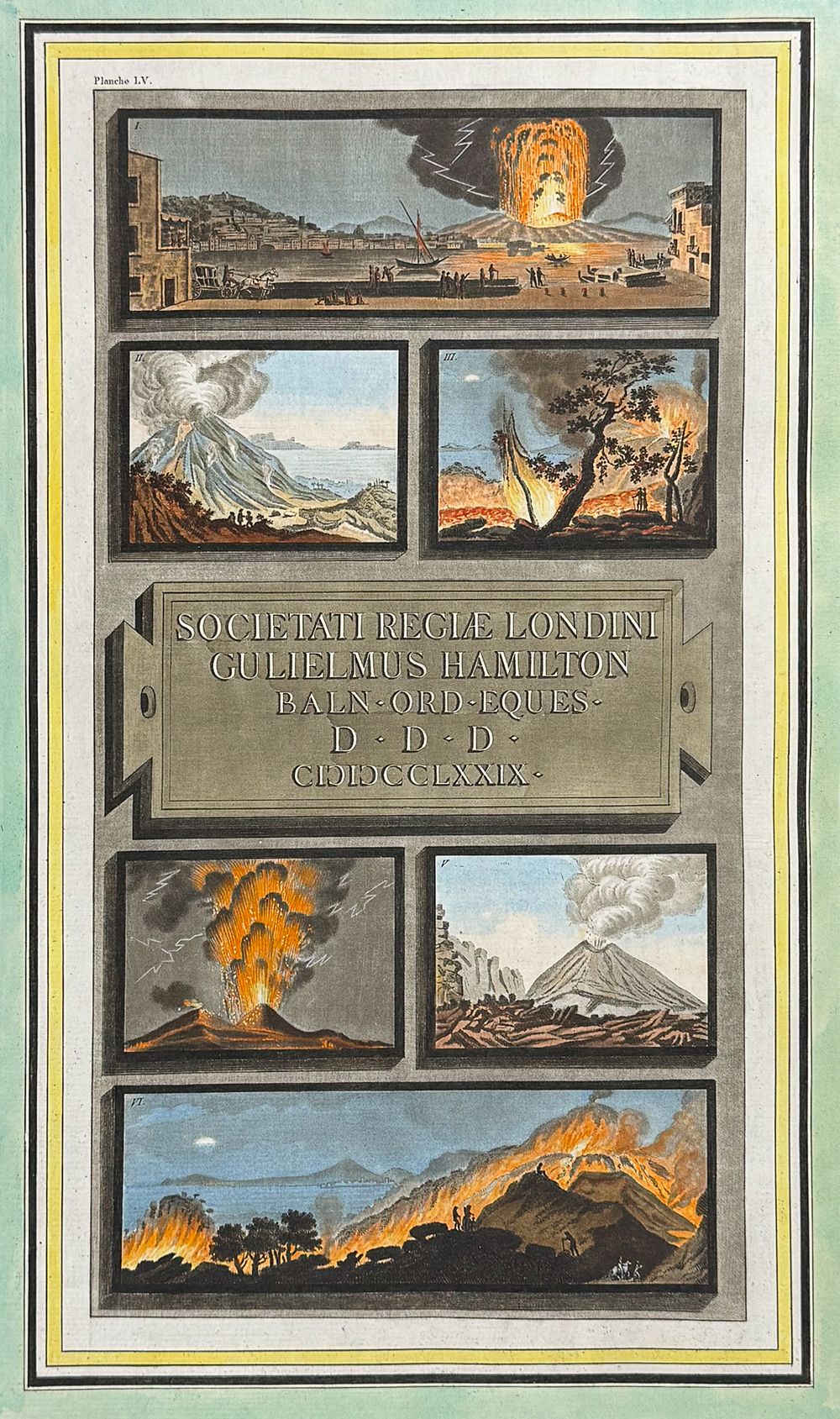
Bidspirit auction | Hamilton & Fabris - Title
Hamilton & Fabris - Title Page - Views of the Eruptions of Mount Vesuvius - This sensational engraving is from William Hamilton's Campi Phlegraei, ou Observations sur les Volcans des Deux Siciles. [Phlegraean Fields, or Observations on the Volcanoes of the Two Sicilies] . It is from the second or De Luxe edition of the work published between 1798 and 1802 in Paris by Chez Lamy, Libraire, Quai des Augustins. The work detailed erupting volcanoes as well as volcanic rocks and landscapes. It was also the first time the view was taken that volcanoes are forces of creation not just destruction as observed by Hamilton. Text page when available will be included and is in French with many having the accompanying English translation. The majority of the illustrations from the work were after Pietro Fabris. Hamilton described the images as ”executed with such delicacy and perfection, as scarcely to be distinguished from the original drawings themselves” (Part I, p. 6, Philosophical Transcations 1767). Campi Phlegraei is known as the ”flaming fields”. It is the area around Mount Vesuvius and Naples which had seen frequent violent eruptions. More people began visiting this area as the excavation of Pompeii and Herculaneum were performed at the funding of King Ferdinand I. The King frequented Hamilton's home due to this fascination and that it was filled with Hamilton's noted collection of art and antiquities. This peaked interest in volcanoes led to many travelers visiting his home, and it was noted that Hamilton himself climbed Vesuvius 58 times despite all the dangers it presented. In some of the images of this work, Hamilton is seen in his red coat, and the artist Fabris is in the blue one, both getting perilously close to the volcanic action. Sir William Hamilton was the British ambassador to Naples from 1764 to 1800, during the city's golden age. An avid antiquarian, Hamilton assembled one of the world's finest collections of Greek and Roman antiquities. In addition to his duties as ambassador, Hamilton was also renowned as a knowledgeable guide and congenial host to the visiting English 'Grand Tourists'. With infectious enthusiasm he would extol the wonders of Naples and the beauties of arts of the ancient world, inspiring in many of his aristocratic visitors a genuine love of the antique. This new-found enthusiasm found its expression in the new style of neo-classicism and in the collections of antiquities which found their way to many of the stately homes of England. Hamilton developed an interest in volcanoes while living in Naples. He became a member of the Royal Society in 1766 and submitted to them many detailed and technical observations of volcanic activity in Naples and Sicily. Some of these illustrations were used to create engravings for Campi Phlegraei... The work included not only views of the Volcanoes erupting, but rocks and landscapes. In particular details of the area as it was in 1760s and 1770s as witnessed by Hamilton. ”Running two villas, a country house at the foot of Vesuvius and his main home in Naples, the money Hamilton received as envoy was insufficient to maintain ambassadorial hospitality and to feed his vast collecting appetite. Briefly returning to London in 1772, he was compelled to sell much of his art collection to the British Museum with a grant given to preserve it in the nation's interest. On the same visit, Hamilton was elected a fellow of the Royal Society. Having already begun correspondence about the increasingly violent Vesuvius, upon his return to Naples his attention was drawn to challenging commonly held assumptions about volcanic activity by documenting what he saw in its eruptions. The excavations of Herculaneum and Pompeii, along with stories of the effects of Vesuvius' eruptions within living memory of Naples' inhabitants, reinforced the view that the volcano was a purely destructive force. However, Hamilton sought to show that in a broader time scale, volcanoes had been responsible for the mountainous landscape and rich, fertile soils that characterized the area. He identified that heat formed basaltic rocks and that the stratified appearance of the land - both in exposed rock faces and in the excavated Roman towns - was due to a build up of layers of ash, lava and debris from Vesuvius. ”Hamilton wrote to the successive Presidents of the Royal Society, Sir John Pringle and Sir Joseph Banks, about his discoveries. The letters were read out at meetings; inviting interaction, they were accompanied by samples of rocks and soil. Seeking to describe rather than theorize, Hamilton published a book of Observations on Vesuvius in 1772; this text was accompanied by five illustrative plates and a map. But Hamilton had ambitions towards creating a more definitive guide to the volcano, to be as aesthetically beautiful as it was intellectually stimulating. Hoping that ”such a publication, executed with magnificence in the Royal printing Office, may perhaps,