Bidspirit auction | Original WWII German General Gause
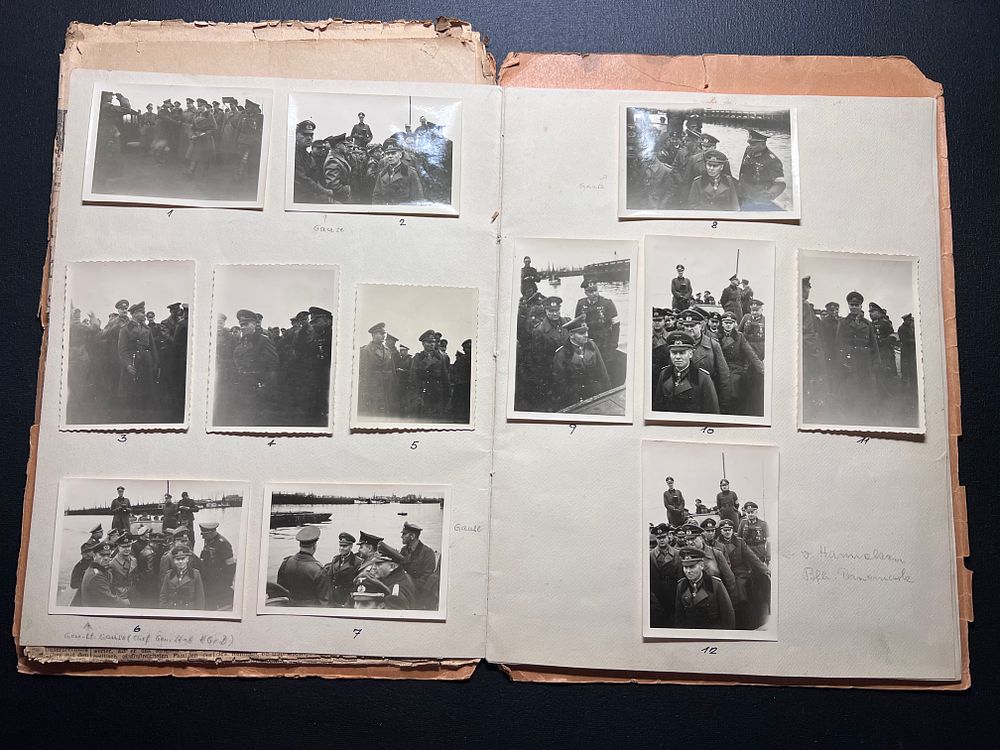
Original WWII German General Gause Photo Album – Rommel Inspection Denmark 1943 - Photo album found in 2024 in Latvia. General Gause was captured in the Courland Pocket (Kurland), astounding that such an item that was for in the personal documents of General Gause. In April he was assigned to Generalkommando II Armeekorps in Kurland (General staff of Army Corps, Kurland). Gause was captured by Soviet troops in the Courland Pocket in 1945 and was a prisoner of the Soviets until his release in 1955 (more on Gause below). Item Description: Photo Album in A4 size, with folded Newspaper of the same event pictured in the photo album. The US Naval Institute published the following article below: https://www.usni.org/magazines/proceedings/1954/june/rommel-normandy In November, 1943, Field Marshal Rommel received orders to inspect the defences of north-western Europe against a possible invasion and to report his findings to Hitler’s H.Q. At his repeated request I was appointed as his naval adviser. I knew the whole of the coasts in question and all the ports from my own experience, for I had been in charge of minesweeping and later of escorts too, first in the German Bight of the North Sea and from the summer of 1940 on in Holland, Belgium, and France. From February to August, 1943, I had been in Italy where I became acquainted with General Gause, Rommel’s Chief-of-Staff in Africa, a capable East-Prussian with a dry sense of humor. We formed rather similar opinions on the over-all situation, and that is why I found myself a member of the staff of Army Group B, with little previous experience in Army ways. There was no Army Group B at that time, only a small staff, composed of twelve to fifteen officers. I joined them early in December, 1943, in Denmark, where we started on our assignment. It was a type of work that was new to us all. Amphibious operations had been neglected almost completely by our Armed Forces between the wars; there had never been any combined landing exercises. My own practical knowledge was restricted to the conquest of the Baltic Islands in October, 1917, when the destroyer, whose gunnery officer I was, put an infantry company ashore by means of ships’ boats, and I tried with negligible results to silence a field battery firing from somewhere in the woods. True, Norway had been an amphibious success, but it had been a surprise operation against half a dozen inadequately defended ports. Now it was a question of preparing extended coasts against one or more large-scale attacks from the sea, executed by modern landing vessels and supported by powerful fleets and air forces. Right from the beginning there was no doubt that the Allies would need a large port comparatively soon after establishing a bridgehead, yet would not make any attempt to take one by direct attack. They had tried that out at Dieppe and had suffered a heavy defeat. Now all the larger ports were still better fortified and prepared. Therefore, it was logical to assume that they would land on the open beach and try to cut off one of the major ports. Denmark was not a likely target of the main assault. Any invasion attempt would probably be within easy operational range of the fighters based on southern England, i.e., somewhere on the coast between Den Helder in Holland and the Gulf of St. Malo in eastern Brittany. Of course, the possibility of secondary operations outside this area was not to be neglected. Grand Admiral Raeder, who at that time had been in retirement for almost a year, wrote a letter to me expressing his concern for the Skagerrak. To prevent a break-through for taking the Jutland Peninsula from the rear, we suggested in our report laying more minefields with many antisweeping devices. This was done, and the mines together with some coastal batteries, among them two with 15 inch guns, made the Skagerrak safer than many other places. In Denmark, we were at once confronted with the problem of defending long and excellent landing beaches with partly motorized infantry, little armor, and hardly any airforce and navy. Rommel very soon came to the conclusion that putting the infantry in a heavily mined belt of field fortifications along the shore was the only practical solution in view of the pronounced inferiority in the air, and that everything should be done to make this “Rommel Belt” as strong and elastic as possible. For this purpose the idea of beach obstacles was evolved here. We had never heard any details of the defences of Tarawa, not even the name of the island, as far as I remember. We took our cue from obsolete tank obstacles made of three steel beams riveted together at right angles. Considered as entirely useless on land, they might rip open light vessels in shallow water. So in they went. On Fana Island off Esbierg, wide flat beaches gave us the notion of erecting strong wooden stakes to prevent gliders from alighting or to damage them when they tried to come in.