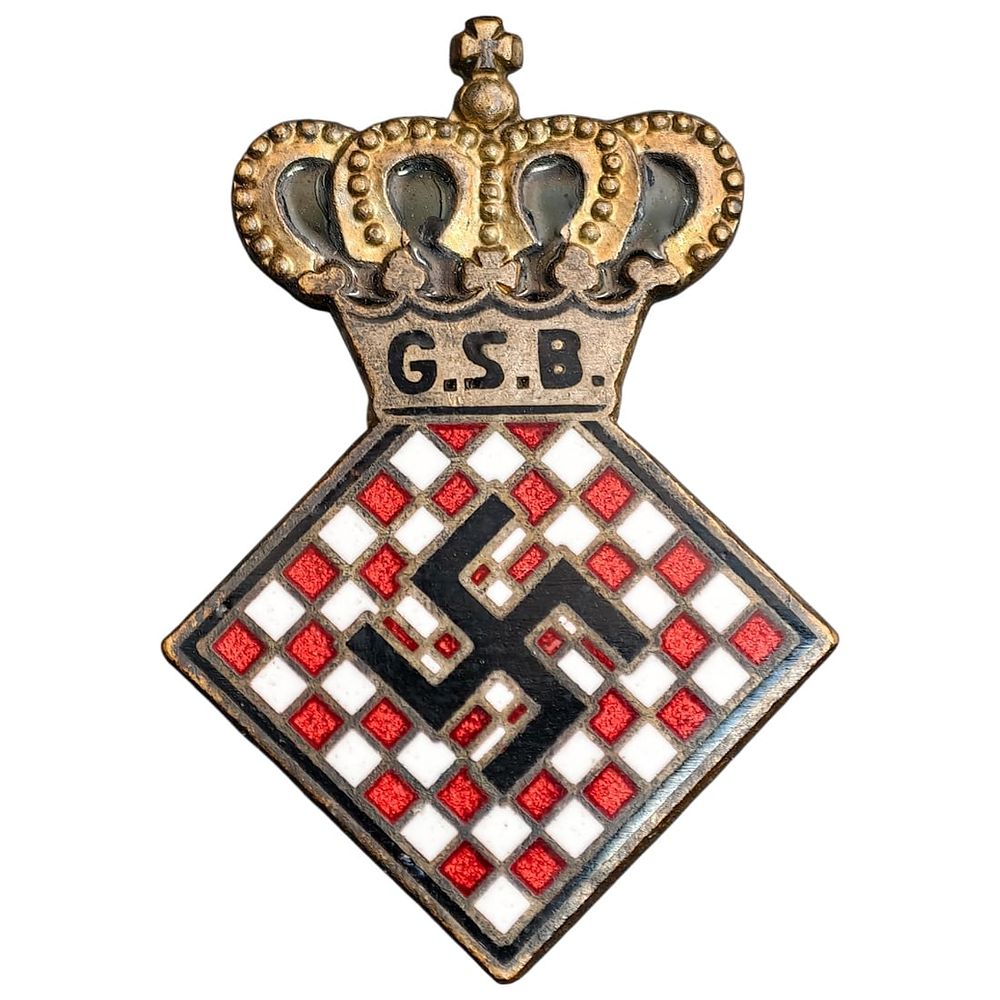
Bidspirit auction | Nazi Grossdeutscher Schachbund Chess Membership
Nazi Grossdeutscher Schachbund Chess Membership Badge - Nazi Grossdeutscher Schachbund Chess Membership Badge, a beyond rare piece .The Greater German Chess Federation (GSB, sometimes also GDSB) was a National Socialist chess organization based in Berlin . The Greater German Chess Federation was the umbrella organization for German chess players from 1933 until the end of World War II .At the beginning of the 1930s, only about one in four organized German chess players belonged to a member club of the German Chess Federation . The rest were organized in the party-politically oriented ( SPD , KPD ) workers' chess clubs, the chess departments of the German National Commercial Assistants' Association , and in several Catholic chess organizations, including the ”Schachbund im Katholischen Jungmännerverband ” (with around 4,000 members in 1933). Since dual memberships were possible, the total number of organized players at the end of the Weimar Republic can only be estimated at approximately 30,000 to 40,000 chess players. [ 1 ]In this context, Berlin chess players founded another National Socialist chess association on December 13, 1931, which called itself the ”Greater German Chess Federation.” The name reflected the association's explicit appeal to chess players among Germans living abroad . Bruno Hartmann was appointed chairman. It was a purely politically motivated foundation. Nothing is known about any games or clubs that joined the GSB until 1933. [ 2 ]After the Nazi seizure of power , the Nazi Party leadership pursued the goal of replacing the existing diversity in chess organizations with a unified organization under the umbrella of the GSB. The workers' chess clubs were banned from operating as early as early 1933; their members were often able to join other clubs.The merger of the existing chess organizations into the Greater German Chess Federation was decided on April 23, 1933. This date was considered the founding date of the GSB in contemporary accounts. Otto Zander became the federal leader , and Ehrhardt Post was appointed managing director. At the end of May 1933, Joseph Goebbels assumed the honorary chairmanship of the GSB.The German Chess Federation temporarily withdrew its consent and appointed a National Socialist official as its leader. The German Chess Federation's attempt to assert its independence in this way failed, and its replacement by the GSB was confirmed in July 1933. At the same time, the Greater German Chess Federation made its claim to leadership clear at its first congress in Bad Pyrmont . The regional associations and member clubs of the German Chess Federation were admitted to the GSB. They were required to hold extraordinary general meetings in July 1933, at which, if possible, a member of the Nazi Party was to be elected as ”club leader.” According to the Führer principle , this member appointed further staff members, such as a ”deputy leader, ” a secretary, or a ”team leader.” [ 3 ] The German Chess Federation continued to exist legally until 1934. [ 4 ]As a result of the Reich Concordat , which regulated the continued existence of Catholic organizations, the Catholic-affiliated chess organizations continued to lead a limited, separate existence until 1937/38. A similar situation applied during this period (until the November Pogrom of 1938 ) to the Jewish chess organizations, which had only been formed after 1933 as a result of the exclusion of Jews from the GSB (see below ).After 1935, the GSB, as a nationwide organization, faced some competition from the chess community of the Nazi recreational organization ” Strength Through Joy ” (KdF). The KdF chess community, which also attempted to organize competitions and tournaments, was limited from 1938 onwards to taking on tasks in popular chess and, in particular, organizing company chess groups.The GSB's publishing organ was the Deutsche Schachblätter , or in 1943/44, the only remaining German chess magazine, the Deutsche Schachzeitung .The Greater German Chess Federation did not become part of the Nazi Party or any of its affiliated organizations . It was therefore forced to remove the swastika from its emblem at the end of 1933 [ 5 ] and thus could not claim any institutional funding.Nevertheless, the Greater German Chess Federation pursued an intensive, politically motivated promotion of German chess, possibly influenced by the model of chess promotion in the Soviet Union . Larger events and ”promotional weeks” were intended to increase interest in the game. In October 1934, Otto Zander reported that, compared to the approximately 10,000 members of the German Chess Federation in 1933, 45,000 to 50,000 players now belonged to the new federation. [ 6 ]In addition to the ideologically motivated exclusion of Jews, the GSB pursued several key approaches. The competitive nature of chess was emphasized. For example, the conditions for awarding the championship title , which was to be awarded for only one year,